
Ministry formation weaves together the head and the heart. Through the years, it has developed its own distinctiveness. It differs from education, though drawing on knowledge and information. It also differs from formation in religious communities or parish and diocesan settings. A key distinctive feature is that our work transpires in a pluralistic environment, not exclusive to the community of believers.
This is why CHA defines ministry formation as "discovering connections between personal meaning and organizational purpose," or mission. Further, "these connections inspire and enable participants to articulate, integrate and implement the foundational elements of Catholic health ministry so that it flourishes now and into the future."1
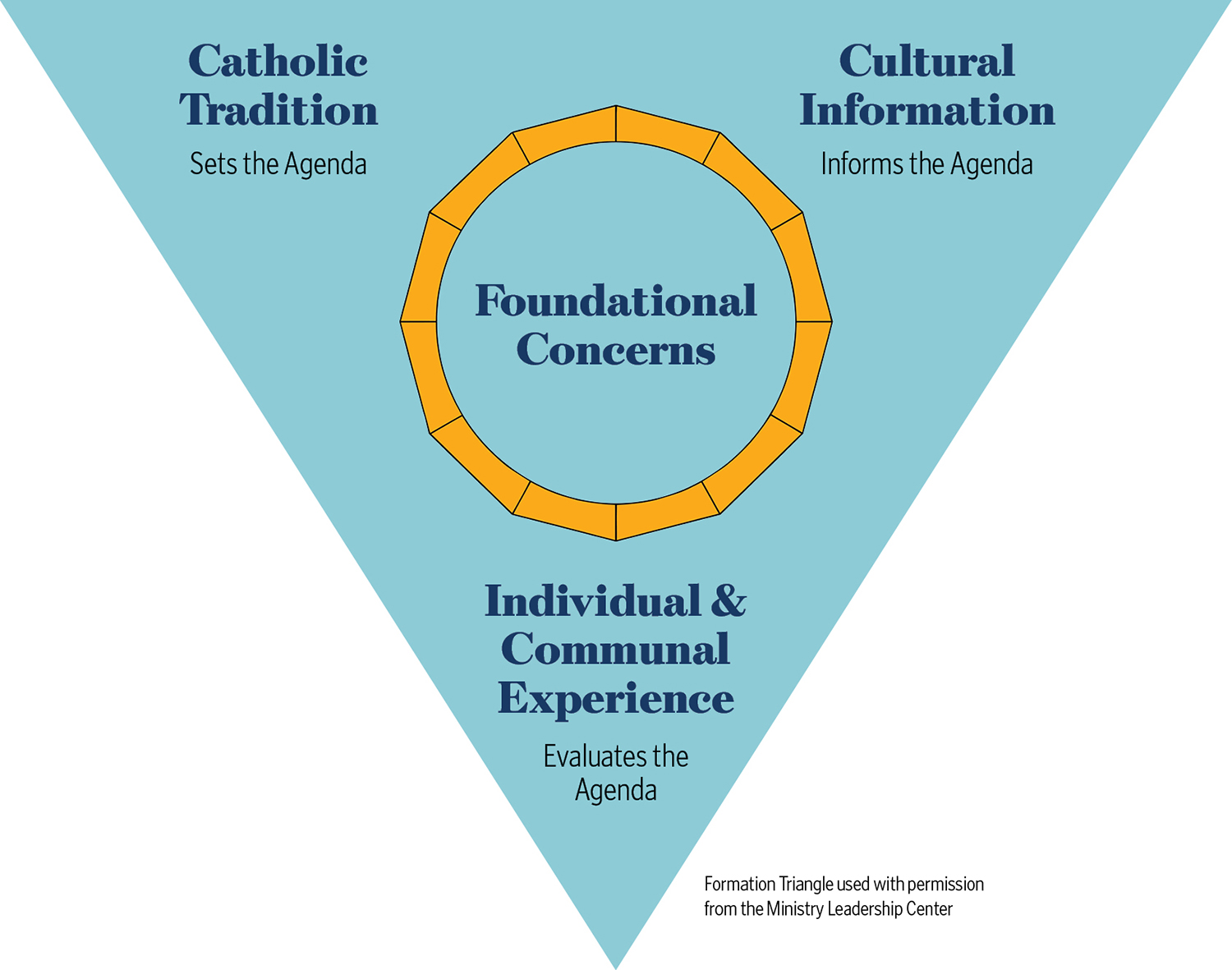
Creating the conditions for these connections is the art of formation. The leaders at the Ministry Leadership Center, an organization that developed leaders in Catholic healthcare, offered the Formation Triangle as a method for sparking such connections. This formation method integrates culture, personal and communal experience, and dialogue with the Catholic tradition.2 The model's three points give mission and formation leaders the indispensable ingredients for any formation experience: lived experience, culture and tradition.
These three areas of the triangle are explored here in part because a recent survey of formation leaders in Catholic health ministries found that a significant percentage come from educational backgrounds and may find this model useful in their formation offerings and programs.3 Many mission and formation leaders are well-versed in presenting and communicating aspects of the Catholic tradition. Yet getting it to land in the hearts and minds of participants is the difficult and essential work of formation. The tradition must be engaged in dynamic dialogue with culture and individual and communal experience, sparking connections that shape personal and organizational spirituality.
EXPERIENCE
Each person who walks into the room for a formation program brings their whole lived experience. Even more, each person is an expert, whether in information technology, medicine, revenue cycle, community health and so forth. Those leading the formation experience must recognize and honor the vast experience and expertise present in the individuals gathered. This may include experiences of parenting and partnership, as well as suffering, accomplishments, love and more. Adults learn by accessing their own repository of memory, learning, feeling and intuition — that is, their whole selves.
Communal experience also includes working and leading within this organization. The formative experience also enables real-time processing of the formation topic with participants and the larger group. For example, if a finance leader has never engaged with healthcare ethics, facilitation prompts them to discuss how they're receiving the content in real time. As the table conversation unfolds, what are they hearing? Where do they see connections to their team and leadership?
In the formation triangle model, experience evaluates the content, the way it is presented and the way it is facilitated in the formation program. "The leaders use past experience to assess the material from the Catholic tradition and the cultural information and determine what they want their future experience to be."4 From this bank of collected information and knowledge, leaders assess the content from the Catholic tradition, in light of the cultural realities, to determine how they may integrate and apply the formation experience into their roles.
CULTURE
In the formation triangle, the culture informs the agenda. Culture, first and foremost, includes the organizational culture. It also includes society and the culture of healthcare, business, service, technology and the like. Cultural spheres provide a context for how individuals come into formation programs and experiences, which is why pioneers in Catholic healthcare ministry formation, Larry O'Connell and Jack Shea, say that it informs the agenda. This includes "pertinent data from the social sciences, cultural analyses, contemporary philosophies, and, most of all, current organizational protocols and processes."5
The cultural context matters for how the tradition will be received or interpreted. Having worked at ministries in southern Kansas, where prayer with references to God or Jesus was expected before meetings, and in other settings where overt religious references can draw skepticism, I tailor reflections to resonate with each audience. These cultural realities give guidance for leading a formation experience.
This corner of the formation triangle echoes the oft-cited line from Gaudium et Spes ("Joy and Hope") that the Church in the modern world has a "duty of scrutinizing the signs of the times."6 Formation programs provide the space and time for those leading the healing ministry to read and scrutinize current movements in culture and society, doing so individually and with the wisdom of a community of experts. Yet, the call of the Second Vatican Council, and now the Synod on Synodality7, is that we interrogate social currents from the Gospel, which is the tradition's foundation.
TRADITION
The Catholic tradition sets, or rather, grounds the entire formation experience. Now, this does not mean that a formation facilitator starts with doctrinal pronouncements. As a theology professor of mine would say, you don't convince a kid that baseball is fascinating to both play and watch by telling them about the infield fly rule!
I have found this especially true for business executives, including those from start-up, venture capital or highly specialized healthcare delivery fields. Few, if any, will be interested in ministry formation by starting with the intricacies of Catholic doctrine.
However, formation participants may be inspired by the story of a courageous woman who came to a new community during its early settlement and helped to found a ward for the town's sick. In the formation triangle, the tradition includes a broad spectrum of themes related to Catholic identity: whether through heritage stories of the founding communities, the Scriptures, Catholic moral and theological tradition, the social teaching, the Ethical and Religious Directives for Catholic Health Care Services, or spiritual traditions, rituals and practices.8
The tradition sets the agenda for a formation experience. This means it is not only the main topic of the presented content, but also the arena in which participants read the signs of the times (culture) and interpret their lived experiences. "The Catholic tradition provides theological perspectives about why these concerns are important, ethical guidelines for addressing them, and insights into their implications."9
The formation triangle becomes a significant tool for connecting people to the mission and meaning of working in Catholic healthcare as a lived commitment. Participants "wake up to the fact that they are more than observers, and that formation is more than a pseudo-graduate class."
Ministry formation facilitates ways to adapt knowledge and practices (elements of the tradition) into "the organizational categories of the working knowledge and skills that leaders must have to lead the mission and ministry of Catholic healthcare."10
O'Connell and Shea describe the corner labeled Catholic tradition as "shorthand for the process of theological reflection that serves as the living link between the past and present. It ensures that 'the appeal to tradition is not mere remembrance of the past,' but a call 'to develop for the future an original, new and constructive mode of thinking.'"11
AGENTS OF A LIVING TRADITION
The formation triangle is an apt model for developing the working knowledge and skills needed to animate the formation framework. "The tradition identifies the areas of knowledge that make up the mission and ministry. But it immediately combines those areas with current cultural assumptions and information and, in the process, makes that knowledge 'working' and relevant to the organizational challenges of healthcare. As the tradition and culture come together into working knowledge, they consult the experience of the leaders. The leaders articulate how this working knowledge relates to their situations and how it can be integrated into the organizational life and mission. The three points of the triangle are in ongoing interaction with one another, contributing to the development of working knowledge and skills."12
The formation triangle provides additional benefits. First, it supplies a unity to the different modules that comprise a formation program. The consistency provides participants with a solid and familiar pattern for addressing various topics, such as vocation, ethics, social tradition, ecclesial relations and so forth. Second, as leaders approach decision-making and discernment processes, the model once again provides familiar territory. Strategic decisions flowing directly from the mission incorporate the tradition, consider the culture, and honor the experience of stakeholders.13
The formation triangle becomes a significant tool for connecting people to the mission and meaning of working in Catholic healthcare as a lived commitment. Participants "wake up to the fact that they are more than observers, and that formation is more than a pseudo-graduate class. They come to terms with the knowledge that the tradition is living and they are agents of it. They are the stewards of the heritage entrusted to them with the expectation that they have real responsibility for the Catholic identity of the organization." As O'Connell observes, "They are not involved in a handoff; they are an integral part of a vital process, the instrument of a throbbing reality that 'exists from out of the present now toward our future.'"14 Leaders begin to see that they are called to mediate the practical wisdom and spiritual values of a community of members and tradition.
The role of the mission or formation facilitator is to know the tradition and bring its elements into the present dialogue in service to the continuous development of both the individuals and the tradition itself. Formation is inherently theological in that it endeavors to "honor the tradition while both respecting and challenging culture in ways that resonate with the individual and communal experiences."15
DARREN M. HENSON, PhD, STL, is senior director of ministry formation at the Catholic Health Association, St. Louis.
NOTES
- "Framework for Ministry Formation," Catholic Health Association, 2020, https://www.chausa.org/docs/default-source/formation-resources/framework-for-ministry-formation_v11.pdf.
- Laurence J. O'Connell and John Shea, eds., Tradition on the Move: Leadership Formation in Catholic Health Care (MLC Press, 2013).
- Per the formation leader survey, 40% had worked in either a Catholic parish or an educational setting, ranging from grade school through higher education. See the following: Darren M. Henson, "Findings from CHA Survey: Formation Reaches Deeper Into Ministries, Increases Demand for New Resources," Health Progress 106, no. 4 (2025): https://www.chausa.org/news-and-publications/publications/health-progress/archives/fall-2025/findings-from-cha-survey--formation-reaches-deeper-into-ministries--increases-demand-for-new-resources.
- O'Connell and Shea, Tradition on the Move, 80.
- O'Connell and Shea, Tradition on the Move, 80.
- Second Vatican Council, Gaudium et Spes, Preface, section 4, https://www.vatican.va/archive/hist_councils/ii_vatican_council/documents/vat-ii_const_19651207_gaudium-et-spes_en.html.
- "For a Synodal Church: Communion, Participation, Mission," The Synod, November 24, 2024, https://www.synod.va/content/dam/synod/news/2024-10-26_final-document/ENG---Documento-finale.pdf.
- "Framework for Ministry Formation," Catholic Health Association. CHA's Framework for Ministry Formation enumerates six foundational elements of the broad Catholic tradition: vocation, tradition (which includes scripture, doctrine, etc.), spirituality, ethics, the Catholic social tradition and discernment. See pages 8-9.
- O'Connell and Shea, Tradition on the Move, 80.
- Tradition on the Move, 66.
- Tradition on the Move, 98.
- Tradition on the Move, 80.
- Tradition on the Move, 80-81.
- Tradition on the Move, 100.
- Tradition on the Move, 99.