
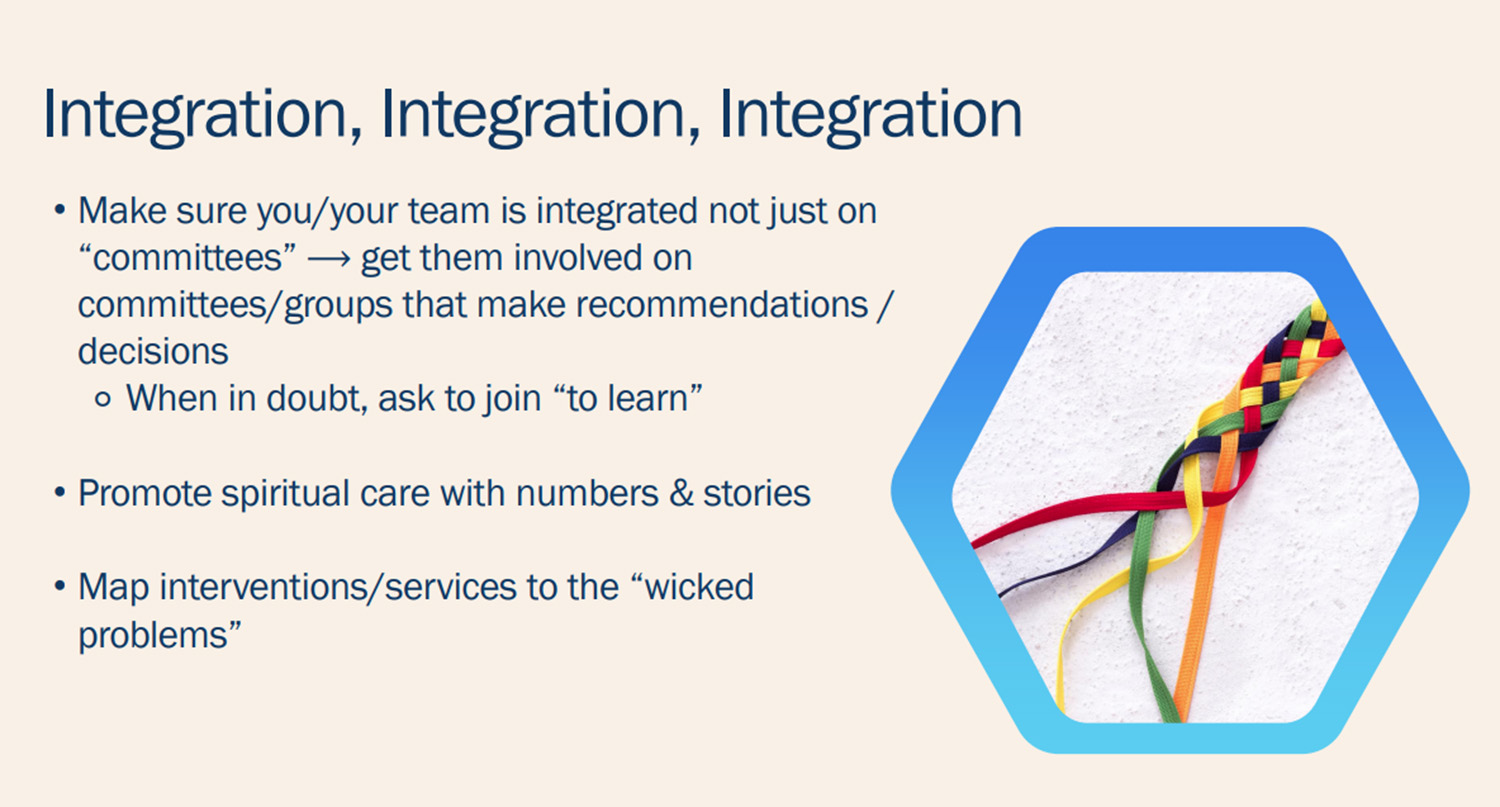
That was a central theme of a July CHA webinar entitled "Healthcare with Soul: Spiritual Care as a Catalyst for Innovation," featuring spiritual care experts Kelsey White and Jason Lesandrini.
The two said that when spiritual care teams are intentional in integrating cohesively into their facilities, understanding leaders' priorities and helping to find innovative solutions to challenges, they can become ever more strategically valuable to their facilities and to staff and patients. White is a chaplain, author and researcher as well as an associate professor of patient counseling at Virginia Commonwealth University and Lesandrini is an assistant vice president for Georgia's Wellstar Health System and an advocate of spiritual care.

"The executive team is hyper-focused on a strategic plan that has certain key performance indicators in it. Your work directly connects to that," Lesandrini said, addressing chaplains in the webinar's audience.
'Under-tapped resource'
Near the start of the webinar, Lesandrini discussed an occurrence at a healthcare facility where he'd worked: A mother had left her baby at home alone and returned to find the infant not breathing in its crib. An ambulance transported the child to the emergency department, where a team tried for an intense 50 minutes to revive the child before one of the clinicians pronounced the child dead.
Immediately after that team's traumatic experience, a chaplain joined them in the breakroom. That chaplain did not immediately offer answers but instead acknowledged, "Yeah, that was brutal," and invited the team to debrief. Some team members expressed deep anger that the child had been left alone and likely died as a result. Some spoke of their grief at having tried so hard to save the baby only to be left with a small, lifeless body at the end.
The chaplain not only let them air their emotions that day but also followed up and checked in on the team in the ensuing days. "We train people to run codes, we drill protocols, we teach them to manage airways and push medications, and make split-second decisions," Lesandrini said, "but we often don't really prepare them for what it feels like when a child dies on your shift under your hands, despite everything you know how to do, and we definitely don't prepare them for the moral weight of it, the anger, the helplessness, the way it follows you home.
"To me, this is why chaplaincy is not optional," he said.
He said this type of trauma and countless other pressures are causing severe burnout among healthcare workers and exacerbating a staffing crisis. He said healthcare workforce well-being, staffing, safety and compensation concerns are some of the top issues that are challenging leaders.
He said spiritual care staff are an "under-tapped resource" for helping leadership address these and other priorities.
A transition in spiritual care
Lesandrini said spiritual care departments that are not integrally connected to their facilities' leadership, purpose and strategic plan are missing key opportunities to be a more vital resource to staff and patients.
White said spiritual care departments have been evolving. Traditionally, these departments have been staffed by some spiritual care professionals who lacked full credentials, were reliant on volunteers, were disconnected from their facilities' higher purpose and were not fully involved in supporting clinician well-being. The evolution is toward greater professionalism, with more board-certified chaplains on the team, less reliance on volunteers and students, high integration in the organization, and a high level of connection with clinicians.
White added that along with the increased professionalism, there's a shift toward better-resourced spiritual care teams that can provide meaningful, impactful support to staff and patients. For instance, these teams may have more resources to integrate into health system operations in ways that benefit clinician well-being.
In their presentation, White and Lesandrini referenced research they've conducted. White was among the authors of this year's "Conceptualizing spiritual care in the U.S. through chaplain activities in research: a scoping review sub-analysis" in the Journal of Health Care Chaplaincy, and White and Lesandrini were among the researchers who published this year's "Wicked problems need spiritual remedies: addressing top issues facing healthcare executives," in the Journal of Health Care Management.
Speak Up
Lesandrini said spiritual care teams' engagement and integration can take various forms, but the teams' leadership needs to be joining committees and councils throughout their facilities, listening to what is important to decision-makers, and getting on the calendars of top leaders and then speaking up to explain how the spiritual care department can help solve challenges and advance goals.
White and Lesandrini shared examples from their own organizations and examples from research of innovations that have come when spiritual care departments have taken this approach. For organizations devoting a lower intensity of resources to spiritual care, examples included chaplains teaching colleagues about wellness, conducting "compassion rounds" to debrief with colleagues and discuss emotionally challenging experiences or ethical dilemmas, and inviting clinicians to shadow them to understand their role.
They also provided examples on the higher end of resource-intensity for spiritual care, a level of investment that provides more resources to chaplains so they can attend more thoroughly to clinicians' well-being. Examples from the webinar included chaplains serving as communication coordinators with patients' families, supporting families when their loved one is an organ donor, and providing patient navigation help in the intensive care unit. At one healthcare facility, chaplains have recorded patients briefly talking about who they are and their background. This recording goes into the patient's medical record for clinicians on the patient's health team to access to learn about the patient.
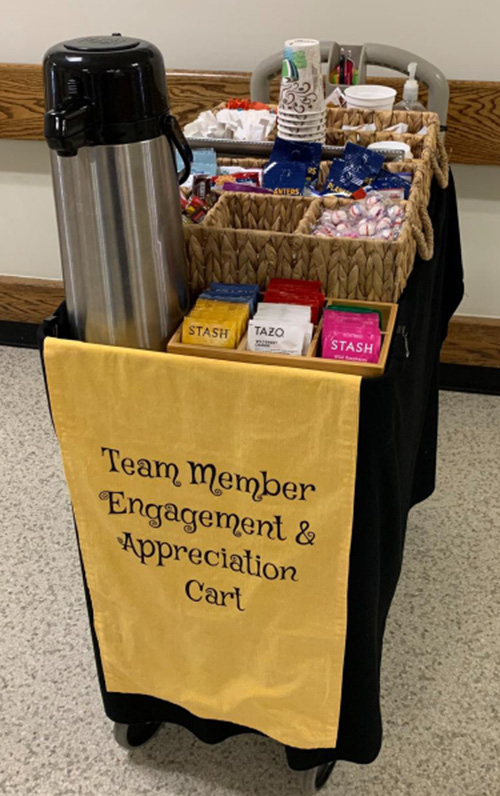
White also held up the example of Virginia Commonwealth University's Team Member Engagement and Appreciation Cart. Chaplains round on units with a cart of goodies, tea and snacks and stress relievers. They invite the clinicians to pause. The chaplains serve the clinicians, chat with them, look them in the eye and provide one-on-one support when needed. This restores a healthy pace and conveys to the clinicians that they matter and that the organization cares about their well-being.
Lesandrini spoke of Wellstar's around-the-clock hotline for its employees. Chaplains do the initial intake, respond to the scene to provide on-the-ground resources, and then when necessary, refer the employees to other mental health resources.
The webinar experts challenged participants to think about how they help advance strategic priorities.
Showing the value
Lesandrini emphasized that spiritual care departments must be smart about demonstrating their impact. "We have to get clear as chaplains and chaplain leaders and mission departments about how the work that we do ties directly into (the strategic work of the broader organization)," he said, "and then starting to measure that work via key performance indicators to connect back, and sort of impact what the leaders are working on day in and day out."
He said, "You can see demonstrable effects pretty quickly, I would argue, and ... you're showing the value ultimately at the end of the day of spiritual care, and that has to be sold on an ongoing basis."