
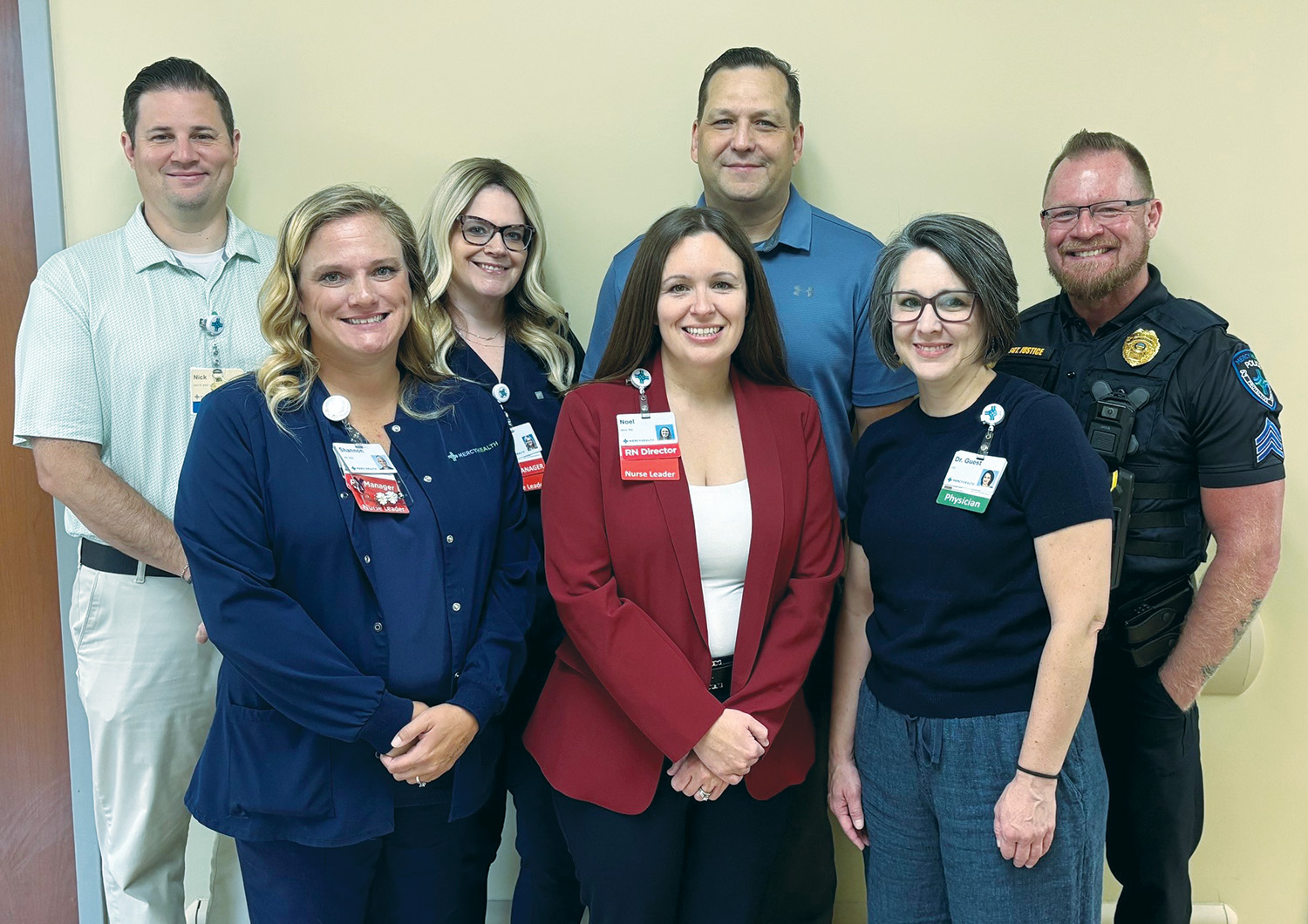
On June 1, a Bon Secours Mercy Health facility in Western Ohio launched a service to address such barriers to care. Through Protocol 99, first responders can get quick and discreet access to mental health support at Mercy Health — Dayton Springfield Emergency Center from specially trained clinicians.
"We wanted to offer this because we value (first responders) so much," said Noel Helton, director of emergency services and the observation unit for Mercy Health — Springfield Market in Ohio. "We want to ensure they have somewhere to go at all hours and to feel supported."
The Springfield Market includes two hospitals in the Springfield-Urbana area as well as the freestanding emergency center in the Dayton-Fairborn area. That freestanding center offers Protocol 99.
Trenton Brown, chief of police at Mercy Health — Springfield Regional Medical Center, leads a police force that is embedded at the freestanding emergency center. "The nature of emergency response work exposes personnel to repeated trauma, high-stress decision-making and emotionally charged incidents that accumulate over time," Brown said. "Yet, many hesitate to seek help because they worry about being labeled as unstable or unfit for duty."
Peer support
Kevin Sanders, a recently retired firefighter and paramedic and firefighter union representative, spurred the idea for Protocol 99.
Nearly a decade ago, while working for Springfield Fire Rescue, he trained to become a peer support team member. He helps team members cope with personal and on-the-job stressors by listening, providing resources and pointing them toward mental health care.
In his peer support role, he saw that fear of stigmatization prevented many first responders from seeking help when they were in crisis. "Best case, that would lead to continued struggling and suffering. Worst case could be self-harm or even suicide," he said.
Sanders added, "Discrete access to the emergency room and the protection of the first responder's professional reputation are key to breaking through and getting help."
Familiar with partnerships to address such concerns in other communities, Sanders approached Helton and some of her colleagues with the idea. He said they "quickly endorsed the program." The Mercy Health team joined Sanders and others in the first responder community to develop the service. Their work included getting advice from other healthcare facilities with similar programs.
Private entrance
The group that developed Protocol 99 chose that name for the "Code 10-99" that many first responder organizations use when communicating that there is distress or heightened emergency.
Helton said Mercy Health team was able to establish new programming at no cost.
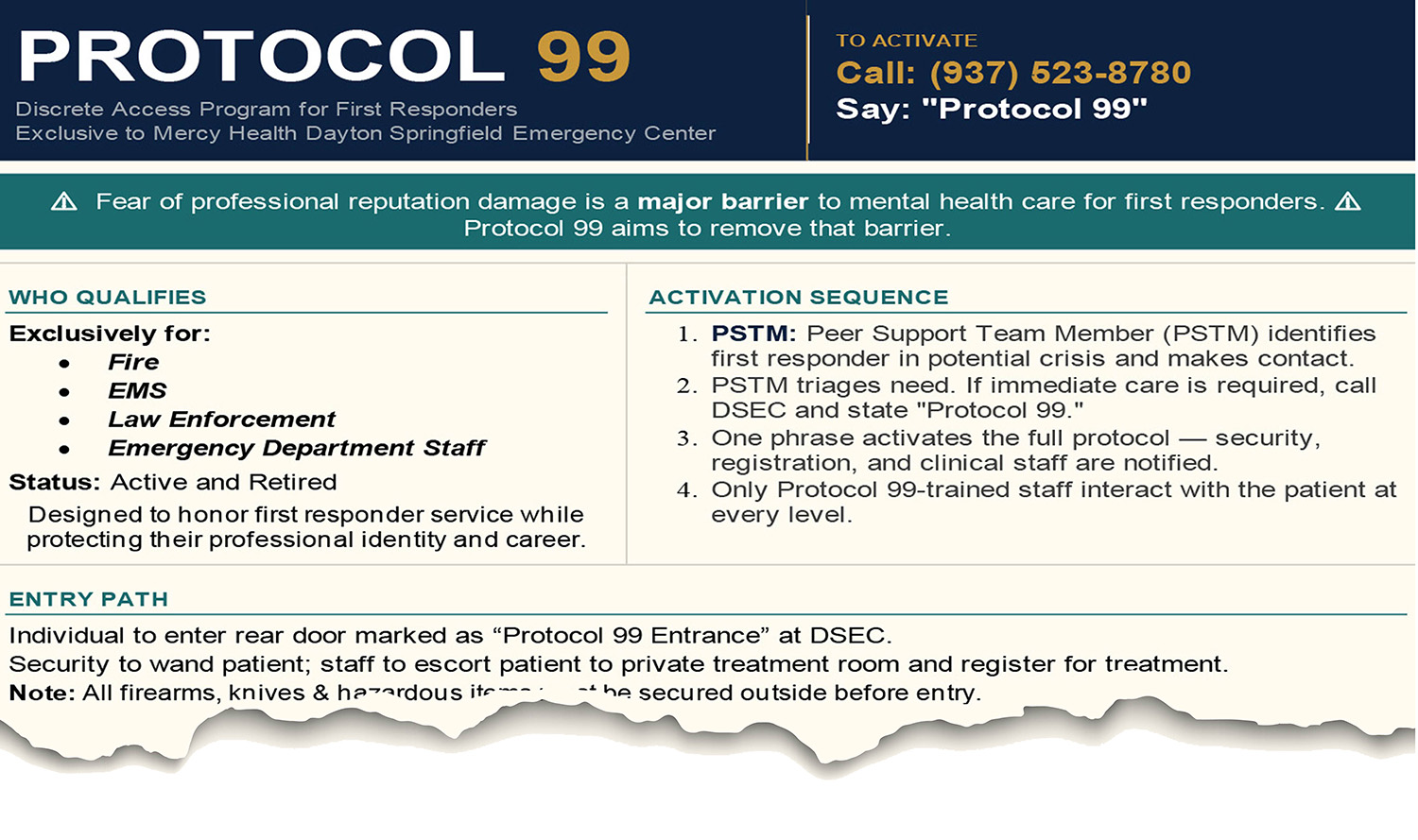
The program is available at any time to any first responder — active, retired, full-time, part-time, or volunteer, at any local fire, police, ambulance or healthcare facility.
Under Protocol 99, when peer supporters see that a colleague is in crisis, they can accompany them to the Dayton Springfield Emergency Center, or the distressed person can go on their own. Once there, they can say "Protocol 99" to staff and bypass the waiting room to be seen quickly in a private treatment room. Alternatively, they can enter the freestanding emergency center through a back door that is away from public view. Once screened by security, the patient goes to a private treatment room.
Only clinicians trained in the new programming interact with the first responders who enter. These clinicians have learned to provide trauma-informed care and crisis intervention in a confidential way. Only authorized staff can access the medical records of the Protocol 99 patients. The clinicians treat the patients' identity protection as a clinical priority.
After assessing the patients, the clinicians determine which treatment, services or resources could help them most. The clinicians then support them in accessing that care. Helton said this can include a transfer or referral to inpatient, outpatient and/or virtual behavioral health care. The team also can refer the patients to substance misuse services.
The emergency center team also connects the patients with follow-up services tailored to first responders to support their long-term recovery.
Gold standard
Sanders said he wanted Protocol 99 to be the gold standard for care, and he is "incredibly proud and thankful that this service is available."
He has been meeting with first responders to build their awareness of the program. He said he's hearing from them that "they appreciate that someone has preplanned for their worst day."
"Knowing that there is a plan and they will be protected is very powerful," he said.
Brown, the police chief, said, "By ensuring anonymity and discretion, Protocol 99 removes ... barriers and reinforces the message that mental health care is not a weakness but an essential component of operational readiness."
He added, "Programs like this strengthen the entire public safety system by promoting early intervention, reducing burnout and preserving the long-term resilience of the people communities rely on most."