
Formation is widely recognized as a crucial tool for embedding Catholic identity and essential for aligning personal values with Catholic health care's mission," writes Shaikat Sen, executive vice president of HSM Group and lead researcher for CHA's nationwide study of ministry formation across its membership. Launched in the fall of 2024 to build on findings from CHA's 2022 Mission Leader Survey, the survey's goal was to discover members' activities and needs related to ministry formation.
The three-part study reveals points of maturation in formation across the Catholic health ministry. Sen observes that mission and formation leaders "in this study appear to be completely personally invested in ministry formation."
When we read those words from an outside consultant without prior knowledge and experience of formation in Catholic health care, we realize that formation has reached a milestone in this ministry of healing. This is not to say that formation is at a point of maturity, but rather that outside perspective affirmed the ministry's years of dedication to growth in this area.
The study points to evidence of growth in formation compared to 10 and 20 years prior. It reveals the depth and breadth of formation activities across Catholic health care ministries beyond senior leadership formation programs, including mid-level leader programs and formation touchstone experiences for hourly workers ranging from bedside to business offices and beyond.
This report shows four things. First, it reveals the variety of activities and breadth of sources used in formative experiences. Second, the study's responses detail formation needs for the organization, and third, it reveals the needs of individual leaders to grow in their competency in creating and facilitating formation experiences. Lastly, this report outlines discoveries about future formation plans across the ministry, demographic information about the nearly 200 respondents from CHA member organizations, opportunities and challenges, and finally, conclusions and analysis of the study's findings.
SURVEY METHODS AND ADMINISTRATION
CHA's ministry formation electronic survey was sent to all mission and formation leaders known to CHA and was open for several weeks in October and November 2024.
CHA's survey plan entailed three parts: qualitative one-on-one interviews, a quantitative survey administered digitally, and a data collection process on systems' senior leadership formation programs.
Sen first conducted 10 in-depth virtual interviews with individuals recruited by CHA. All shared a commonality in that they were mission or formation leaders engaged in leading, creating or facilitating formation experiences. They differed in terms of the scope of responsibility, professional titles, system or facility size, geography and years in Catholic health care, spanning from as little as three years to more than 40 years. These interviews provided rich background information that helped HSM and CHA craft the quantitative survey.
The quantitative survey included approximately 35 questions across four main categories: time and involvement in formation activities, personal and organizational formation needs, participation and effectiveness, and demographic and other administrative data. The survey was designed to take less than 20 minutes to complete. All responses were anonymous, with individual information secured by HSM. CHA received only aggregate and de-identified data.
Altogether, the survey was sent to nearly 500 mission or formation leaders, with 196 responses. Among those who took the survey, approximately 20% had formation in their professional title. CHA was pleased with the response rate from members, as it was within reach of industry standards of +/-5% margin of error, suggesting that the findings accurately reflect the ministry as a whole.
DEFINING FORMATION AND BREADTH OF ENGAGEMENT
The first question on the electronic survey tool asked the leader, "What does formation mean to you?" followed by an open box to receive written responses. HSM manually analyzed the responses. There, they found reliable congruency for the definition of formation articulated in CHA's 2020 Ministry Formation Framework. The top three themes include: personal reflection, exploration or calling; integration of Catholic identity with daily work or personal values; and lifelong growth and learning.
Additionally, respondents noted that formation reinforces organizational values, creates connections that build community and enables transformative experiences. These responses reverberate the language of CHA's member-driven formation definition that says it enables "connections between personal meaning and organizational purpose," so participants can articulate, integrate and implement "the foundational elements of Catholic health ministry" so that it "flourishes now and into the future."1
When asked about an individual's involvement in formation, nearly all mission and formation leaders confirmed some activity, and 1 in 5 dedicate half or more of their time to formation. The survey asked respondents to specify formation activities they have led at least once during the past 12 months. The results reflect a broad scope and depth of formation, and the following percentages reflect the proportion of respondents confirming their involvement.
Formation activities by mission and formation leaders range from leading reflections at leadership meetings (97%) or department meetings (89%), creating or leading a ritual celebration/blessing (84%), facilitating an onboarding or orientation (82%), leading didactic programmatic experiences (71%) and creating formation curriculum (63%). Among those experiences, leaders are more likely to facilitate these experiences with mid-level leaders, followed by senior leaders, and then hourly workers. Just over half of the respondents report leading reflections for boards of directors (55%) and facilitating discernment processes (57%).
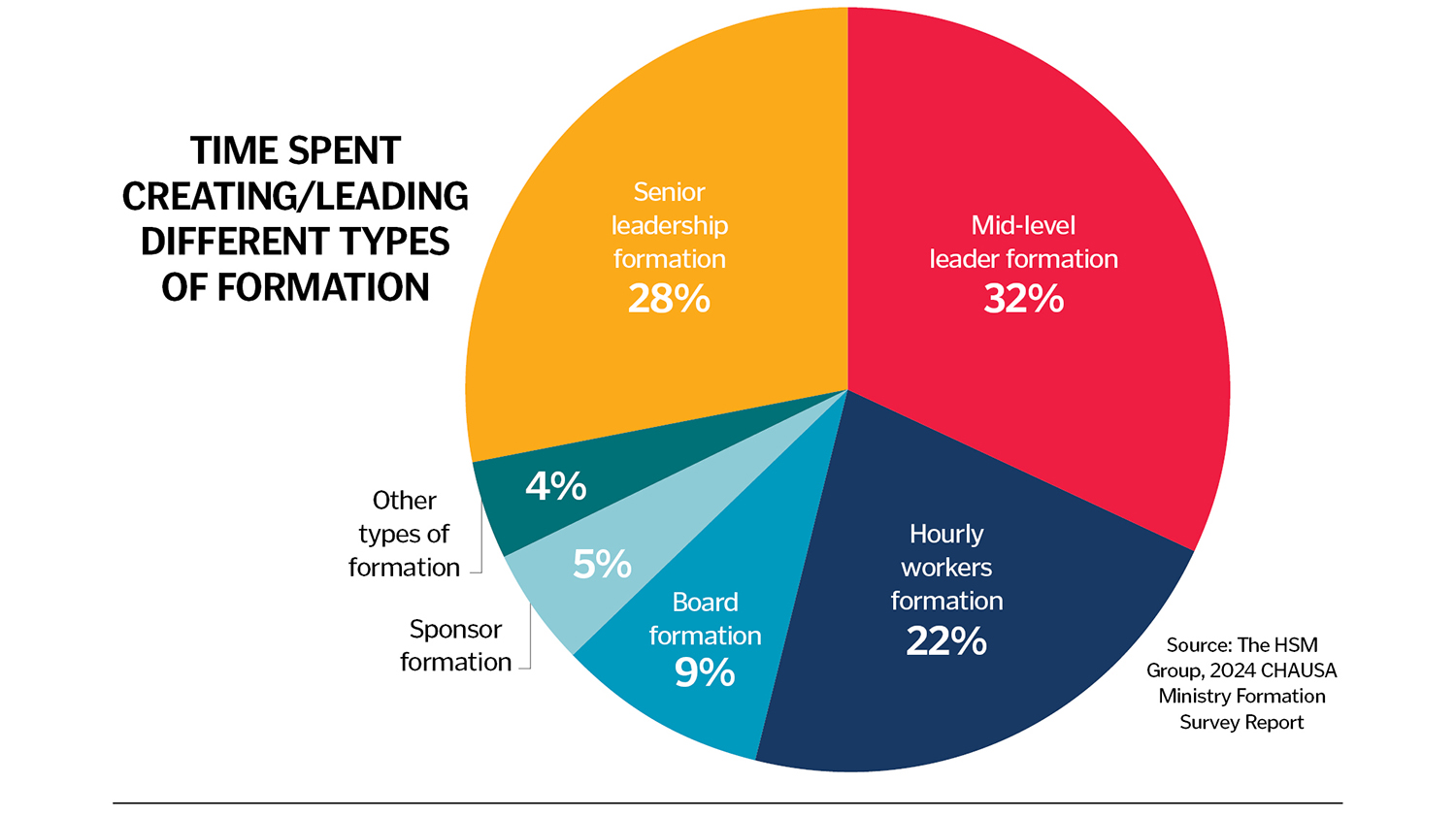
Among the data, a new discovery emerged: the prominence of time dedicated to mid-level leader formation activities. On average, nearly one-third of all mission or formation leaders' time is given to this area of the organization, with 28% of their time dedicated to executive leadership, and 22% spent with front-line workers (see chart above).
ORGANIZATIONAL NEEDS
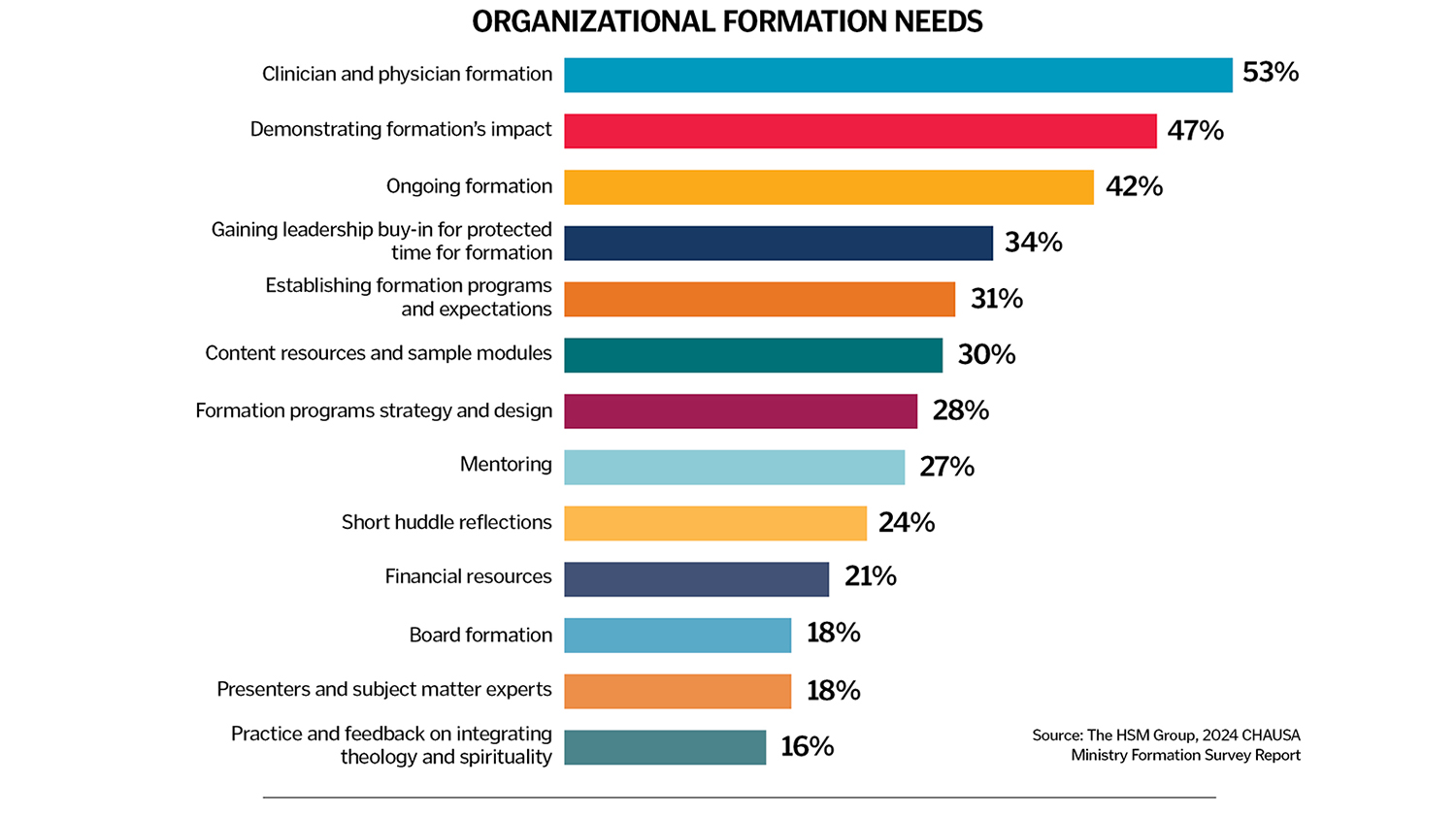
The survey asked leaders to identify top formation-related needs for the organization, summarized in the graph shown below. Respondents were given a list of 18 options (including "other") and asked to select up to five and rank them in order. The top three needs were clinician and physician formation (53%), demonstrating formation's impact on the organization (47%), and ongoing formation opportunities and content (42%). The next most frequent responses relate to system and leadership support, such as gaining leadership buy-in for protected time for formation (34%), establishing formation expectations for all leaders (31%) and financial resources (21%).
Mentoring newer or less experienced formation leaders and partners gained favorability by more than a quarter (27%) and was ranked first by nearly 10% of all respondents. Leaders also cited the need for content resources and sample modules (30%) and formation strategy and design support (28%).
CONTENT NEEDS
Similarly, the survey presented 18 options to identify source content that mission and formation leaders typically use when facilitating a formative experience. Top sources include a ministry's mission statement and core values, followed by heritage stories, including those of Jesus and the founding congregations. Rounding out the top five was the Catholic social tradition. When presented with the same list yet asked where the need is for new materials, Catholic social tradition emerged as the fourth most frequent option, along with spirituality and inspirational authors or wisdom figures (43% each) and theological tradition and sources (40%). This means that mission and formation leaders frequently resource the Catholic social tradition, and they also desire fresh resources related to it.
When posed with the idea that CHA could potentially create fresh materials in 10 different identified areas, respondents chose justice and disparities as well as individual spirituality (47% each), leadership (46%) and discernment (36%). While not in the top tier, the following areas resonate with up to 25% of leaders: care for creation and environmental sustainability, synodality and lay leadership in the Church, accompanying seniors and the chronically ill, and ethics.
We asked leaders about their plans over the next two to three years. In open-ended responses sorted by the consultants, the most frequent response was developing and improving leadership programs (27%). The next three top areas cited by 1 in 5 leaders included formation for all workers; integrating the Catholic social tradition, mission and values; and honing delivery methods and evaluating program length. These were followed by clinician formation and the integration of spirituality. One in 10 noted plans related to board formation.
INDIVIDUAL NEEDS
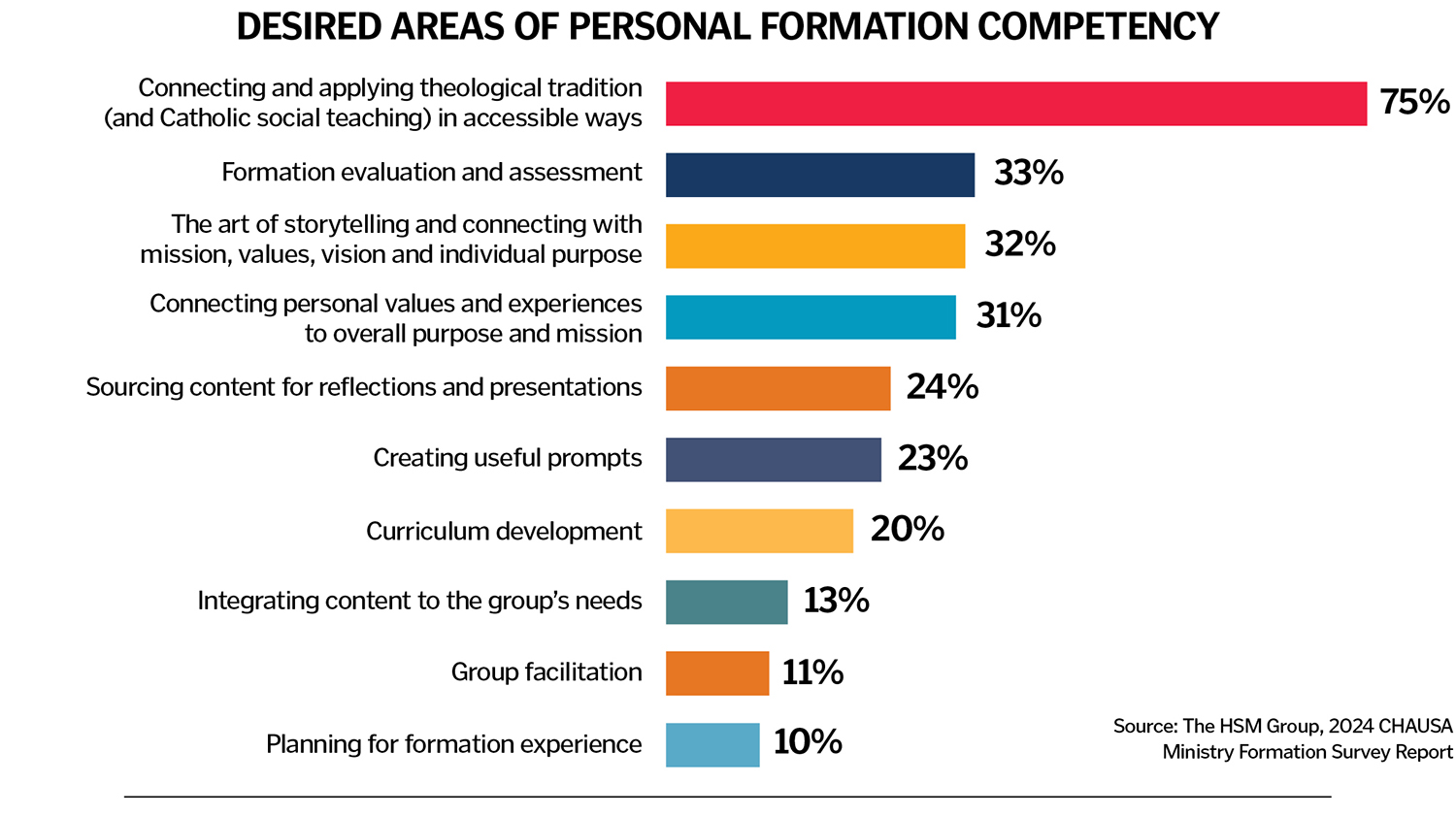
We wanted greater understanding of the aspects of formation where individual leaders desired to grow. CHA has long articulated formation as a core competency of excellence in mission leadership. CHA's 2022 Mission Leader Survey found that overall, mission leaders ranked formation as their top area for growth. In this current survey, the tool offered more than a dozen skills or areas for potential individual growth related to formation (see graph below). Respondents were asked to rank three. Three quarters (75%) cite connecting with and applying the theological tradition (including the Catholic social tradition) in accessible and relevant ways as the overwhelming areas where leaders would like to grow. As many as 3 in 4 respondents picked this as one of their top three needs.
The next grouping of areas for growth includes evaluating and assessing formation experiences, the art of storytelling, and connecting personal values to the overall organizational purpose or mission. Up to 33% of all respondents identified these areas. In the next notable tier (20%-24%), respondents cited crafting useful prompts, sourcing content and curriculum development.
When asked about the likelihood of signing up for a program, participants favored a facilitation skills workshop, in addition to individual mentoring and communal spiritual practices.
DEMOGRAPHICS AND EDUCATION
The survey concluded with a series of questions related to demographics. The questions repeated the majority from the 2022 Mission Leader Survey and other past surveys to build longitudinal analytics. This study validated the integrity of data reported from the 2022 survey, particularly in terms of race and ethnicity.2 The current study reflects a statistically equal split between women and men mission leaders, closing a gap reflected in the 2013 survey, where women held a clear majority (70%), perhaps due to the historical prevalence of women religious in these roles.3
The current study also inquired deeper than past surveys into leaders' educational backgrounds. While past CHA surveys of mission leaders also inquired about education and degrees, this study had a keen interest in understanding any distinctiveness in the theological training among those leading formation experiences.
The data affirm that today's mission and formation leaders are steeped in the theological and spiritual tradition, as 84% have a university education in theology, religious studies and/or spirituality. Furthermore, responses revealed that nearly 7 in 10 have a master's degree and 17% have a doctoral degree, whether a PhD, DMin or other applied doctorate. These data indicate consistency with the 2013 Mission Leader Survey.4
The current study broke new ground by specifically inquiring about a Master of Divinity (MDiv). The significance is that the MDiv is typically a minimum of 81 graduate credit hours, whereas other master's programs are typically 36 graduate credits, less than half the credit hours of an MDiv. Moreover, the latter is the basic academic credential for ecclesial partners in ordained ministry. This formation survey shows more than a quarter of respondents have an MDiv (27%), an impressive accomplishment.
PREVIOUS WORK AND FORMATION EXPERIENCE
Lastly, this study inquired about previous work experience, believing that past participation in other aspects of church forms an individual for ministry. Most respondents had prior work experience in a Catholic ministry. Fewer than a quarter had no experience in other Catholic ministries. Forty percent had worked in either a Catholic parish or an educational setting, ranging from grade school through higher education.
Religious Life and Seminary Formation
Perhaps more fascinating is the finding that well more than half of respondents have experienced formation as a part of a religious community, seminary and/or ordained ministry. This is significant as one hypothesis is that the community of mission leaders has long benefited from former religious or former priests and seminarians, yet it will one day have diminishingly few from these ranks and be comprised of individuals with little to no experience with other facets of church life.
These data suggest that current mission and formation leaders are well-represented by those settings. What is more, of the 95 individuals indicating previous experience in religious life or seminary, 80% of them spent at least five years in that setting, and 57% spent 10 years or more.
Formation flows from the head to the heart and the whole. In an age of information and data saturation, formation forges a path for the whole person to flourish, particularly as it offers opportunity and nourishment for the spiritual dimension of being human.
In addition to intellectual preparedness, this survey also forged toward a fresh frontier by inquiring about ongoing spiritual growth. Interestingly, nearly half of all respondents engage with a spiritual companion or director on a consistent basis. This is important because decades ago, when women religious led the ministry, there could be a very solid assumption that each sister had a spiritual director. Spiritual direction is part and parcel of a religious community. Yet this cannot be assumed for lay leaders in a ministry. There is no structure for communal support, never mind accountability, for lay spiritual growth and development. This study, however, offers indicators that a sizable portion of mission and formation leaders demonstrate an objective commitment to spiritual life as a key aspect of their own ongoing formation.
CONCLUSION AND ANALYSIS
Robust and Evolving
This study validated years-long developments in ministry formation that once focused nearly exclusively on senior leaders and now extends deep and wide in the ministry. The data show how mission and formation leaders have responded to the call to extend formation beyond executive positions, all the way to hourly workers. This is evidenced by mission leaders' time commitments to orientations for all workers and new leaders. Further evidence appears in plans to fortify formation for all workers. Formation is truly integrated throughout the entire continuum of care in highly complex organizations.
Spirituality as a Formative Experience
There is a need and desire for spiritual resources. This underscores a critical distinguishing feature of formation — that it is more than an intellectual exercise. Formation flows from the head to the heart and the whole. In an age of information and data saturation, formation forges a path for the whole person to flourish, particularly as it offers opportunity and nourishment for the spiritual dimension of being human.
Spiritual development is a key path for ongoing formation. Unlike degree programs or professional certifications, formation is not primarily about undergoing one program only to then embark upon another. Rather, tending to the spiritual life of being human is a primary means and an indispensable method of ongoing formation.
Programs serve a critical function, akin to an initiatory process. They help leaders gain a deep understanding and experience of being immersed in a ministry and connecting and integrating their professional expertise into the needs and vision of the organization, which also happens to conduct the work of the Church. In other words, they become more fully aware of what it means to be part of a ministry. From there, leaders in ministry are called to commit to fostering contemplative practices that attune their awareness to the transcendent in the ordinary, and to make these connections for the teams they lead.
Formation Needs Are Real
Clear direction for more support and resources for formation emerged as a notable need from CEOs and executive leaders in this recent study. Leaders cited a need for financial resources, and other indicators of executive support emerged, such as protected time for leaders to fully participate in formation programs. Do leaders and sponsors know which members of the executive team have completed a formation program, and do they unequivocally promote their participation in those programs?
Demonstrating Formation's Impact
Another perennial need in the field of formation is tools and processes to translate the individual formative experiences, outcomes and value of formation to the overall organization into a dialect understood and appreciated by operational leaders. It has been said that the sisters who founded our ministries often eschewed the spotlight, in the most positive sense. They were committed to their calling and ministry of care for others in need and did not invest much in telling their own story.
Today is different, and with near-exclusive lay leadership across the ministry, there is a greater need to tell the good news of our own work. Formation is no different, and formation has very good stories (and data) to tell. Such work underway by CHA and many member organizations relates to how to do that, for whom and by what methods.
Three points summarize a heap of information. First, we must celebrate and offer high praise for the work, dedication and development of ministry formation. A quarter of a century ago, when sisters insisted on embedding formation in the operations of the healing ministry, they may have only dreamed of the breadth and depth of activities cited in this study.
Second, our ministries must grow their investments in formation programs and activities. This includes people, time, organizational culture and financial resources. Continual improvements and innovation in established programs emerged as a top organizational need. A follow-up article on current practices in senior leadership formation programs will be forthcoming in the next issue of Health Progress.
And third, there remains a hunger for integrating elements of Catholic identity, particularly the social tradition, and then demonstrating the impact that formation has on individuals and the organization. CHA has materials in development that will support members' excellence in both of these areas, and updates will be shared in the near future.
DARREN M. HENSON is senior director of ministry formation at the Catholic Health Association, St. Louis.
NOTES
- Framework for Ministry Formation (St. Louis: Catholic Health Association, 2020), https://www.chausa.org/store/products/product?id=4363.
- Dennis Gonzales and Jill Fisk, "Survey Reveals Encouraging Trends—and Concerns—for Future Mission Leaders," Health Progress 104, no. 1 (Winter 2023): https://www.chausa.org/news-and-publications/publications/health-progress/archives/winter-2023/mission---survey-reveals-encouraging-trends-and-concerns-for-future-of-mission-leaders.
- Brian P. Smith and Sr. Patricia Talone, RSM, "New Survey: Mission Leaders Respond," Health Progress 94, no. 6 (November-December 2013): https://www.chausa.org/news-and-publications/publications/health-progress/archives/november-december-2013/new-survey-mission-leaders-respond.
- Smith and Talone, "New Survey."