
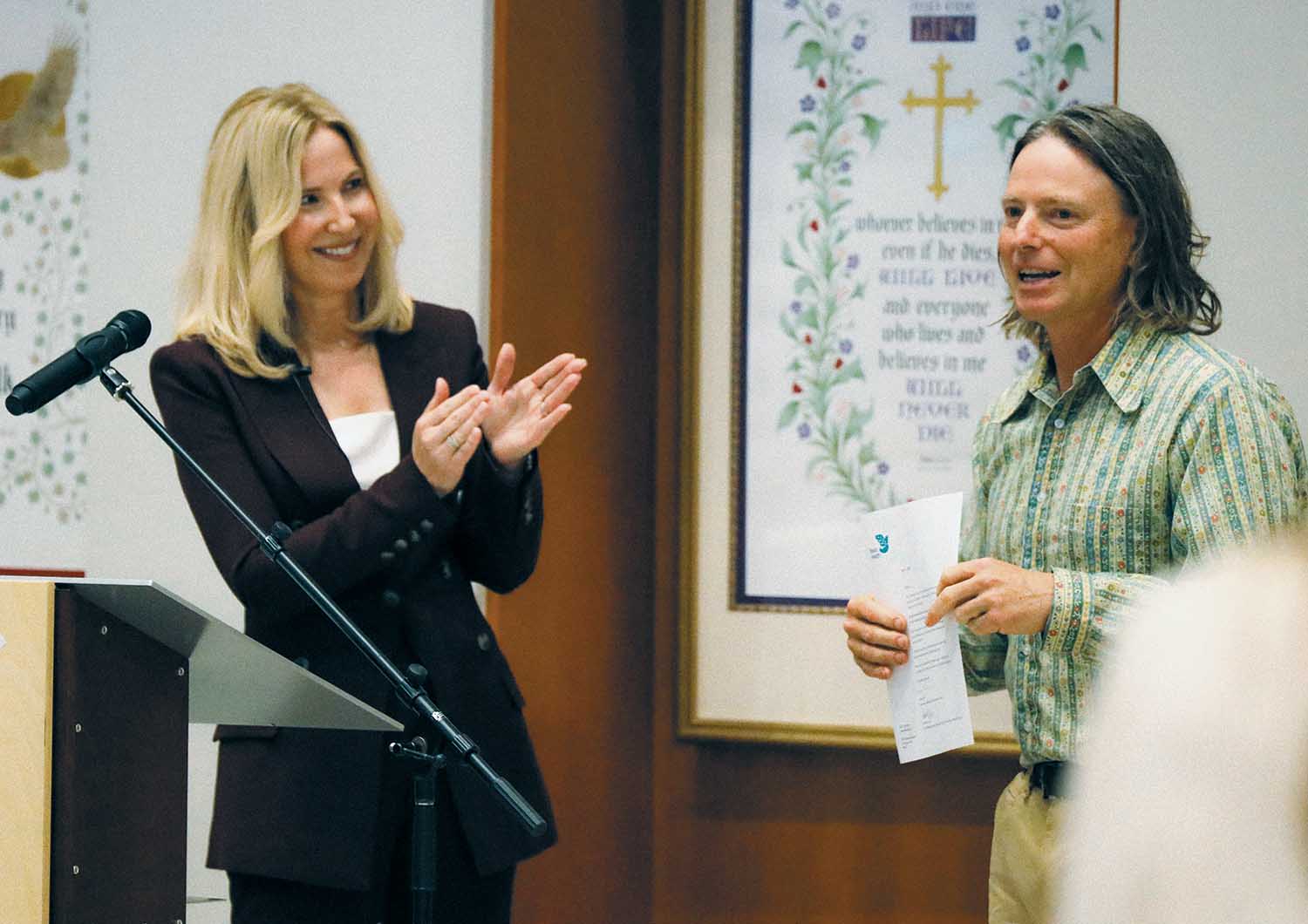
Sarah Ness often quotes Sr. Kathleen Pruitt, who has spent many years in leadership roles with the Sisters of St. Joseph of Peace and says: "Let us be who we say we are."
In January, Ness became president and CEO of PeaceHealth, a health system founded by the Sisters of St. Joseph of Peace. Sr. Pruitt sits on its board. Ness calls Sr. Pruitt's motto "my center point."
"I share it often with our leaders and our caregivers, because I think that is our keel," she says. "If we can be who we say we are in every moment and with every decision and every interaction, PeaceHealth will be the provider and employer of choice in the markets that we serve, and we are determined to make it so."
Before moving into the top post at PeaceHealth, Ness spent more than 20 years with the system in various positions. Most recently she was executive vice president and chief administrative officer.
She says what drew her to health care was the profound effect caregivers could have on people, especially at their most vulnerable moments.
"Health care is one of the few fields where we have the opportunity to directly touch lives clinically, emotionally, spiritually and across patients and families and communities," she says. "I believe the work that we do is absolutely sacred and has a lasting impact."
Deepening connectionsPeaceHealth, based in Vancouver, Washington, includes 3,200 physicians and other clinicians plus about 16,000 more caregivers. It operates more than 160 clinics and nine medical centers in Washington, Oregon and Alaska.
Ness is focusing on three key priorities as PeaceHealth's leader. The first is deepening connections between the system and its workforce. To do that, she sees it as essential to spend time on-site with PeaceHealth employees to listen to their concerns and learn what they need to thrive.
As part of that listening and learning process, she is going on "Carry Forward tours" of PeaceHealth sites. "It's an opportunity for me to share the vision as we think about PeaceHealth's next chapter," she says. "But more importantly, it's hearing directly from our caregivers and our clinicians and our donors around how we serve."
On the visits, she reinforces to staff the importance of collectively carrying forward PeaceHealth's mission to meet individual patient needs and to promote the common good across communities.
In her time at PeaceHealth, Ness has advanced workforce development. She championed the system's Women of Peace movement to empower women caregivers to flourish by giving them encouragement and opportunities. She helped roll out Nurture 360, a program that connects staff with resources to improve their physical, mental, spiritual, financial and emotional well-being.
Modernizing care delivery and service
Ness' second priority is modernizing PeaceHealth's care delivery and service model so that the system provides "exceptional and holistic care to every person we serve across every stage of their health and wellness journey."
She says PeaceHealth already has examples of this in place. In Vancouver, the system opened a community health hub with staff from local social services agencies in the emergency department. The partnership between the hub and those agencies leads to "warm and seamless handoffs" for patients in their time of need, Ness explains. In Eugene, Oregon, PeaceHealth is partnering with a transitional housing organization to provide "recuperation cottages" and a medical clinic for discharged patients with no place else to go to recover.
Another part of PeaceHealth's modernization effort, Ness says, is to leverage technology to better serve patients and caregivers. She points out that some of the most transformative advances she has seen in her two decades in health care involve technology, such as the expansion of access to care through telehealth and the use of robotics to make surgeries more precise and less invasive.
"These new technologies are really having a direct impact in a positive way for our patients but also easing some of the burden of our physicians as well as we ensure that they have the best tools and technology and support to provide the care that our patients and communities deserve," Ness says.
"Health care is one of the few fields where we have the opportunity to directly touch lives clinically, emotionally, spiritually and across patients and families and communities. I believe the work that we do is absolutely sacred and has a lasting impact."
— Sarah Ness
Ensuring the system's health
Her third priority as she leads PeaceHealth forward is to ensure the system's financial and operational health. She notes that this has been made more challenging by various factors, such as rising costs for services, uncertainty around Medicaid and Medicare reimbursement rates, and the lapse of enhanced premium subsidies for people insured through the Affordable Care Act.
"I think we have got to be able to better manage costs while protecting access and quality," she says. "And that means working together collectively with policymakers, with payers, with community partners to really find solutions together to better manage costs while always protecting that quality and access."
Ness points out that like other nonprofit health systems, PeaceHealth is a stabilizing force in the communities it serves and further supports through community benefit programs. In fiscal year 2025, PeaceHealth's community benefit donations totaled $280 million.
When she's not working, Ness says she tries to strike a balance between calmness and activity. She's an early riser who cherishes a quiet start to the day with a walk through her neighborhood with her mini-goldendoodle, Madison. She treasures time with her husband, Joe, and enjoys catching up with her two college-age kids, Will and Caroline, whenever they're home.
She appreciates the outdoor beauty of the Pacific Northwest — whether skiing on Mount Hood, taking weekend hikes, or spending time on the tennis court. She keeps a good book at her bedside, often something by Washington-based author Kristin Hannah, so she can put herself in "a different mental space" as she ends her day.
Bright future, sustained commitmentAs she settles into her new role, Ness sees a bright future for PeaceHealth.
"I share with our leadership team and our caregivers that I believe this ministry is really just beginning to realize what it is capable of as we become more connected, as we become more purpose driven and as PeaceHealth serves our growing communities with greater access to care, always being faithful to our mission and values," she says.
She also says that PeaceHealth stands firm in its commitment to care for the most vulnerable in the communities within its footprint, just as its founding congregation did when they began establishing health care ministries in the late 1800s.
"That need has not wavered," she says. "It's as strong now as it ever was, if not more so. And my job as CEO is to ensure that we remain just as committed today to that work as we were 135 years ago."