
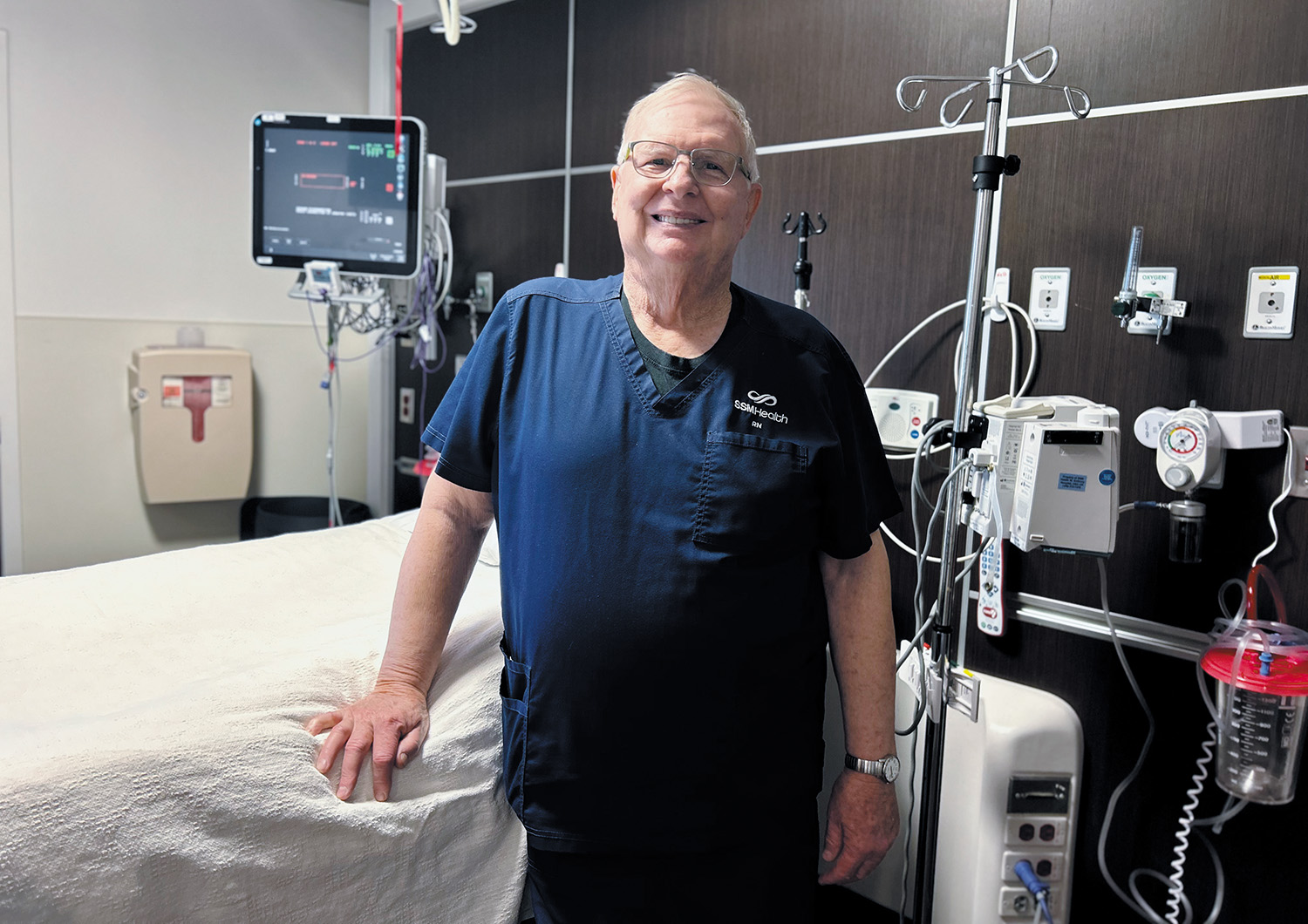
When stroke patients enter SSM Health St. Anthony Hospital in Oklahoma City, many will quickly receive a life-changing medication — greatly minimizing chances of significant disability.
St. Anthony has cut its average door-to-needle time, the period between arrival and treatment for a stroke, to 34 minutes from 90 minutes. That achievement, with the guidance of stroke nurse navigator Orville Fisher, has advanced the hospital's certification from primary to comprehensive stroke center — the highest level of care.
Five years ago, Fisher put his own stroke team to the test. After his vision began rapidly deteriorating, his wife rushed him to St. Anthony.
"At first, I was like, 'What the heck is going on?'" Fisher says. "And then my nurse-brain kicked in and said, 'You're having a stroke.'"
Clot busters are a game-changer
Fisher, a former emergency department nurse at St. Anthony, accepted the position of stroke nurse navigator in 2014. An important part of the job involves patient care and family support.
"We translate information from 'doctor-ese' into plain English," Fisher says.
His role also entails community education and the essential task of minimizing door-to-needle time.
When Fisher began as stroke nurse navigator, it took an average of 90 minutes for St. Anthony stroke patients to get an injection of clot-busting medications called thrombolytics, which restore blood flow. Now, nearly all are treated within 60 minutes, in line with American Heart Association guidelines, and in half of cases, within about 30 minutes. The hospital's record is 4 minutes.
To reduce the door-to-needle time, when patients with stroke symptoms are en route, medical staff call a "code stroke." Immediately after a patient's arrival, they begin a critical evaluation process including a CT scan. Among other things, they determine if the stroke is ischemic or hemorrhagic. Ischemic strokes, which involve a clot, make up the vast majority and can be treated with thrombolytics. Hemorrhagic strokes, involving a rupture, cannot.
Fisher says that without blood flow, the blocked part of the brain loses nearly 2 million neurons per minute. The sooner thrombolytics can be injected, the better.
"It can mean the difference between going home with absolutely no deficits whatsoever or being disabled for life," he says.
'Complete confidence'
One morning in September 2021, Fisher was making an omelet for himself and his wife and thinking about repairing fences on their 50-acre farm. As he reached to his right for a knife, he realized he had to turn his head 90 degrees to see it.
Ever the professional, Fisher checked his face in a mirror for drooping and tested his grip for loss of strength. While those symptoms weren't present, his vision was getting worse.
Fisher always advises people to call an ambulance if they suspect a stroke. But because he lives nearly an hour away from the hospital, his wife, also a nurse, drove him.
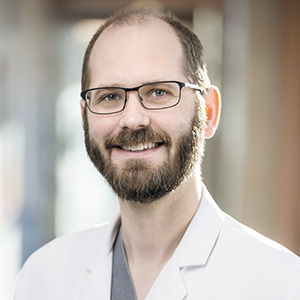
Dr. Jaron Marriott was at St. Anthony when Fisher phoned to say he was on the way.
"Because Orville is such a jovial guy, my initial thought was that it was a joke," Marriott says. But then Fisher told him, "No, I'm serious."
Waiting for Fisher to arrive, Marriott felt the gravity of the moment.
"You try to treat all patients like family," Marriott says. "But when it is actually one of your family, one of your friends, it's a little more nerve-wracking."
When Fisher came in, the team surrounded him.
"I had complete confidence in them," Fisher says. "It was an incredible feeling to know how well they're trained and that they're willing to do whatever it takes to get you better."
Fisher's door-to-needle time? Twenty-one minutes.
He recovered his sight, and during a three-day hospital stay, it became apparent there was no lasting damage. Fisher says even while hospitalized, he resumed working.
"We had a meeting in my ICU room," Fisher says.
Marriott says Fisher's recovery "is really a testament to his quick action and understanding. Most people react to a stroke or heart attack or other major health issue with, 'Oh, that couldn't possibly happen to me.'"
'Incredibly lucky'
In his community outreach, Fisher reassures residents that when it comes to stroke, he and other medical professionals don't mind false alarms.
"I would rather people come in 100 times and me tell them, 'Thank goodness you're not having a stroke — it's something else,'" Fisher says, "than to have to tell someone, 'If you could have just gotten to us a couple of hours sooner, we might have been able to prevent this outcome.'"
A year and a half after his first stroke, Fisher had a second, this time while shopping with his wife. Again, she drove him to St. Anthony and he was treated with thrombolytics. While he was left with some balance issues, Fisher was able to continue working and running the farm.
"I feel incredibly lucky," Fisher says.
Fisher uses his own experiences to further improve care. As a patient, he realized how overwhelming it is to be asked so many questions by the stroke team — even if they're essential ones such as "What medications are you on?"—and advised the team to use a softer tone.
Fisher lets patients know he's been in their shoes, especially when preparing them for an injection. Some patients — and even medical professionals — worry about the very thrombolytics that greatly minimized Fisher's complications. A slight risk of brain bleeding created an early but persistent stigma around the drugs, he says.
"I tell them, 'I know this is scary, but they gave me the same medication,'" Fisher says. "And look at me now.'"
'That steady rock'
Fisher is seen as a trustworthy educator, according to Dayla Hall, St. Anthony's director of neuroscience.
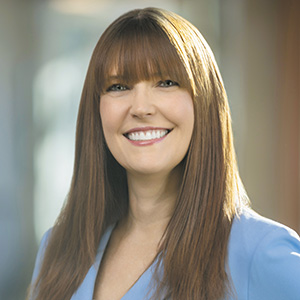
"As a nurse, and then also as a rancher in the rural farming and ranching areas, he's very relatable," Hall says. "He has been a great asset to us."
Hall says Fisher, who's now semiretired, deserves most of the credit for St. Anthony becoming a comprehensive stroke center.
"His contribution to this program has made it what it is — one hundred percent," Hall says.
Teamwork is vital to the success of a stroke program, Hall says. Marriot agrees. The cohesion of St. Anthony's team is apparent even in the configuration of their office space.
"We used to have two offices next to each other," Marriot says. "And we literally knocked the wall out in between so we could communicate even faster and better."
Even though Fisher now works only about one day a month, he's still a vital part of the team, Marriott says.
"He's that steady rock that everybody leans on for his guidance," he says.
______
Watch: Orville Fisher talks about his work as a stroke nurse navigator.