
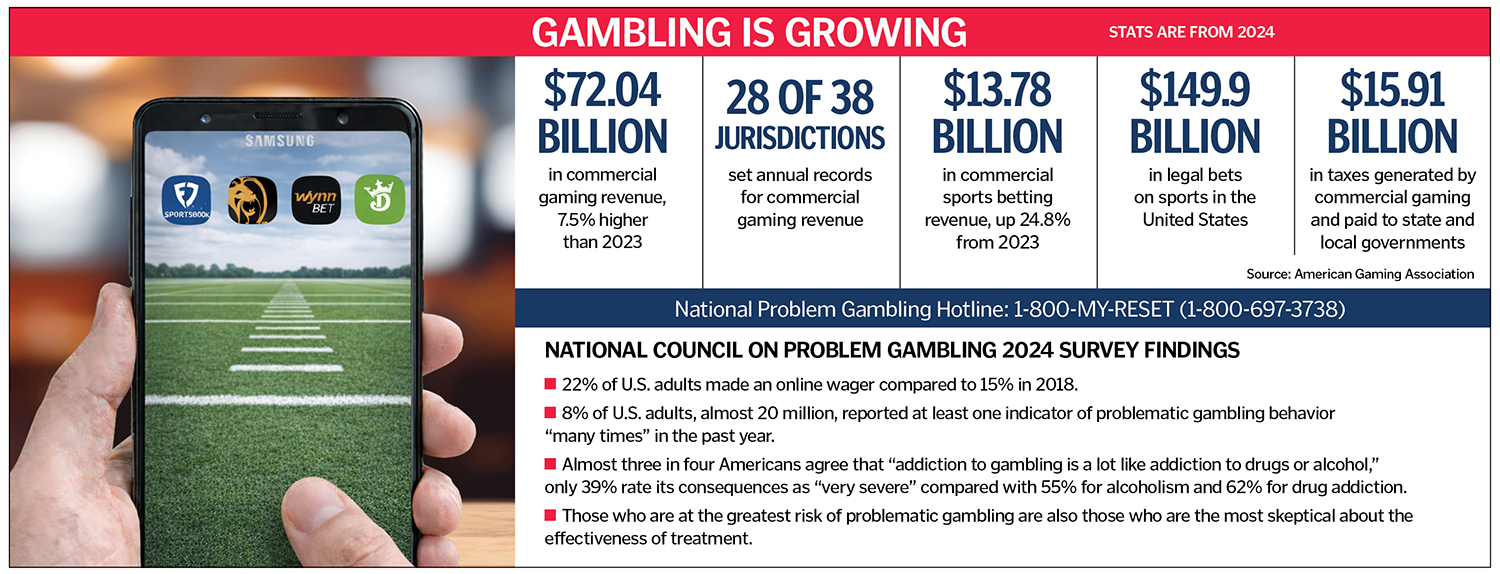
The sharp increase in sports betting since a Supreme Court decision led to its expansion shows gamblers are willing to accept the stakes. But some mental health experts worry the growth of sports betting, and of gambling in general, poses wider risks that are overlooked.
"This rapid growth has normalized gambling and made it more accessible than ever," says Dr. Arpan Waghray, a psychiatrist who is CEO of Providence's Well Being Trust. The trust works to improve the mental health and well-being of communities within the footprint of Providence St. Joseph Health in seven western states and to advance mental health care nationally.
At the same time gambling is expanding, Waghray sees what he calls a persistent "public blind spot" when it comes to gambling addiction and its potential comorbidities such as financial strain, social isolation, depression and substance abuse. "There are no formal surveillance systems tracking prevalence or harm," he notes.
Court ruling opens door
In 2018, the year the Supreme Court struck down a federal law that had prohibited states from authorizing sports betting, revenue from the practice was $430.2 million, according to the American Gaming Association. By 2024, when 38 states had embraced sports betting, the revenue was 32 times greater, at $13.78 billion nationwide. Sports betting that year accounted for 19% of the $72 billion brought in by commercial gaming, a total that continues a record-setting trend, the association says.
Today, 39 states, the District of Columbia and Puerto Rico have legalized sports betting. One of the reasons states are willing to do so is the tax revenue that gambling generates. The American Gaming Association put the figure at almost $16 billion for state and local governments in 2024, up from $9.7 billion in 2018.
However, a study published in February 2025 in the journal JAMA Internal Medicine noted that very little of the tax revenue from gaming is earmarked to help problem gamblers. Looking at funds set aside in 2023 for gambling addiction programs, the study found "most states allocated less than $1 million and 20 states allocated less than $400,000, despite ample tax revenues."
20 million report risky habits
Cait Huble is director of public affairs for the National Council on Problem Gambling, a nonprofit dedicated to mitigating gambling-related harm. Huble says that while the council takes no stance on legalizing gambling, it does strongly support education and research on the economic and social costs of problem gambling. It also supports access to treatment.
"Problem gambling as a field receives no federal funding at all, which is our number one advocacy priority," she says.
In 2018, the council began doing surveys every three years of Americans' gambling habits. The 2024 survey found 8% of U.S. adults — or 20 million — "reported experiencing at least one indicator of problematic gambling behavior 'many times' in the past year." Those indicators include thinking about gambling constantly and feeling the need to bet more money and more often.
The survey pointed to several predictors of risk for problem gambling, such as gambling weekly or more often, agreeing that gambling is a good way to make money, and being male and/or under 35.
However, the survey found that those who are at the greatest risk of problem gambling also are the most skeptical of treatment. "We have a lot of work to do in terms of education, making sure that people can understand that gambling addiction is a real thing, it's a real addiction, and the treatment that is available is very effective," Huble says.
Smartphones, gambling apps
Dr. Thomas Horn is a psychiatrist who leads the behavioral health program at Chesterfield, Missouri-based Mercy. Horn points out that just as the legalization by states of sports betting has led to its expansion, so has the embrace of smartphones and the development of apps on those phones specifically for betting.
"We've got a casino in our pocket now at all times," Horn says. "And I think that's why you're seeing so much interest and intrigue into that intersection of gambling and how it fits in our culture."
He believes that advertising for sports betting, in particular, seems meant to entice young men by giving them infinite options to test their intuition. For example, major sports betting sites take wagers on not only outcomes of competitions such as Major League Baseball games but on specific action within the games such as whether the next pitch will be a strike or ball.
"I think they're marketing to that competitive individual that's looking to gambling as an outlet," Horn says.
Though most bettors don't get in so deep that they put their finances and relationships at risk, Horn says enough do that mental health care professionals should be trained to look for early signs of gambling addiction and to encourage treatment when they see indications of trouble.
While there is no ingested substance involved in betting, Horn says gambling has an effect on the brain like other addictive practices. He says interventions for other compulsions, such as 12-step therapy, counseling and medications, also have proven effective in breaking gambling addictions.
If society understood problem gambling to be an addiction, Horn says it might prompt more compulsive bettors to seek help. "I think talking about it that way, hopefully, does decrease the stigma around it, and allow people to, if they're curious at all, ask 'Do I have a problem with this or not?' and to seek out a mental health provider," he says.
Recommended guardrails
Waghray informally polled mental health colleagues across the country about compulsive gambling. "What was fascinating to me is that everyone recognized this as a problem, but didn't really have well-thought-out, sophisticated solutions," he says.
Even given that finding, he agrees that there are effective treatments for gambling addiction. But he sees a need for more education of care providers and the public about the problem and more research into how best to identify and address it early on.
Waghray stresses that Providence sees advancing compassionate, evidence-informed solutions to expand access, reduce stigma, and close care gaps for all mental health needs, including compulsive betting, as part of its Catholic mission.
He says that mission frames the trust's practical recommendations to keep gambling from turning into a societal scourge. Those recommendations include:
- Establish guardrails like spending limits and requirements for responsible advertising.
- Embed routine screening in primary care and emergency settings.
- Invest in youth-focused prevention.
- Build cross-sector partnerships to monitor harms and deliver accessible care.
"Our goal is simple and aligned with Catholic social teaching: protect people, heal families, and strengthen communities — so legalization does not become normalization of harm, but an opportunity to put ethics, public health, and dignity at the center of policy and practice," Waghray says.