
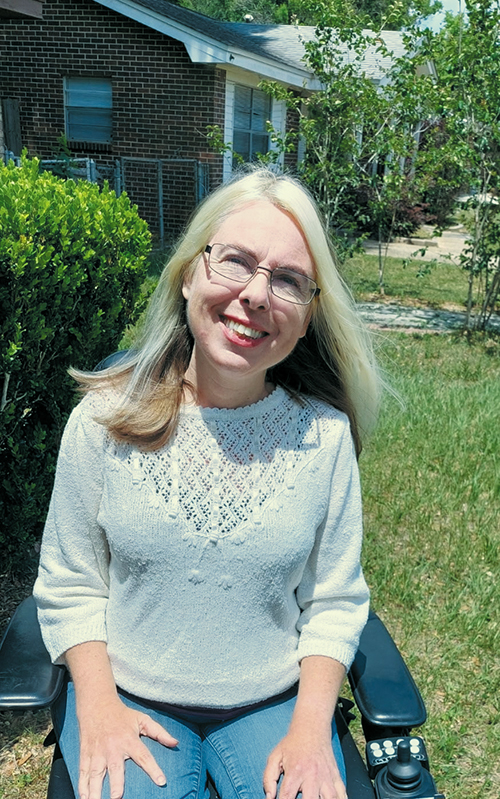
As a strategy consultant for Ascension Florida, Becky Washler looks for patterns in data and community needs to help the ministry plan. As a person with spinal muscular atrophy, a rare genetic disorder also known as SMA that causes muscle weakness, she's always looked for ways to cope with the disease.
"I think my SMA made me a planner and a problem solver," Washler said, "because I always had to figure out a different way to get at something or a problem."
Ten years ago, when she learned that the Food and Drug Administration approved a new drug, Spinraza, to treat SMA, she wondered if her hospital, Ascension Sacred Heart in Pensacola, could offer it. If not, patients there would have to drive hours to other cities like Orlando or Birmingham, Alabama. That could be a difficult and expensive trip, especially for those with advanced cases of the disease. They might have to ride while lying down or in a wheelchair.
The drug costs hundreds of thousands of dollars for a year of treatment and it's complicated to administer. Spinraza is given through a lumbar puncture, and a clinician with advanced training is needed for patients with complicated spinal issues. Over time, the disease can take away a person's ability to walk, eat and breathe.
Washler, 60, has a mild form of SMA. She uses a wheeled walker at home and a wheelchair elsewhere. Getting the drug administered wouldn't be a big issue for her. "I'm an easy stick," she said.
First injections
Meanwhile, Nicole Wilson, 49, also learned about the new drug. Wilson has a more advanced form of SMA and uses a wheelchair. She'd need to have the drug administered through an access point in her fused spine. "I didn't even know if I could get the medication," she said.
Both women nudged and pushed — asking the hospital to offer the treatment and the drugmaker, Biogen, to make it available. They succeeded, and the hospital went through the complicated process of getting insurance approvals. The drug, which doesn't have a widespread demand, is not kept in stock and is ordered for specific patients for a scheduled administration.
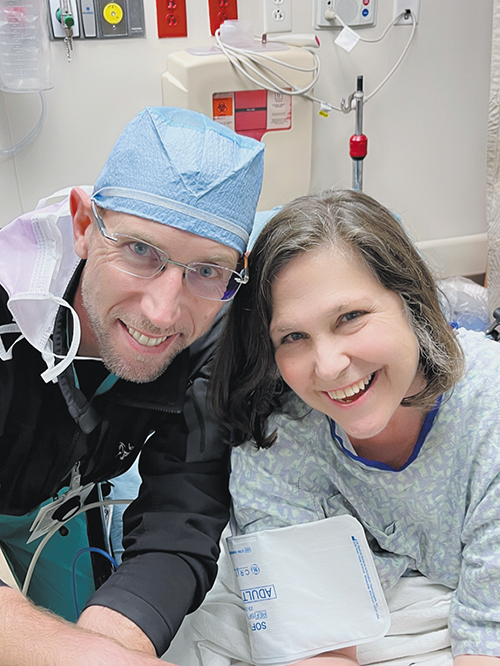
Eleven months after learning about the drug, Washler got her first injection, administered by a physician assistant. Because the injection was fairly easy for her, Washler became a test case to figure out any logistical or clinical barriers.
In 2018, neuroradiologist Dr. Nathan Kohler and neurosurgeon Dr. Christopher Villar joined Ascension Sacred Heart. The doctors can administer Spinraza, known generically as nusinersen, to people with complicated cases. Kohler gave Wilson her first injection.
"You don't want just anybody rooting around in your spine," Wilson said. "Kohler is phenomenal."
Both women report that, after regular injections of Spinraza, they have more stamina. Both appreciate that they don't have to drive to different cities to get the drug. As far as they know, Ascension Sacred Heart is the only hospital in the Pensacola region to offer it. In 2020, the Studer Family Children's Hospital at Ascension Sacred Heart Pensacola made the drug available for pediatric patients. In March, the FDA approved a high-dose regimen.
Building relationships
Kohler regularly treats six to eight patients with Spinraza. He enjoys building relationships with them and helping them connect with one another. He started a Facebook group for local patients with SMA and will give phone numbers of patients to others with their permission.
Kohler downplays his role in the process. "I'm just the guy with the needle," he said. "If you tell me there's a need, for me the skill required is very minimal. There's no reason I'm not going to say yes."
He attributes the hospital's ability to offer the medicine to Wilson and Washler. "You voice your concerns enough, people will listen," he said. "I think both of them are strong advocates for their case, and I always tell patients that the best advocate for your care is you."
Washler said she knows the hospital has competing needs. One reason she was so dogged, she said, was because she knew offering the drug wouldn't take valuable hospital resources. She also knew it could make a real difference for patients, no matter how tiny the population.
"Everybody was very receptive to trying to make it happen," she said. "And I'm just glad we're here where we are, and able to offer it."