
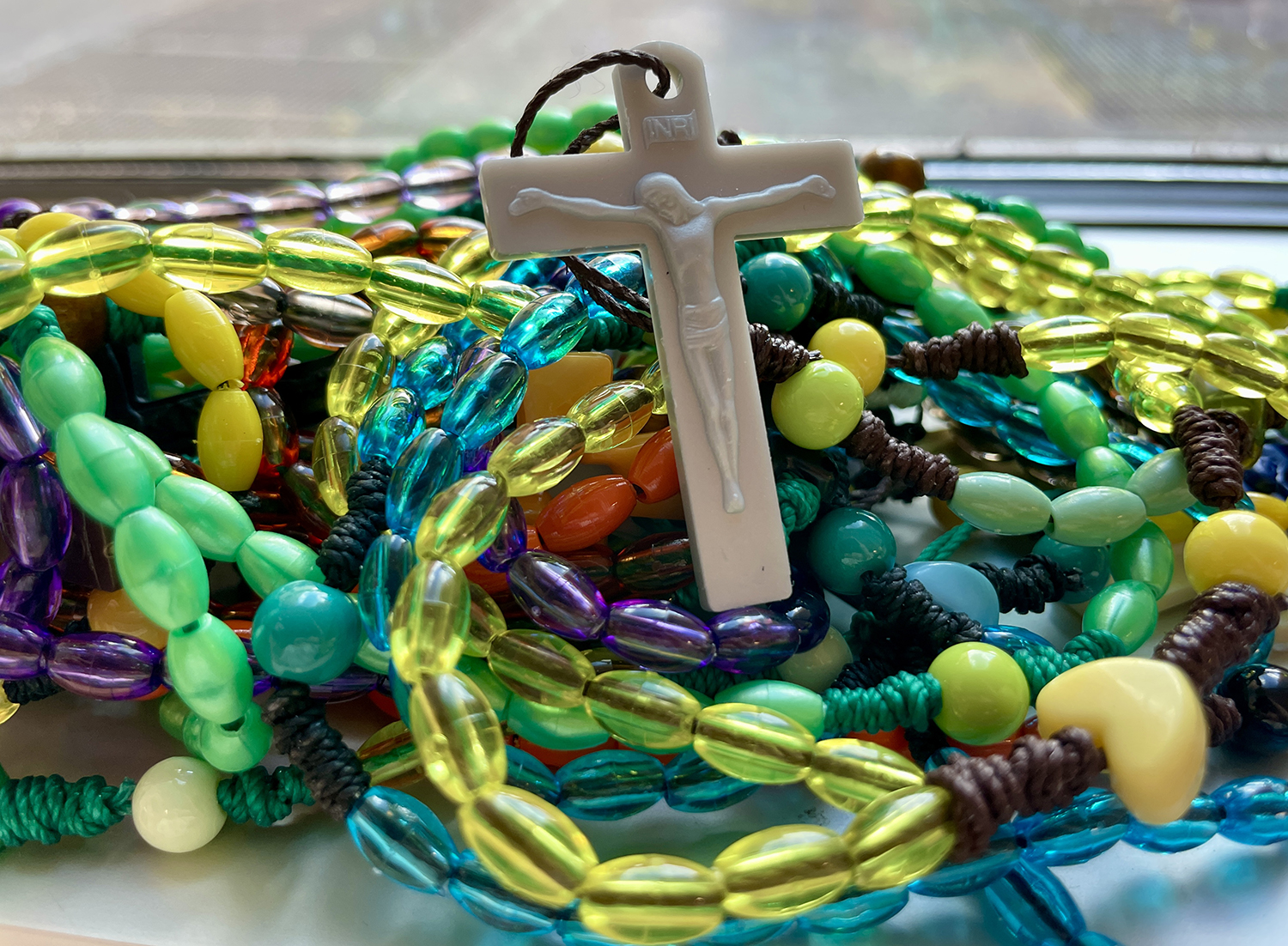
Thanks to a loyal corps of volunteers at an Intermountain Health hospital in western Colorado, patients and their loved ones can have a tangible sign of hope that they can take with them when they leave: a rosary handmade with love and care.
A group of about a half dozen volunteers assemble as many as 150 of the rosaries each month for pastoral care staff and volunteers to hand out at the 334-bed Intermountain Health St. Mary's Regional Hospital in Grand Junction.
The rosaries have had a meaningful impact on the lives of thousands of people since the volunteers began making them about 15 years ago, says Alan Amos, manager of mission integration and spiritual care for St. Mary's.
Amos says that offering the rosaries is just one of the "touchpoints" that St. Mary's pastoral care team offers to benefit patients and their loved ones. "Sometimes it's just a simple act — just being present, saying 'hi' — it doesn't have to be grand," he says.
High demand
The rosary-making program began when a chaplain at the hospital heard about a group of women who made the gifts but no longer had a place to do so. The hospital's volunteer services gave them a meeting place at St. Mary's where they have since been gathering once a month, with about six people joining each time.
In the past, the pastoral care department sometimes had a surplus of rosaries and would donate them to churches, overseas missionaries and jails.
But, these days, the rosaries are in such high demand there are no leftovers. The group has begun seeking new members to increase the number of rosaries they can make.
Beads and Cords
The volunteers provide the funds for the supplies. One member of the group orders the items and brings them to each gathering.
Each rosary is made of a cord, with the beads of the rosary held in place by knots, and with a centerpiece and cross. Each rosary has five sections with 10 small beads separated by a large bead, with that arrangement forming a loop. A centerpiece secures that loop and has an additional strand with two large beads on either side of a set of three beads, with the cross at the bottom of that strand.
Each small bead represents the praying of the Hail Mary, and each large one represents an Our Father. The crucifix represents the recitation of the Apostle's Creed.
Volunteers choose the two colors of beads they use for each rosary. Some choose red and green at Christmas and pastels at Easter. Some choose colors representing favorite sports teams.
It takes about an hour for each volunteer to make three rosaries, and the volunteers make additional batches at home in between the rosary-making sessions at the hospital.
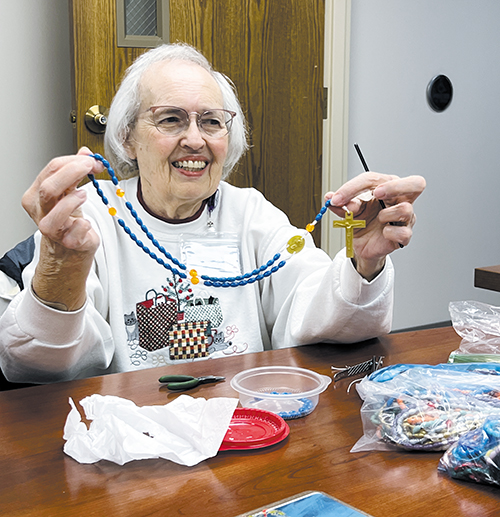
A knot and a prayer
Each time the group gathers, they begin with a short prayer. Then they begin making the gifts. They have practice materials for new group members just learning.
Carol Kelker, who has been volunteering with the group since about 2012, rarely misses a rosary-making gathering. She says the activity is a quiet labor of love for her. With each knot she makes, she says a prayer for the person who will hold the rosary.
"I love to make them," Kelker says. "I realize they are going for a good cause."
Jim Selcke joined the volunteer group in 2015, having already been making rosaries at home. He says he looks for purpose in life, and making rosaries is one.
Available to anyone
Amos notes that although rosaries are most closely associated with Catholicism, the pastoral care department's staff and volunteers can offer the rosaries to anyone. The pastoral care representatives can provide instructions on the rosary to those unfamiliar with the contemplative devotional.
Kelker says the group has been told that patients love to receive the rosaries. The group has heard that even patients struggling with their faith have accepted the gift. Sometimes, patients will say they do not wish to speak with a chaplain, but they will accept the rosary gift.
Fellow rosary-maker Joan Wasinger says one patient, when offered a rosary, requested one for each of her five grandchildren.
Selcke says some patients who were at the end of their life when they received a rosary asked that others be offered to mourners at their funeral.
Amos says some patients have requested to be buried with the rosary they received.
Amos hopes the volunteers continue making the rosaries "forever and ever." He says he and other pastoral care team members who give out the gifts know they are making a difference. "We can hand them a rosary," he says, "and it changes their entire outlook from the hospital stay."
Kelker says, "People are so happy to get those rosaries, and they just love them."