
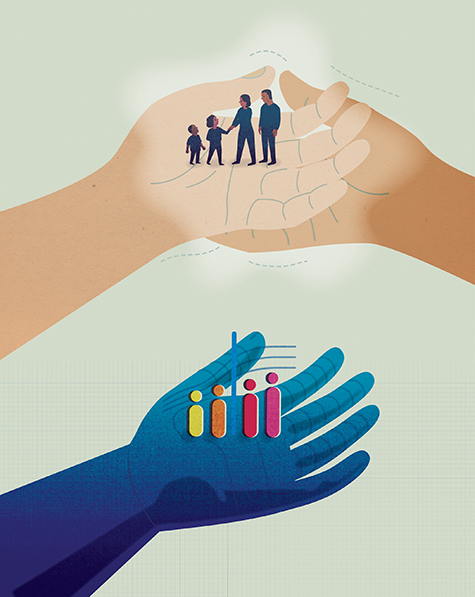
Artificial intelligence is rapidly transforming healthcare. From predictive analytics and clinical decision support to administrative automation and virtual assistants, AI promises to reshape how care is delivered, experienced and organized. This transformation presents both opportunities and challenges for Catholic healthcare to practice the healing ministry.
This past spring, the Center for Theology and Ethics in Catholic Health hosted a two-day conference at Boston College, "Artificial Intelligence, Authentic Mercy: Navigating AI Ethics in Catholic Health," gathering leaders from theology and ethics, healthcare, the Church and the AI industry. Insights from the conference revealed significant implications for organizational AI ethics in Catholic healthcare.
The role of AI adoption and use in Catholic healthcare must be approached as an organizational ethics issue. Organizational ethics "deals with value-related issues concerning an organization in the broadest sense: mission, vision, sponsorship, governance and leadership."1 Organizational ethics is principally concerned with the ethical quality of an organization's structure and culture, which are often reflected in organizational charts, position descriptions, policies and formation programs.2
To guide its practice effectively, ethical norms for the use of AI in Catholic health must be embedded in organizational structures, culture and interdisciplinary discernment.
TECHNO-OPTIMISM AND HEALTHCARE
Influential and powerful industry and thought leaders hold a stridently optimistic, and even utopian, outlook regarding the future of AI in healthcare. Elon Musk claims that by 2030, "there will probably be more Optimus robots [Tesla's AI-powered robot] that are great surgeons than there are all surgeons on earth."3 Bill Gates predicts that by 2035, human physicians will not be needed due to AI. Gates argues that the globe needs AI physicians to solve the ongoing shortage of healthcare professionals.4 Futurist Ray Kurzweil predicts that human beings may soon reach longevity "escape velocity," a point at which medical advances outpace aging itself. In such a world, death would become optional rather than inevitable. AI-directed nanobots operating within the human body would prevent decline.5
These predictions and their techno-optimism belie a particular vision of medicine's ends and nature. In this vision, technology is the solution to all societal problems. The current issues in healthcare are technical problems requiring technical solutions. Further, this vision understands the body as a machine and medical professionals as its technicians. The patient-as-person recedes from view, leaving only manipulable flesh and bone. This vision must be interrogated in light of the core commitments of Catholic healthcare.
THE CATHOLIC VISION OF HEALTHCARE
The late Catholic physician-ethicist Edmund Pellegrino argued that the end (or goal) of healthcare is the patient's good. The good produced in healthcare, as in education, resides in the person who is served and enabled to flourish, not in any external product, such as profit. Pellegrino distinguished between models of medicine that reduce the physician to a "body mechanic" and those that understand the physician as a healer and helper. Because healing emerges from a relationship between the healer and the patient, "The central feature of healthcare is the personal relationship between a health professional and a person seeking help."6
Further, healing is not mere curing but restoration to wholeness. Although healing is principally directed toward a patient's physical and psychological wholeness, it opens possibilities for social and spiritual well-being. This vision of healing as wholeness enabled by the provider-patient relationship is affirmed by Catholic healthcare because it reflects Jesus' healing ministry.
Consider Jesus' healing of the man with leprosy in Mark's Gospel (Mark 1:40-45). Upon seeing Jesus, the man kneels and begs to be made "clean." Jesus touches and cures him of his affliction. Persons with leprosy were rarely, if ever, touched in the ancient world, so Jesus' touch both mediates a relationship between the healer and the healed and reintegrates the man into the community. Jesus then tells the man to show himself to the priests but to say nothing to others. Overcome with joy, the man becomes one of the first evangelizers in the Gospels, publicizing his healing at Jesus' hands, so that "people kept coming to him from everywhere."
The man is not only cured of his leprosy, but he is also restored to the community, and his faith is cultivated. The healing encounter touches his whole person, not merely his body. Jesus' healings open opportunities for the marginalized to flourish. Note that throughout his ministry, Jesus heals those who are at the margins of society: those who are blind, deaf, mute, paralyzed and suffering with leprosy and hemorrhage. These are the ancient world's untouchables, whose health conditions serve as markers of social exclusion.
Jesus invites his followers into his healing ministry. In Luke's Gospel, Jesus tells his disciples that when they enter a town, they should "cure the sick in it and say to them, 'The Kingdom of God is at hand for you'" (Luke 10:9). Jesus invites his followers to proclaim the Kingdom by healing the sick. Catholic healthcare, then, is not only a humanitarian enterprise. It is a sign that God loves all persons, and in a special way, those who are poor, sick, disabled, depressed, blind and deaf. It is not merely a provider of services but a ministry that is a public, organized expression of the Church's commitment to care for the sick and suffering.
The invitation to heal involves healing in a particular way — mercifully. Note that after the man with leprosy begs Jesus for healing, Jesus was "Moved with pity, he stretched out his hand, touched him, and said to him, 'I do will it. Be made clean'" (Mark 1:41). In the original Greek, splagchnizomai (translated as pity or compassion) connotes a deeply visceral, emotional response to human suffering. Thus, Jesus' response to this man involves both compassion and a work of mercy. He has an internal reaction to his suffering and an external response to heal the man. This dual response is the essence of the virtue of mercy, which involves suffering with the other and healing him of his affliction.
This brief study shows that Jesus' healing ministry — and by extension, Catholic healthcare — has a unique goal, a clear rationale, a commitment to particular persons, and a specific manner of pursuing that goal. First, the goal of healing is the person's physical, emotional and spiritual well-being. Second, this work is undertaken to give witness to God's universal love and the coming of God's Kingdom. Third, the healing ministry is oriented toward particular persons: the sick, with a preferential concern for those who are marginalized, vulnerable or excluded. Finally, it prescribes that care should be a work of mercy, in which caregivers do not remain distant from those who suffer, but enter into the suffering of the other, accompanying patients in their time of distress.
These four marks must continue to guide Catholic healthcare and must inform the adoption and use of AI in the ministry.
EMERGING AI NORMS IN CATHOLIC HEALTHCARE
The following norms emerge from this understanding of Catholic healthcare's healing ministry and its core values and virtues. In addition, these are the specifications of AI norms contained in various Vatican-issued documents, including Antiqua et Nova ("Ancient and New"). These norms reflect an emerging consensus about the ethical development, adoption and use of AI in Catholic healthcare:7
- AI must promote patient well-being and whole-person flourishing.
- AI must enhance, not erode, the quality of the patient-provider relationship.
- AI should expand access to care, especially for those who lack it.
- AI must be actively monitored to reduce bias and prevent the widening of healthcare inequalities.
- Human decision-makers must remain responsible and accountable for all healthcare actions. Healthcare professionals should not delegate moral responsibility to algorithms.
- AI use should promote the well-being of healthcare professionals, administrators and staff, respecting the dignity of their work.
- The environmental impact of AI should be acknowledged and mitigated.
These norms provide important but necessarily general guidance. Because AI technologies are evolving rapidly, ethical discernment must be ongoing and context-dependent. Decisions about AI adoption should involve interdisciplinary discernment. Clinicians, ethicists, administrators, technologists and patient advocates each bring perspectives essential to good discernment. None of these groups can discern well in isolation from the others. In addition, leaders must not reduce ethical reflection on AI to legal compliance. Instead, it should engage the deeper theological and ethical goods at stake in Catholic healthcare.
INSTITUTING ETHICAL NORMS
Catholic healthcare leaders should integrate the norms into the structures and cultures of each Catholic healthcare organization.
A structure is a web of relations among social positions.8 For example, a Catholic healthcare organization is structured through the relations among its sponsors, CEO, chief financial officer, VP of mission, the board of directors, physicians, nurses, custodians and other support staff. Performance expectations define each position. Physicians are charged with providing medically indicated, beneficial treatment to patients, while CFOs are charged with monitoring and enhancing the organization's financial health. Catholic health ministries should be structured to enable and reward physicians who provide excellent patient care and to constrain and penalize those who practice below the standards of care. Thus, we find that a hospital is more than a mere collection of individuals. Instead, it is a highly structured organization that presents position-holders with enablements and rewards, as well as constraints and penalties, on their actions. Therefore, it matters a great deal what the organization enables, rewards, constrains and penalizes, as employees tend to pursue rewards and avoid penalties.
Personifying AI blurs the distinction between person and machine and creates the false impression that the AI's output reflects a reasoned judgment or emotional response deserving the same respect as a human being's.
An essential tool for operationalizing the previously mentioned norms (or any norms the organization values) is to have them represented in the annual performance goals and compensation review of the position-holder. For example, if a hospital CEO knows that their performance will be evaluated by the board based on the patient's AI-related experience in the clinical setting, the CEO is highly motivated (and likely) to direct the chief information officer, chief medical officer and others to monitor patient satisfaction reports with AI in their care. Likewise, if the CEO's annual review includes a goal of increasing clinicians' job satisfaction, the CEO will direct others to evaluate each AI tool, considering its expected effects on clinicians before adoption. Ethical norms that are not embedded in position descriptions and performance goals are largely impotent.
Culture also plays an important role in shaping how ethical values and norms affect the well-being of patients and healthcare professionals. A healthcare organization's culture contains the ideas and values that it endorses and enforces.9 For instance, in accordance with human dignity, every Catholic system affirms racial equality. Because these systems endorse this belief, they also enforce it. Therefore, healthcare organizations penalize (often firing) employees who utter racist comments.
Language plays a significant role in shaping culture and actions. Personifying language gives the impression that AI is a person with agency, decision-making capacity, moral responsibility and emotional responses. As Antiqua et Nova affirms, AI applications are not persons.10 Such tools do not think, reflect, decide, feel or care. They cannot love or experience empathy. For these reasons, Catholic healthcare organizations should create a culture that discourages the personification of AI. Personifying AI blurs the distinction between person and machine and creates the false impression that the AI's output reflects a reasoned judgment or emotional response deserving the same respect as a human being's.
Formation programs are key to fostering a healthy AI culture. Such programs should, for example, discourage position-holders in Catholic health ministries from using personal pronouns (for example, he or she) when discussing an AI or its outputs, and referring to AI as possessing or enacting moral traits, such as empathy. Patients should always know they are interacting with an AI and not a human person. If a developer gives a human name to an AI, it is prudent to add "AI" to the end to prevent clinicians or patients from viewing it as a person.
PROMOTING HUMAN FLOURISHING IN THE AI AGE
The task before leaders in Catholic health is to create organizational structures and culture that enable clinicians and administrators to adopt, use and evaluate AI based on the healing and flourishing of patients, the well-being of healthcare professionals, and the witnessing to God's love for all persons, especially those who are sick and poor.
In the end, the test for each AI tool is whether it enables Catholic healthcare ministries to "cure the sick … and say to them, 'The Kingdom of God is at hand for you.'"
DANIEL J. DALY is the founding executive director of the Center for Theology and Ethics in Catholic Health. He is also an associate professor of moral theology at Boston College's Clough School of Theology and Ministry.
Listen and view the LinkedIn Live recording in YouTube: Catholic Healthcare and Artificial Intelligence: A Health Progress AI Week Event
NOTES
- Fr. Gerard Magill and Lawrence Prybill, "Guidelines for Organizational Ethics," Health Progress 82, no. 4 (2001): 12-14.
- Daniel J. Daly, "The Virtuous Hospital: A Catholic Organizational Healthcare Ethics," The Journal of Healthcare Ethics and Administration 8, no. 2 (2022): https://doi.org/10.22461/jhea.1.71635.
- Orianna Rosa Royle, "Elon Musk Shares 4 Bold Predictions for the Future of Work: Robot Surgeons in 3 Years, Immortality, and No Need for Retirement Savings," Fortune, January 13, 2026, https://fortune.com/2026/01/13/elon-musk-future-of-work-predictions-retirement-lifespan-robot-surgeons/.
- Lee Chong Ming, "Bill Gates Says AI Can Help Solve Worker Shortages in 2 Surprising Professions," Business Insider, April 16, 2025, https://www.businessinsider.com/bill-gates-ai-job-shortages-doctors-teachers-work-free-time-2025-4.
- Ray Kurzweil, The Singularity Is Nearer: When We Merge with AI (Penguin, 2024).
- Edmund Pellegrino, "The Commodification of Medical and Health Care: The Moral Consequences of a Paradigm Shift from a Professional to a Market Ethic," in Pellegrino's Clinical Bioethics: A Compendium, eds. G. Kevin Donovan, David G. Miller, and Claudia Ruiz Sotomayor (Catholic University of America Press, 2025).
- Daniel J. Daly, "Statement from the 'Artificial Intelligence, Authentic Mercy: Navigating AI Ethics in Catholic Health,' Conference–March 21, 2026," Center for Theology and Ethics in Catholic Health, https://site.chausa.org/docs/default-source/ctech/ctech-conference-statement-with-signatures-3-25-final.pdf.
- Douglas Porpora, "Who is Responsible? Critical Realism, Market Harms, and Collective Responsibility," in Distant Markets, Distant Harms: Economic Complicity and Christian Ethics, ed. Daniel K. Finn (Oxford University Press, 2014), 3-24.
- Dave Elder-Vass, The Reality of Social Construction (Cambridge University Press, 2012), 44.
- Dicastery for the Doctrine of the Faith and Dicastery for Culture and Education, "Antiqua et Nova: Note on the Relationship Between Artificial Intelligence and Human Intelligence," The Holy See, section 59, January 28, 2025, https://www.vatican.va/roman_curia/congregations/cfaith/documents/rc_ddf_doc_20250128_antiqua-et-nova_en.html.