

I recently overheard a concerning conversation between two people who disagreed over a news story. Their arguments were valid. They passionately represented differing perspectives. But as their dialogue shifted into debate, curiosity disappeared. They were no longer listening. In that moment, they forgot their relationship was one of deep, personal knowing, and instead, invisible lines were drawn — each assigning a partisan label to the other. Walls rose quickly. Fellowship felt impossible.
In today's politically supercharged society, I imagine this scenario resonates with you. Perhaps you have been an observer. Or perhaps you've found yourself in a similar situation with someone who didn't see the issue the way you did. Chats like these between two people, each bringing their unique experiences and opinions, can quickly become a three-way fork in the road.
One option is to maintain a posture of open dialogue, attempting to see and hear the other, uncovering points of connection and humanity in the exchange, and at best, strengthening the relationship. Another option is to masquerade as a present listener — appearing open while quietly withdrawing one's receptivity to the other's humanity. A third option is to walk away, sometimes physically, or often, locating the nearest conversational off-ramp to slough off the other's vantage point. In moments like these, disagreement itself is not the crisis; the loss of human dignity is. There is a thin line between disagreement and depersonalization.
As leaders, we know mission statements uplift our commitment to human dignity, and our values guide us on how it must look. We follow the way of Jesus and the founders of Catholic healthcare organizations to serve in love as good neighbors. In doing so, we represent the Church's ministry through compassion and community.
But the inward work of honoring human dignity as ministry leaders begins within. How we show up before the "other" has a profound impact on our teams, our ministries, the Church and society. Knowing who we are — not merely what we believe — has the power to transform how we honor human dignity.
TUNING OURSELVES TO RESONANCE
Shortly after witnessing the conflicted conversation, I encountered a life-altering baccalaureate service speech delivered in 1980 by theologian and civil rights activist Howard Thurman at Spelman College. Entitled "The Sound of the Genuine," Thurman's charge to students, during the rumble of their lives, was to be still long enough to hear the genuine within themselves: "There is in every person, something that waits and listens for the sound of the genuine in herself. … Nobody like you has ever been born. … And no one like you would ever be born again."1 According to Thurman, knowing one's unique life as a gift to the world is a treasure that takes slowing down to discover.
In an age of polarization, Thurman, who was a spiritual mentor to Rev. Martin Luther King Jr., offers a spiritual antidote rooted not in strategy, but in human dignity:
"Now if I hear the sound of the genuine in me, and you hear the sound of the genuine in you, it is possible then for me to go down in me, and come up in you. So that when I look at myself through your eyes, having made that pilgrimage, I see in me what you see in me. And the wall that separates and divides will disappear. And we will become one, because the sound of the genuine makes the same music."
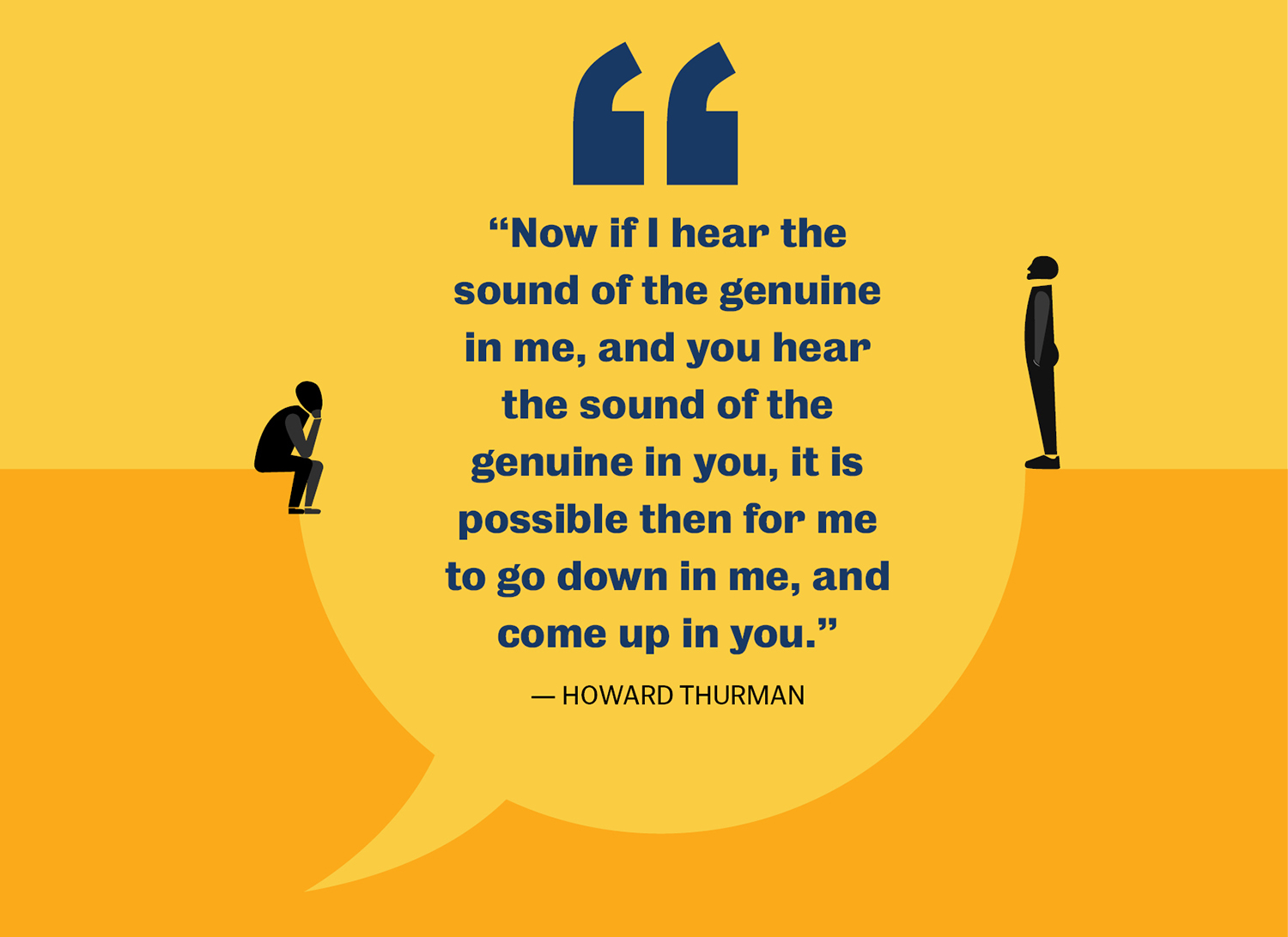
In conflict, we forget that we carry the Divine spark within us. And we certainly forget the Divine spark of the "other." This inner remembrance matters, for it changes the atmosphere into one in which God is still present. I wonder what it might have been like if Thurman's words were spoken over my two friends. I wonder what might have shifted if his words had framed that moment — if curiosity had replaced defensiveness, if voices had lowered, if love had remained possible.
THE COURAGE TO LISTEN
Living, and for some, leading, in a way of love rooted in nonviolence, peace and a neighbor-first attitude requires personal sacrifice. Through Thurman's mentorship, King embodied this kind of living and leading. The world yearns for leaders who know the sound of the genuine within themselves and are willing to listen for it in the lives of others — neighbors, patients, co-workers and family members. Polarization and partisanship muffle the sound of the genuine; they reward self-protection and normalize walls that divide.
May we, as leaders and neighbors, resist the noise long enough to listen — and have the courage to lead others to do the same. May we relentlessly pursue mentors, thinkers and theologians who will call us to listen, especially to the sound of the genuine. I am convinced this is the courageous, prophetic leadership most needed now. May we slow down long enough to hear.
JILL FISK, MATM, is director, mission services, for the Catholic Health Association, St. Louis.
NOTE
- "The Sound of the Genuine (Baccalaureate Ceremony) (Spelman College), 1980 May 4," The Howard Thurman Digital Archive, https://thurman.pitts.emory.edu/items/show/838.