

In exam rooms across the country, something subtle but significant is changing.
At FMOL Health, that change is already taking shape. Clinicians are beginning to practice in a different way, less focused on screens, more focused on patients, while documentation happens in the background.
Ambient listening, a tool that uses artificial intelligence to securely listen to clinical conversations and generate structured medical notes, is helping make that shift possible.
But the experience of implementing this technology has underscored something broader: Adopting AI in healthcare is not primarily a technical challenge. It is an organizational one that requires clarity of purpose, trust and sustained attention to how care is delivered.
STARTING WITH A REAL PROBLEM
Like many health systems, FMOL Health began exploring ambient AI in 2024 in response to a familiar challenge: the growing burden of clinical documentation and the possibility that emerging technology could meaningfully address it. The Baton Rouge-based health system provides care in Louisiana and Mississippi.
Our early efforts focused on ambulatory settings, including internal medicine and family medicine, where documentation demands are especially high. Over time, use has expanded into specialty areas and emergency departments, with additional pilots beginning in nursing.
Today, nearly 400 clinicians across our system are actively using one of two approved ambient listening tools. These tools are primarily used to generate encounter notes, with providers reviewing and approving all documentation before it becomes part of the medical record.
For providers who use this technology consistently, and in most encounters, the impact has been measurable. Research by an independent third party that included data from FMOL and two other health systems revealed that clinicians spent less time on charting, particularly outside of scheduled clinic hours.1
RECENTERING THE PATIENT VISIT
While reducing documentation burden was the initial goal of using ambient listening, one of the most meaningful outcomes has been a shift in the clinical encounter itself, with the average time to close an encounter note significantly reduced.
As documentation becomes less intrusive, providers can be more present. Patients notice the difference.
Across FMOL Health, patient satisfaction has improved as clinicians spend less time divided between the patient and the computer, and more time engaged in the moment.2 The technology, in effect, is helping restore something foundational in healthcare: human connection.
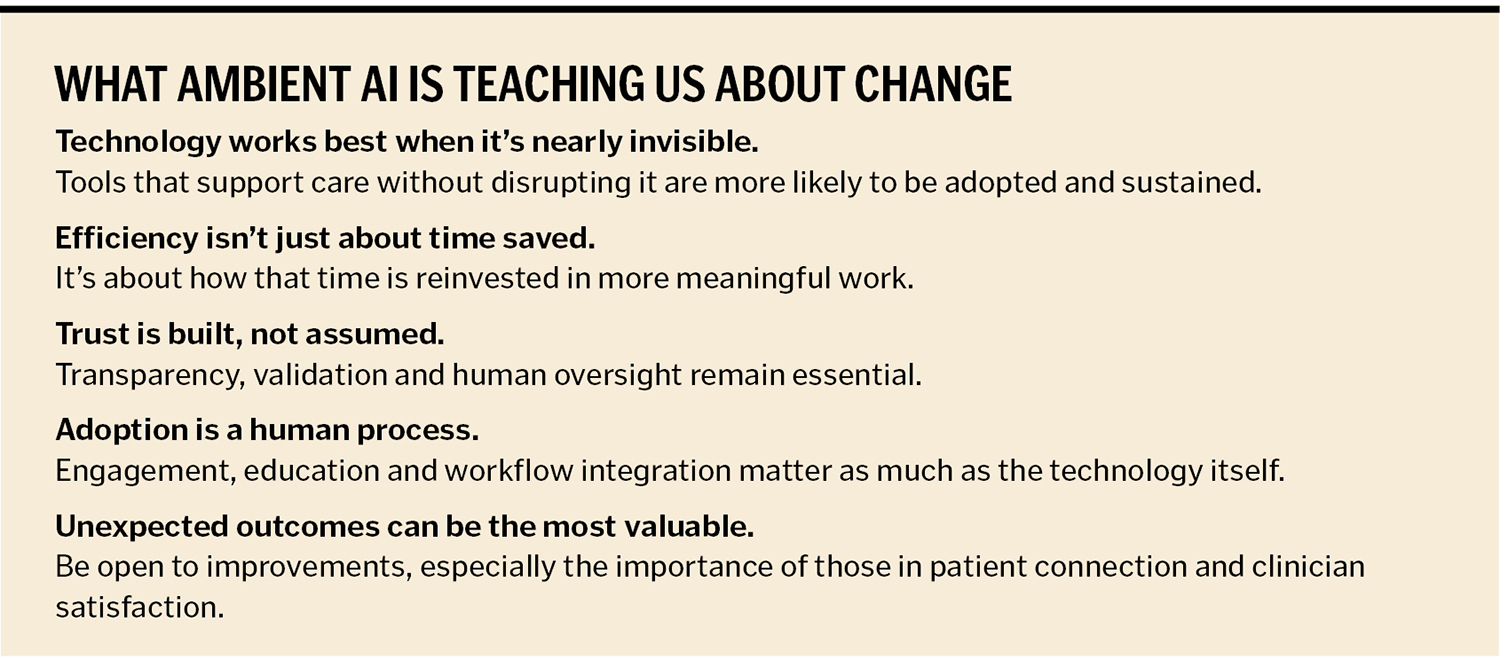
In this way, ambient AI is doing more than improving efficiency. It is reshaping the experience of care, placing the relationship at its center once again.
RETHINKING EFFICIENCY
One of the assumptions often tied to new technology is that it will reduce the time spent working. In practice, the impact has been more nuanced.
At FMOL Health, some clinicians are spending less time on after-hours documentation. Others are using that time differently, shifting from catching up on previous notes to preparing for upcoming visits.
This kind of previsit planning can be more purposeful and professionally rewarding. It reflects an important insight: Addressing burnout is not only about reducing time spent working, but about improving how that time is used.
Ambient AI, in this context, is not simply making work faster; it is helping make work more meaningful by allowing greater focus on the patient and less time on clerical documentation.
FROM PILOT TO PRACTICE
While ambient AI technology may be advanced, successful implementation depends on very human factors.
At FMOL Health, the approach has emphasized careful piloting, clinician engagement and ongoing evaluation. Starting in targeted settings allowed teams to refine workflows, identify challenges and build confidence before expanding adoption.
There was some initial hesitancy among providers, which was an expected response to any meaningful change in clinical practice. Over time, as clinicians experienced the benefits firsthand, engagement has grown and adoption has followed.
Education has been central to that process. Digital health and electronic medical record teams support clinicians with training on how to incorporate changes into workflows, verify accuracy and communicate with patients about the role of AI in their care.
This "human-in-the-loop" model reinforces that AI is an assistive tool, not a replacement, for clinical judgment. It further reduces the risk of language inaccuracies or transcription errors through human-led review and approval.
BUILDING THE CONDITIONS FOR TRUST
As with any use of AI in healthcare, questions of privacy, accuracy and governance are critical.
Patients may not always be aware that ambient tools are being used unless clinicians explain them. Clear, simple communication — what the technology does, how information is used and how it is protected — helps build confidence.
Internally, FMOL Health has implemented review processes and guidelines to support appropriate use. These structures are not barriers to innovation; they allow it to scale responsibly. Governance includes a technical AI committee within Information Services (IS), reporting through IS Steering, and an AI ethics group reporting to the health system's Ethics Committee.
This approach also reflects a broader commitment grounded in Catholic healthcare: New technologies should be introduced thoughtfully, in alignment with our mission team, and with careful consideration of their impact on both patients and those who provide care.
LOOKING AHEAD
Ambient listening technology is one of the more immediate and practical applications of AI in clinical care. But the lessons emerging from its implementation extend beyond documentation.
At FMOL Health, early results, including strong clinician adoption, improved patient experience and a positive return on investment, suggest that success is not driven by the technology alone, but by how it is introduced and supported.
As healthcare continues to evolve, the question is not simply which technologies to adopt, but how to integrate them to strengthen the human experience of care.
In that sense, implementing ambient AI is not just about improving documentation. It is part of a broader effort to ensure that, even as technology advances, the focus of care remains exactly where it belongs: on the patient.
WILL LANDRY focuses on healthcare information systems, technology and innovation at FMOL Health. He leads the health system's shift toward cloud-based platforms, automation and virtualization.
NOTES
- "Suki ROI Validations 2026," KLAS, January 22, 2026, https://klasresearch.com/report/suki-roi-validations-2026-cross-organizational-results-from-suki-s-clinical-intelligence-platform/3869; "Transforming Clinical Workflows: How Franciscan Missionaries of Our Lady Health System is Partnering With Suki to Reduce Burnout," Suki, August 12, 2025, https://www.suki.ai/blog/transforming-clinical-workflows-how-franciscan-missionaries-of-our-lady-health-system-is-partnering-with-suki-to-reduce-burnout/.
- "Suki ROI Validations 2026."
QUESTIONS FOR DISCUSSION
Will Landry, FMOL Health's senior vice president and chief information officer, describes a process many health systems are undergoing: transitioning to greater use of artificial intelligence in their facilities.
- How are you already using AI in your workplace? What are your hopes for it? What are your concerns? Are you finding that it eliminates some administrative tasks? Is it playing a much larger role, analyzing population health matters, or helping with community benefit analysis?
- How has your work environment introduced and explained its use of AI? Is it being used in operations, research, patient care or other aspects of your work? What is an appropriate use for it?
What should never be delegated to AI? - Managing the rate of change can be challenging in an organization. What do you think of the suggestions Landry provides for this?
- A central tenet of Catholic social teaching is the dignity of the human person. As healthcare organizations implement AI into patient care in order to maximize efficiency and reduce the burden on providers, what can be done to ensure that the human connection remains at the center of all interactions and relationships?