
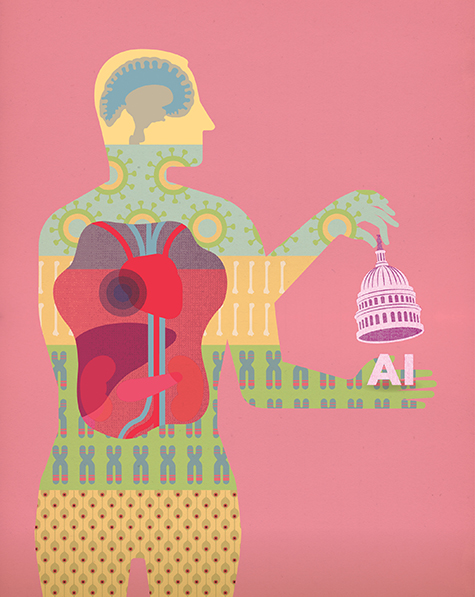
Artificial intelligence is rapidly changing how healthcare is experienced and delivered. The Catholic health ministry is using AI tools in countless ways to improve care, from radiology and imaging to precision medicine to surgeon-controlled AI-assisted robotics. Research is even underway to develop and test fully autonomous AI robots that can perform surgery with minimal or no spoken guidance from a human surgeon.1
While AI use in healthcare offers great advances in diagnosis, treatment and patient engagement for patients, it also poses significant ethical challenges, as illustrated by the prospect of operations conducted without a human surgeon. Overreliance on AI risks eroding both the physician's skills and the patient-doctor relationship. If clinicians increasingly cede functions to AI, how will they, through experience, gain the judgment and skills they need to care for their patients?
The ability of AI to gather and analyze data at scales and speeds far beyond human capacity, based upon complex algorithms, means that doctors may not be able to fully explain recommended treatments. It also means that such systems can produce biased or discriminatory outcomes because of inadequate databases or algorithmic assumptions. This lack of transparency can erode trust, which is fundamental to the patient-provider relationship, and raises questions about accountability and liability. When something goes wrong, does responsibility lie with the clinician or hospital that used the AI tool, or with the developers who designed it?
These are just some of the challenges the accelerating use of AI in healthcare is raising. How can we best respond?
MONITORING AND EVALUATION
To address unanswered questions around AI's use in healthcare, it is important to first come to agreement around ethical principles. Many different organizations and associations have developed principles for the ethical use of AI, including the Vatican. In 2020, the Pontifical Academy for Life organized a conference on AI that culminated in the Rome Call for AI Ethics with Microsoft, IBM, and representatives of the United Nations, the Italian government and the European Parliament. Dozens of additional private and public sector organizations have since signed on, including Catholic health systems. The document promotes principles for the ethical use of AI: transparency, inclusion, accountability, impartiality, reliability, and security and privacy.2
Both the late Pope Francis and Pope Leo XIV have been outspoken on the need for ethical, human-centered AI practices. During Pope Francis' pontificate, the Vatican issued "Antiqua et Nova ("Ancient and New"): Note on the Relationship Between Artificial Intelligence and Human Intelligence," and Pope Leo's first encyclical is focused on AI. Closer to home, this past spring, the Center for Theology and Ethics in Catholic Health issued a statement following its conference on AI ethics and Catholic healthcare, articulating seven ethical norms for the use of AI in the Catholic health ministry.3
Second, hospitals and health systems should have internal processes to evaluate which AI tools to use, how to use them, and how to monitor their effects over time. The president of a large public health system was recently quoted as saying that, once the regulatory landscape allows it, he's ready to replace radiologists with AI in some circumstances, allowing AI to read images on its own, with human doctors only offering "second opinions" if abnormalities are detected.4 Would this be appropriate in Catholic healthcare?
Some Catholic health systems have already established internal controls. CommonSpirit Health has a multidisciplinary Enterprise Data and AI Governance committee to evaluate the ethics, data, algorithm and governance implications of AI tools. With more than 240 AI applications across the system,5 the committee has recently gone from biweekly to weekly meetings.6 At Providence, they have two work groups for AI oversight and governance. A clinical AI work group appraises and provides feedback on clinical AI tools. The Enterprise AI Guardrails Work Group evaluates the safety, equity, legal, ethical and privacy implications of AI tools.7
There have also been attempts to establish voluntary, industrywide self-governance standards for AI in healthcare. An early effort was the Consumer Technology Association's 2021 release of its ANSI/CTA-2090 standard, The Use of Artificial Intelligence in Health Care: Trustworthiness. Another example is the Trustworthy and Responsible AI Network, launched in 2024 by more than a dozen health systems in collaboration with Microsoft.
Founded in 2022, the nonprofit Coalition for Health AI (CHAI) brings healthcare organizations, tech companies, clinicians and other stakeholders together to develop guidelines for the safe, effective, responsible and innovative development and use of AI in healthcare. In 2025, CHAI partnered with the Joint Commission on an initiative to develop AI playbooks, tools and a certification program based on evidence- and consensus-based best practices for health AI. CHAI initially worked closely with the federal government during former President Joe Biden's administration in an attempt at a public-private partnership, but the relationship ended under President Donald Trump's administration, with an emphasis on deregulation, competitiveness and innovation.
REGULATING AI
What should the government's role be in overseeing AI in healthcare? Existing federal health regulations already apply to AI in several ways. The Food and Drug Administration (FDA) is the most actively involved agency. The agency regulates medical devices across their lifecycle, including those using AI. As of the end of 2025, the FDA had approved more than 1,400 devices using AI, with radiology accounting for three-quarters of all approvals.8 So far, no generative AI device has been approved by the FDA, but one is under consideration: a virtual care chatbot to monitor and assist patients after joint replacement surgery.9 Because generative AI can "learn" and change over time and, depending on how a question is asked, provide different answers, it will be a challenge for the FDA to apply its usual standards, and the outcome of its review could set important industry precedents.
Hospitals and health systems should have internal processes to evaluate which AI tools to use, how to use them, and how to monitor their effects over time.
At the U.S. Department of Health and Human Services, the Office of the National Coordinator for Health Information Technology (ONC), the Office for Civil Rights (OCR), and the Centers for Medicare and Medicaid Services (CMS) all play policy roles with respect to AI in healthcare.
ONC oversees national policy on the development and use of health IT and electronic health records, and the interoperability of health IT for data sharing. ONC gets involved in regulating AI applications when they provide algorithm-based decision support within health IT systems.
OCR is responsible for nondiscrimination and patient privacy laws. The office issued regulations in 2024 that applied the Affordable Care Act's nondiscrimination requirements to health entities' use of clinical algorithms and AI tools. OCR also enforces the Health Insurance Portability and Accountability Act (HIPAA), which applies to AI tools that interact with protected health information when used by health providers, plans or AI vendors.
Finally, CMS determines which treatments Medicare and Medicaid will cover and reimburse, decisions that can influence what kinds of AI tools are developed and used not just in those programs but also in private-sector coverage as well. As of January 2026, CMS had approved 26 AI codes for clinical services, 23 of which were temporary new technology codes.
CMS has a Medicare pilot program to reward health outcomes in patients with chronic conditions, which encourages participants to use technology solutions such as AI diagnostics, biomarker monitoring devices and software that streamlines key workflows. It has another voluntary pilot to experiment with the use of AI to make prior authorization determinations in Medicare. CMS has not yet directly regulated or mandated the use of AI tools in care delivery, but could do so in the future, for example, by amending the hospital conditions of participation.
These examples show how existing federal policy applies to AI in an ad hoc way — there is currently no comprehensive federal AI policy that exists in healthcare or in general. And the states have stepped into the vacuum.
As AI rapidly expands, it is understandable that states are responding to the need for a regulatory structure to manage emerging risks. But if we are going to both manage risks and encourage innovation, a national approach makes more sense.
STATE GOVERNANCE OF AI
State activity escalated in 2025 and has surged this year. According to Manatt Health, in 2025, more than 250 bills on AI and healthcare were introduced across 47 states, and in just under half of those states, a total of 34 bills were signed into law.10 By the end of April 2026, the flow of legislation had already almost outpaced the 2025 total with more than 240 bills in 43 states, and seven laws enacted in seven states.11
Colorado and California have enacted the most sweeping cross-sector consumer protection laws. The Colorado statute imposes extensive requirements on developers and deployers of "high-risk" AI systems to publicly disclose information, develop risk management policies and impact assessments, and protect consumers from algorithmic discrimination.12 The California law targets very large entities with revenues over $500 million that develop highly complex AI "frontier models" — the most advanced, large-scale, general-purpose AI models — and its application to healthcare is likely to be limited.
Bills specifically addressing AI in healthcare tend to have similar themes across states.
AI chatbots are a common topic, particularly concerns about preventing harmful or inaccurate responses, their use in mental health situations and their impact on minors. Legislation on clinical uses of AI has restricted its use in making therapeutic decisions, interacting directly with patients or generating treatment plans without clinician oversight, and has mandated patient disclosure and consent when AI is used in their care. States continue to be concerned about payers' use of AI to make medical necessity or prior authorization determinations.13
While states are seeking to regulate AI, some are also encouraging innovation by establishing "sandboxes," environments where developers can experiment with and test various AI models and machine learning algorithms. Three states — Utah, Texas and Delaware — now have laws creating programs to exempt participants in regulatory sandboxes from legal and regulatory requirements that would otherwise apply and could stifle innovation. Four more states have introduced sandbox legislation so far this year.14
As AI rapidly expands, it is understandable that states are responding to the need for a regulatory structure to manage emerging risks. But if we are going to both manage risks and encourage innovation, a national approach makes more sense. Some in Congress have called for, but not passed, a federal preemption law, and President Trump issued an executive order directing federal agencies to find ways to challenge state regulation. However, until federal policymakers can develop and pass legislation, simply preempting state laws leaves patients and consumers without protection.
There are signs of hope in Washington, D.C. In March, the White House released its National Policy Framework for Artificial Intelligence with recommendations for Congress on which issues warrant federal oversight and which should be left to the states. On June 2, President Trump signed an executive order focusing on cybersecurity concerns, directing federal officials to work with developers to create a voluntary clearinghouse to assess AI model vulnerabilities and to establish a classified process for prerelease review of certain new frontier models.15
In Congress, Sen. Marsha Blackburn, R-Tenn., released a draft bill that reflects several of the administration's priorities. Republican members of the House Committee on Energy and Commerce voted out a package of children's online safety bills, including H.R. 7757 (the KIDS, Kids Internet and Digital Safety, Act) and H.R. 6489 (the SAFE BOTs, Safeguarding Adolescents From Exploitative BOTs, Act), establishing AI chatbot guardrails for transparency and disclosure, protecting minors, and requiring chatbots to provide referral to mental health crisis resources. House Democrats have formed the Commission on AI and the Innovation Economy to work with tech leaders, stakeholders and Congressional committees of jurisdiction to develop national policy proposals across a range of sectors, including healthcare.
Ten years ago, AI was practically science fiction. Today, it is omnipresent, touching most aspects of our lives. It offers great promise to expand access to healthcare, accelerate cures, resolve health disparities and manage disease. But we must also identify and mitigate its potential harms.
A CALL TO LEAD
Ten years ago, AI was practically science fiction. Today, it is omnipresent, touching most aspects of our lives. It offers great promise to expand access to healthcare, accelerate cures, resolve health disparities and manage disease. But we must also identify and mitigate its potential harms. To do that will take the efforts of developers, clinicians, healthcare organizations and government at the state and federal levels. We need adequate government regulation, but to get the policy right, we must get the principles right, not just the tech. That's where Catholic healthcare can be a leader, by articulating principles grounded in human dignity and a true anthropology of the person, developing governance structures, deploying person-centered use cases, and advocating for policies that protect patients while enabling innovation.
KATHLEEN A. CURRAN is senior director, public policy, for the Catholic Health Association, Washington, D.C.
Listen and view the LinkedIn Live recording in YouTube: Catholic Healthcare and Artificial Intelligence: A Health Progress AI Week Event
NOTES
- "AI in Hospitals: 2025 Adoption Trends & Statistics," IntuitionLabs, May 17, 2026, https://intuitionlabs.ai/articles/ai-adoption-us-hospitals-2025.
- "The Call," RenAIssance Foundation, https://www.romecall.org/the-call/.
- Daniel J. Daly, "Statement from the 'Artificial Intelligence, Authentic Mercy: Navigating AI Ethics in Catholic Health,' Conference–March 21, 2026," Center for Theology and Ethics in Catholic Health, https://site.chausa.org/docs/default-source/ctech/ctech-conference-statement-with-signatures-3-25-final.pdf.
- Marty Stempniak, "CEO of America's Largest Public Hospital System Says He's Ready to Replace Radiologists with AI," Innovate Healthcare, March 31, 2026, https://radiologybusiness.com/topics/artificial-intelligence/ceo-americas-largest-public-hospital-system-says-hes-ready-replace-radiologists-ai.
- Naomi Diaz, "CommonSpirit Expands AI to 242 Tools with Strong Governance," Becker's Hospital Review, February 5, 2026, https://www.beckershospitalreview.com/healthcare-information-technology/ai/commonspirits-ai-footprint-grows-to-242-deployments/.
- Alex Kacik, "Why AI Tests Clinician Trust—and How Providers Are Responding," Modern Healthcare, April 10, 2026, https://www.modernhealthcare.com/providers/mh-medstar-health-commonspirit-ai-oversight/.
- Sara Vaezy, "Artificial Intelligence with a Purpose at Providence," Health Progress 106, no. 4 (2025): https://www.chausa.org/news-and-publications/publications/health-progress/archives/fall-2025/artificial-intelligence-with-a-purpose-at-providence.
- "FDA's AI Medical Device List: Stats, Trends & Regulation," IntuitionLabs, March 13, 2026, https://intuitionlabs.ai/articles/fda-ai-medical-device-tracker.
- Katie Palmer, "FDA Grants 'Breakthrough' Status to Generative AI Chatbot for Surgical Patients," STAT, March 3, 2026, https://www.statnews.com/2026/03/03/fda-breakthrough-designation-generative-ai-chatbot-recovryai/.
- Randi Seigel et al., "2025 AI Policy and Health Care Priorities In Review: What Was Hot; What Was Not," Manatt, December 16, 2025, https://www.manatt.com/insights/newsletters/2025-ai-policy-and-health-care-priorities-in-review-what-was-hot-what-was-not.
- Randi Seigel et al., "Manatt Health: Health AI Policy Tracker," Manatt, April 9, 2026, https://www.manatt.com/insights/newsletters/health-highlights/manatt-health-health-ai-policy-tracker.
- The Colorado bill has been controversial. Its effective date was pushed back to June 2026 because it has been challenged in court, and lawmakers are working on a compromise version.
- Seigel et al., "Manatt Health: Health AI Policy Tracker."
- Seigel et al., "Manatt Health: Health AI Policy Tracker."
- "Executive Order 14409 of June 2, 2026, Promoting Advanced Artificial Intelligence Innovation and Security," GovInfo, June 5, 2026, https://www.govinfo.gov/content/pkg/FR-2026-06-05/pdf/2026-11415.pdf.
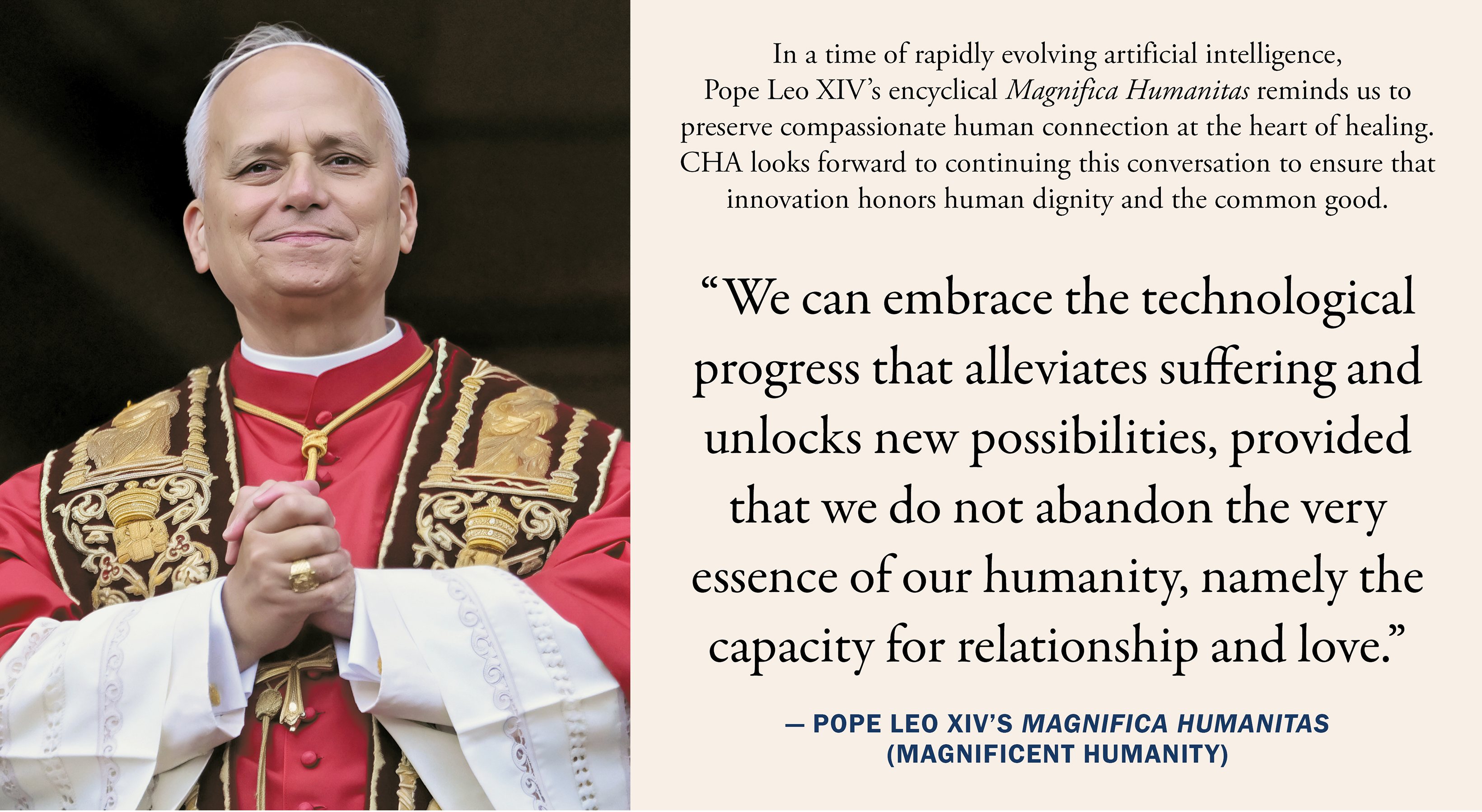
Read: Encyclical Letter of His Holiness Leo XIV - Magnifica Humanitas (15 May 2026)