
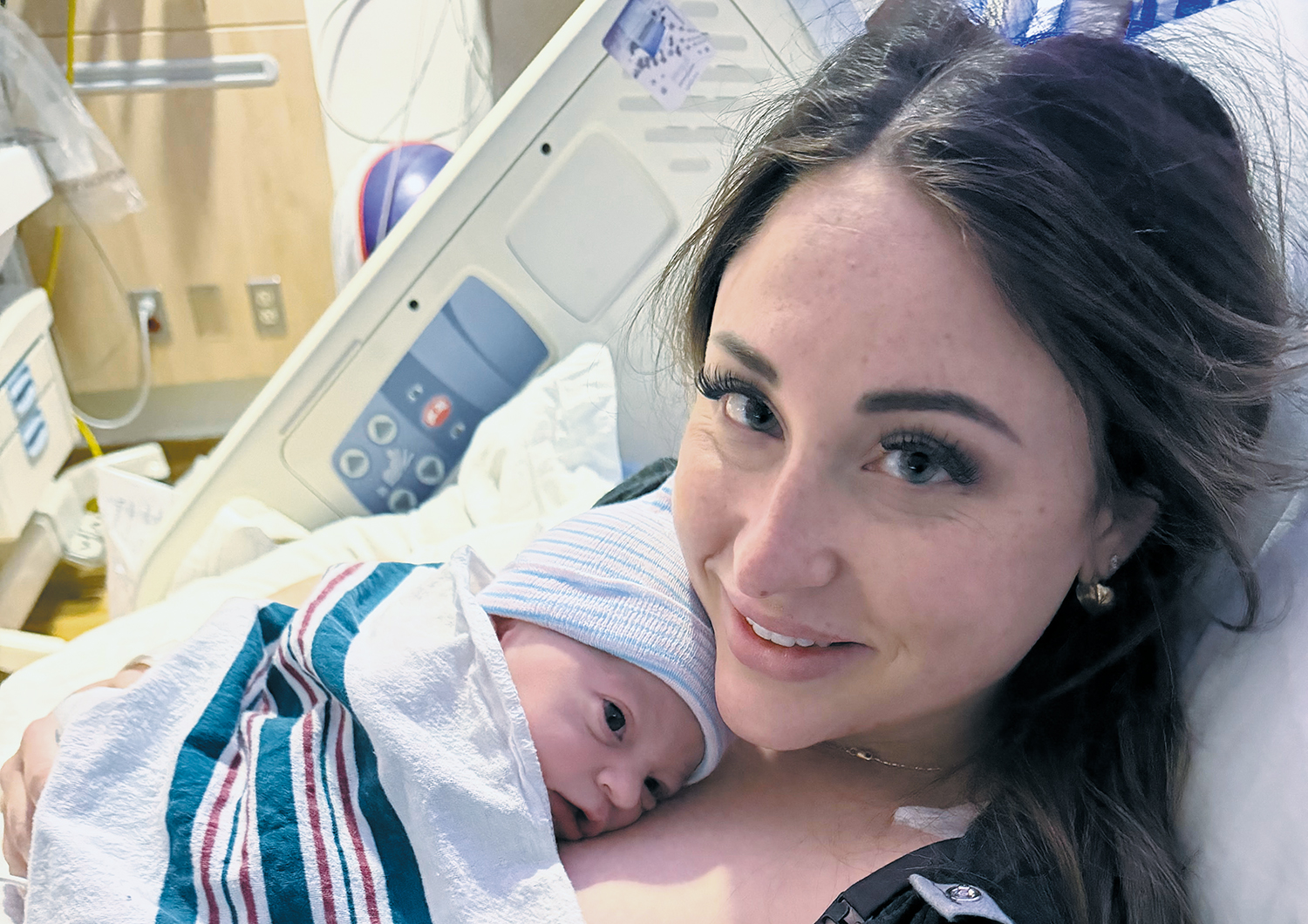
Tests showed Nolte and her husband were carriers of a gene linked to cystic fibrosis, though they don't have the disease themselves nor does anyone in their families. A test of their son, still in the womb, showed signs of the disease - the portent of a difficult future where thick, sticky mucus is prone to build up and damage the digestive system, lungs and other organs.
A possible treatment existed that could turn the negative prognosis around, but the needed insurance approval and the treatment's success were uncertain.
Fortunately for the Noltes, their medical team at CHRISTUS Children's in San Antonio delivered, in several ways. The team helped the family win insurance coverage for the in-utero treatment, a medication taken orally by Nolte, and on May 13 the team delivered Warren Joseph - 7 pounds, 5 ounces. The infant is thriving with no signs of cystic fibrosis.
Dr. Louise Giles, chief of the CHRISTUS Children's Pediatric Pulmonary Division, said Nolte is not only one of the first women to undergo the
in-utero treatment at the hospital, but also one of the few women worldwide without cystic fibrosis to undergo it. She put the number at "maybe not even two dozen," enough to give the medical team hope if not confidence in the baby's outcome.
"We had held off the worst of the disease for Warren, and I would have been cautiously optimistic that he would be doing fabulous in terms of growth and everything like that," Giles said. "I think what I was not anticipating was how well he's actually been doing."
Far from routine
Until the Noltes of New Braunfels, Texas, were both tested at 18 weeks and the signs of cystic fibrosis were spotted, Kendall's pregnancy had proceeded normally.
After the diagnosis, a cystic fibrosis specialist discussed immediate treatment with Nolte. "And that sounded really appealing to me, that there could be possibility for treatment," she said. "But then I also had other doctors telling me there's nothing you can do if he has it, so why don't you just wait until birth, to get the newborn screen, and then we'll go from there."
The CHRISTUS Children's team told Nolte about the three-drug therapy called Trikafta with the caution that not much was known about giving the drug directly to the unborn child through the placenta. "But the little research that there was was beneficial," Nolte said.
The Food and Drug Administration first approved Trikafta in 2019 for cystic fibrosis patients 12 and older. The agency has since approved it for patients 2 and older. Its use beyond that remains experimental. The medication has been proven to be highly effective but not without risks, such as liver damage, cataracts and mental health complications.
Nolte was nervous about whether to pursue the treatment. "I thought about it for two weeks during the night. I couldn't sleep. I was restless about what my choices would be. And me and my husband decided that the risk of not taking it was too high," she recalled. "So we ended up doing the treatment because it was better than to have complications at birth that would risk Warren's life."
That big decision wasn't the only hurdle Kendall faced. Four times, her health insurance rejected her efforts to get coverage for the medicine before finally relenting and ending what Giles called "a real struggle." The doctor said without the coverage, the medication could cost the family $325,000 or more every year.
As Nolte put it, to get the coverage, her medical team "fought like crazy."
The CHRISTUS Children's team began Nolte's daily Trikafta treatment at 30 weeks into her pregnancy.
When it was time for the birth, Nolte recalled in late summer, more than a dozen neonatal intensive care unit staffers were in the delivery room "just ready to jump on at any moment and do lifesaving measures."
The emergency preparations proved to be unnecessary.
"After Warren was born, we did skin to skin for an hour, stayed that night and went home the next day," Nolte said.
Months later, Nolte, a first-time mother, continues to take Trikafta as she nurses Warren. If needed, he eventually will be prescribed the medication on his own.
Good news in general
To Giles, Warren's success story is welcome news for other families facing a similar situation. "I remember as a medical student, identifying cystic fibrosis in a baby," Giles said. "There was no newborn screen at this time, and the conversation that the respirologist or the pulmonologist had with the family was just devastating in a lot of ways."
Doctors in the past would assure families they would do all they could for children born with the disease, Giles said, but still had to caution that their child might not survive to adulthood.
With Warren, Giles added, "We're learning from him as we go along. To be able to sit there and think Warren can have a totally normal life is just indescribable."
Erika Lopez, a nurse who is cystic fibrosis clinic coordinator at CHRISTUS Children's, said getting Nolte to the treatment was challenging. "There were a lot of roadblocks with insurance and what have you, and it was imperative that we get Kendall on this medication at a certain point in her pregnancy," Lopez said. "So jumping over all of those hurdles and getting her on it at the correct time was surreal. This is pretty phenomenal."
Nolte intends to help other families who face a decision like hers on whether to undergo in-utero cystic fibrosis treatment. She wants them to understand the stakes and the possible outcomes.
"I really want to be a part of the community to support other moms and potential babies that could have it," she said. "I would like to be a support and share my experience and my story to potentially persuade someone to do this treatment, because it really does save lives."
Lopez said of Nolte: "She's really the hero of this story. She took the leap of faith with us. Knowing all the side effects, knowing this or that could happen, knowing that there are so many unknowns, she still took that chance to do what she could for her baby. Thankfully he's doing amazing, she's doing amazing, and she's the hero for real - 100%!"