
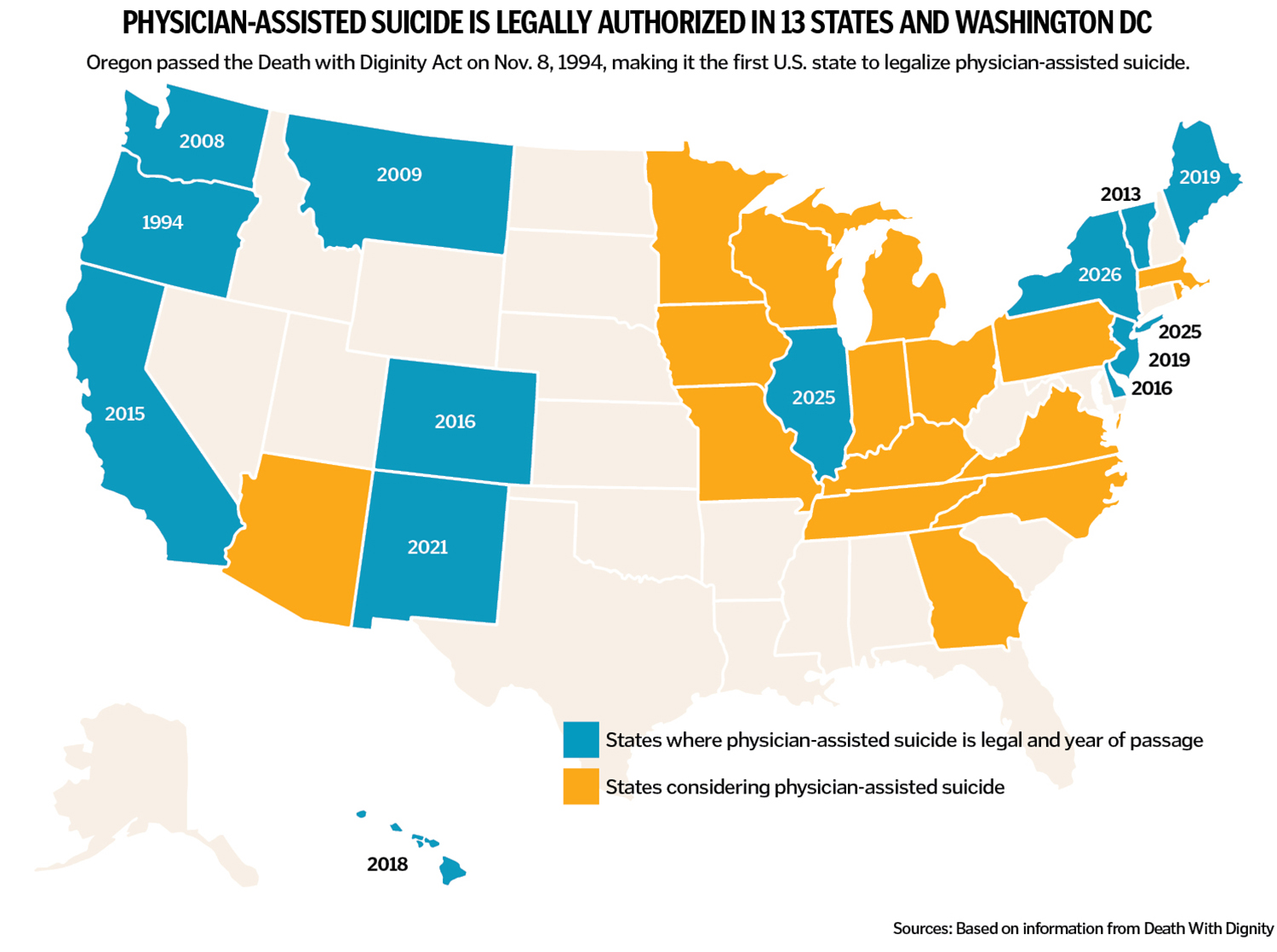
Since Oregon passed its Death With Dignity Act in 1994, a dozen states and Washington, D.C., have followed suit in legalizing physician-assisted suicide. Fourteen more states are considering legalizing the practice.
Assisted suicide proponents have a great deal of momentum, Dr. Myles Sheehan says. He is a Jesuit priest and physician who directs the Pellegrino Center for Clinical Bioethics at Georgetown University.
The nation is at a dangerous tipping point as more states pass such legislation, Dr. Daniel Sulmasy says. He is a professor of biomedical ethics and director of the Kennedy Institute of Ethics at Georgetown University.
Even in states where assisted suicide opponents have defeated legalization efforts, proponents remain relentless, continuously returning to push legislation, says Indu Spugnardi, CHA Senior Director of Community Health and Eldercare.
Experts with a range of vantage points on the topic say Catholic healthcare providers can and should respond in states where assisted suicide laws have passed and in states with pending legislation.

Persistent push
Sulmasy says much of the energy behind the push for physician-assisted suicide has come from the nonprofit Compassion & Choices. Its predecessor, the Hemlock Society, dates to 1980. The organization advocates for the legalization of assisted suicide, educates people on its supposed benefits, and helps people navigate end-of-life decisions. It is a well-funded lobbying group that has organized people to "infiltrate" state medical associations and to influence other organizations that are pivotal to gaining support for assisted suicide, Sulmasy says.
Alongside its legislative efforts, Compassion & Choices has been working to normalize assisted suicide among Americans, and the practice is gaining acceptance, says Kathy Curran, CHA Senior Director of Public Policy.
Within the last year, three states, Delaware, Illinois, and New York, have legalized assisted suicide. This summer, five Catholic organizations sued New York, saying its law would force the organizations' care facilities to assist with suicides in violation of their beliefs. Those litigants are the Dominican Sisters of Hawthorne, the Carmelite Sisters for the Aged and Infirm, the Little Sisters of the Poor, the Diocese of Rockville Centre, and Catholic Health.

CHA as a resource
The Ethical and Religious Directives for Catholic Health Care Services say, "Catholic health care institutions may never condone or participate in euthanasia or assisted suicide in any way. Dying patients who request euthanasia should instead be given loving care, psychological and spiritual support, and appropriate remedies for pain and other symptoms so that they can live with dignity until the time of natural death."
Pope Leo XIV recently spoke of the Catholic Church's perspective on the sick and dying. During a trip to France in September, the pontiff reaffirmed that people's human frailty does not diminish their dignity. He spoke at a shrine in Lourdes where the sick come for healing. His visit comes in the wake of the French National Assembly's approval in July of an assisted suicide law. The French Bishops' Conference had spoken out against the law, according to Catholic News Service, which noted that Pope Leo has decried the passage of such a law in his native Illinois.

CHA offers online resources related to the church's Ethical and Religious Directives and will consult and support Catholic healthcare facilities and others. The association's ethicists advise facilities on questions about applying the directives.
CHA's advocacy team advises association members when laws threaten their ability to carry out the directives. The team also provides recommendations on advocacy efforts to oppose physician-assisted suicide as well as to bolster palliative care.
Particularly in recent months, CHA has actively opposed the push for legalization. For instance, CHA President and CEO Sr. Mary Haddad, RSM, penned a commentary piece for the National Catholic Reporter that argues against assisted suicide while advocating for good palliative care. The association hosted a webinar on ethical questions surrounding assisted suicide. It produced a podcast with Lori Dangberg, executive vice president of the Alliance of Catholic Health Care, on her organization's experience in the wake of California's legalization of assisted suicide. And CHA's Health Progress published an article on assisted suicide and the need for holistic end-of-life care in its Fall 2026 issue.
Holistic care
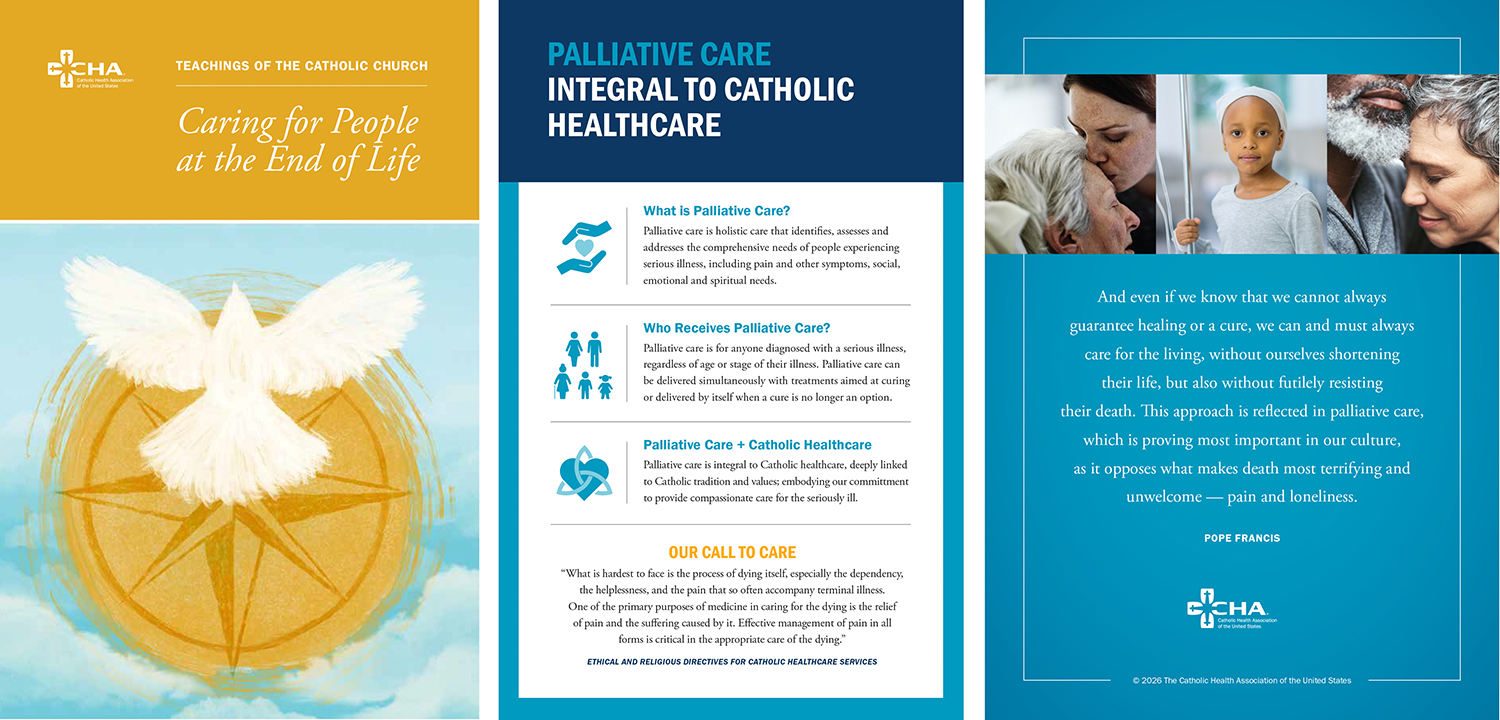
To counter the use and spread of assisted suicide, those who spoke to Catholic Health World say there is much that Catholic health systems and facilities can do. Curran says a key step Catholic health systems and facilities can take is to build awareness that high-quality palliative care is an alternative to physician-assisted suicide. She says they can "continue to provide palliative care in their hospitals, and they can continue to advocate for it ... so that it becomes more common and better understood."
Foremost, the experts say, ministry facilities must recognize that making high-quality palliative care available addresses many of the very real concerns that drive people to consider seeking medical aid in dying. Spugnardi says that vulnerable people who are suffering and afraid need accompaniment, including through palliative care, not abandonment. Dangberg says ministry facilities should make sure their hospice units that offer end-of-life care are functioning optimally. Sulmasy notes that primary care providers also should be well equipped to support patients who are near the end of life and suffering.
Ensuring the delivery of optimal care at the end of life includes adhering to the top standards of care, educating and training staff to provide the best possible care, and promoting a culture in which staff value the dignity of all patients, even the most difficult ones, Sulmasy says. Catholic healthcare facilities should be highly proficient in pain control as well as in delivering the spiritual and mental health care that address nonmedical needs, he says.

Disciplined messaging
Sulmasy and others say ministry systems and facilities also should build ongoing awareness of the availability of palliative care. They say societal buy-in for assisted suicide has happened in part because people do not know about the highly effective medical and nonmedical treatments for pain and suffering.
Sulmasy says "letting people know what the alternatives are" is vital to halting the spread of assisted suicide.
Dangberg says as people are dying, Catholic healthcare can help them "understand what can be brought to the journey." Curran says telling the stories of people who have benefited from palliative care is one way to do this.
Spugnardi says Catholic healthcare "cannot just be about opposing physician-assisted suicide. We need a hopeful message about palliative care, and about how we accompany people and not abandon them. It is about holistic care."
Further reading: Assisted-suicide opponents can learn from the experience of a California Catholic coalition, one of its leaders says