
As a woman who immigrated from Iran as an adult, Moojan Rezvan knows what it is like to confront communication barriers. And as a medical interpreter and the interpreter services supervisor at Providence Mission Hospital for the last three years, she understands firsthand that language barriers can have a direct impact on patient health.

So, when Rezvan learned about an opportunity to address health equity concerns through a Providence St. Joseph Health fellowship, she knew which inequity she would want to take on. She applied for the fellowship proposing a project to understand why sepsis patients with limited English proficiency have worse outcomes compared to patients who are fluent in English — and to see what could be done about it.
Rezvan was accepted into the fellowship cohort that began in June 2023. Over the course of the yearlong program, she led an effort to study disparate sepsis outcomes, survey affected patients, consider evidence-based solutions, and put those interventions in place.
Her project resulted in measurable improvements to the health outcomes of patients with sepsis who were not proficient in English. Because of the success of the project, it is no longer a pilot but an offering of Providence Mission Hospital, which is in Mission Viejo, California.
She says she is "very grateful that I got to help one of the most vulnerable populations we serve."
If people don't know what's happening with their health because of language barriers, Rezvan says, "how can they feel safe and connected and how can we continue their care when they leave the hospital?"
A top cause of death
Rezvan knew sepsis was an important issue to address, she says, because it is one of the most used diagnosis-related group codes in the hospital and because it is one of the top causes of deaths in the hospital.
At the start of her project, Rezvan worked with Mission Hospital's quality improvement team to analyze data and learned that sepsis patients with limited English proficiency had longer lengths of stay and higher readmission rates than other patients with sepsis.
Early in the project, Rezvan set up a focus group in which surveyors spoke with hospital patients who were Spanish-speaking and not proficient with English and who'd been hospitalized with sepsis. Talking with those patients and their family members about their experience, the team found four main areas of concern: people did not have a good understanding of the disease process for sepsis, they did not fully trust hospital staff, there were communication breakdowns, and there was a lack of continuity in care after their discharge.
Nurse navigators
Based on those findings and additional research, Rezvan developed and put in place solutions. One was to build partnerships, including with clinics, to educate community members generally about sepsis in their own language and to address barriers to care. Another was to create printed materials about sepsis and have them translated into the top four languages spoken by Mission Hospital patients.
But the most impactful intervention, Rezvan says, was to put in place four sepsis nurse navigators. These nurses met with sepsis patients while they were in the hospital. They provided the patients with information in their native language, sought to ensure the patients understood the information, coordinated care among the patients' clinical team, and helped address barriers to follow-up care upon discharge. "The goal was discharge readiness," Rezvan explains.
After discharge, the nurses kept in regular contact with the patients and their families, ensuring they had the information and means needed to follow discharge instructions.
Rezvan says of those nurses, "They have a love for helping the underserved. They went above and beyond."
Measurable improvement
Rezvan says there were a lot of challenges to carrying out this project, since it was a new role for the nurses. They needed to interface with staff at the hospital and with organizations outside of the hospital that they normally did not work with in their usual nursing role.
But the project surpassed the goals Rezvan and the team had set. It achieved a 25% reduction in average length of stay and a 28% reduction in 30-day readmissions for the selected patient population.
With much support from the project's executive sponsor and the executive leadership team at Mission Hospital, Rezvan was able to make the interventions permanent, and Mission Hospital now has a full-time sepsis nurse navigator. Rezvan is sharing the program with leaders at other Providence hospitals in the hopes of spreading it beyond Mission Hospital.
'I see that they care'
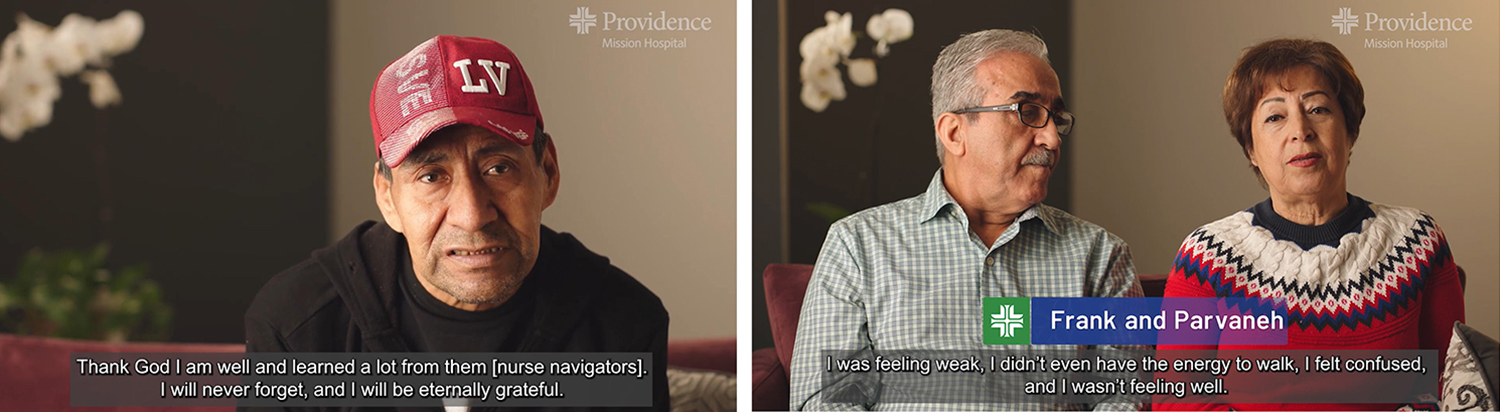
Three patients and some of their relatives shared their experiences with the nurse navigator pilot program in a video testimonial for Mission Hospital. They shared only their first names in the video.
Jose says when he was hospitalized at Mission Hospital with an infection in his foot, clinicians feared he had sepsis that would spread to the rest of his body. He says three nurses who served as sepsis nurse navigators helped him feel at ease "because they spent the time treating and teaching me."
Jose says "it was critical to understand what was happening and to continue my treatments." He says of the team, "I learned a lot from them, and I will never forget, and I will be eternally grateful."
Parvaneh was taken by ambulance to Mission Hospital after her husband called 9-1-1 when she was feeling weak, confused and barely able to walk. After her clinical team determined she had sepsis, a nurse navigator met with her and explained the condition to her in her native language. She had never heard of sepsis, and while she was reticent to accept the help of the navigator — because she prefers to be independent — she is glad she did. "I'm certain that if an interpreter had not been used that day, I wouldn't have understood everything accurately and completely," she says.
After Parvaneh's discharge, the nurse navigator team stayed in touch with her and her husband, checking on her status and answering her questions. "When I go to a hospital and I see that they care about me and my health, I feel at ease," she says. "I don't worry anymore that I am a stranger in a foreign country who can't communicate with them."
Further reading: In fellowship program, Providence staff devise practical solutions for real-life health inequities