
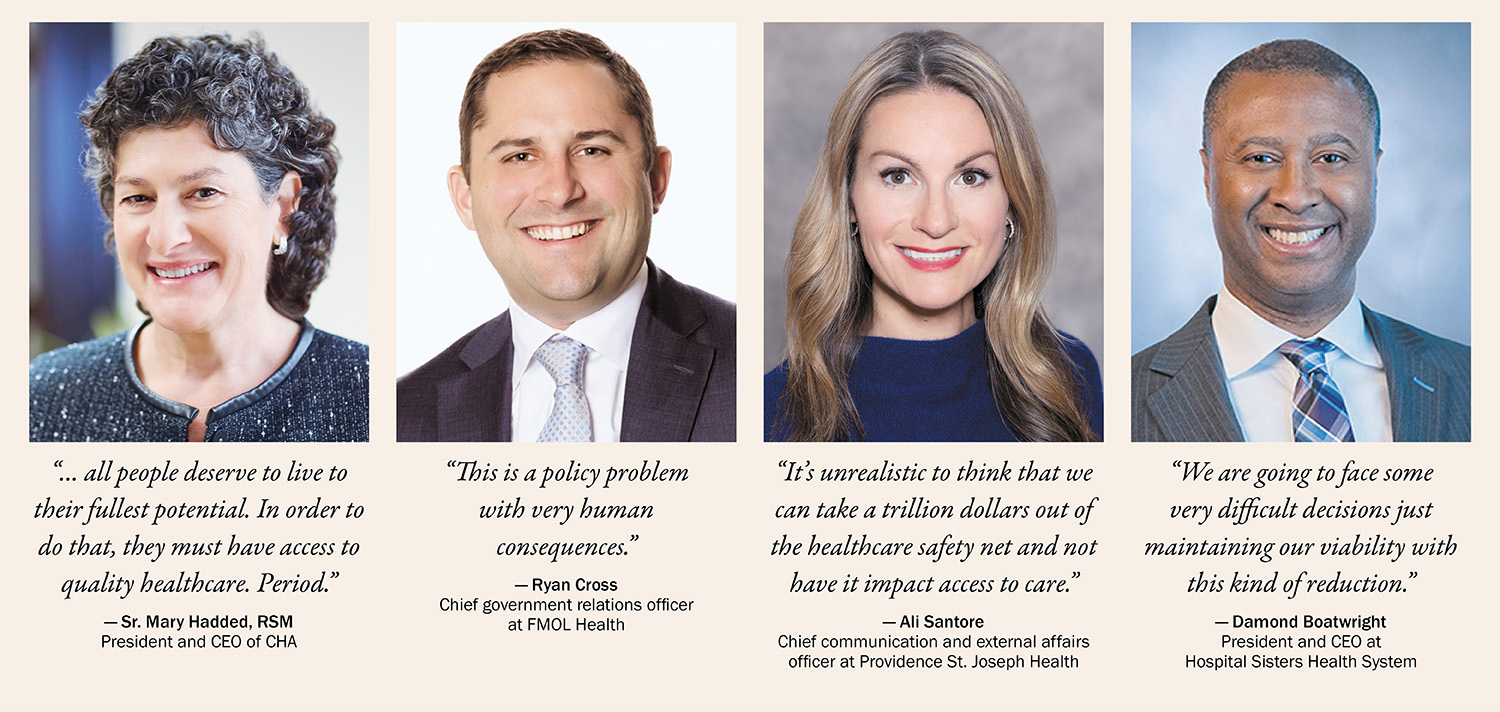
Sr. Mary Haddad, RSM, president and CEO of CHA, says the changes threaten access to healthcare for millions of Americans and the viability of some Catholic healthcare providers, who are pledged to care for all.
"We believe that every person is made in the image and likeness of God, and they have inherent dignity," Sr. Mary says. "And because of that, we also believe that healthcare is a basic human right, and that all people deserve to live to their fullest potential. In order to do that, they must have access to quality healthcare. Period."
Loss of enhanced premiums
One change in place since the start of the year is the loss of the enhanced premium subsidies for low-income Americans who buy coverage through the Health Insurance Marketplace. The subsidies started during the COVID pandemic. The health policy research organization KFF projected in February that for the average enrollee who had gotten the assistance, the cost of premiums would double.
Ryan Cross, chief government relations officer at FMOL Health, suspects that spike in premiums accounts in part for a spike in uninsured patients. At the system's flagship hospital, FMOL Health - Our Lady of the Lake Regional Medical Center in Baton Rouge, Louisiana, the share of uninsured services rose from 2.8% in July 2025 to 5.6% in July 2026. In the first six months of this year, uninsured behavioral health admissions more than doubled compared to the same period in 2025.
While uncompensated care affects FMOL Health's bottom line, Cross says low-income patients are most affected. They face tough choices like foregoing care, paying out of pocket, going into debt or seeking charitable assistance. "This is a policy problem with very human consequences," Cross says.
"Courageous decisions" to be made
At Providence St. Joseph Health, Ali Santore, chief communication and external affairs officer, says the system is bracing for cuts to Medicaid funding that are set to begin next year. The Congressional Budget Office has projected that the cuts will total $1 trillion over 10 years. The office predicts the cuts and other changes to Medicaid will increase the number of people who are uninsured by 10 million.
Santore says about 25% of Providence's patients rely on Medicaid programs for coverage, although in some of its service areas that number is as high as 40%. Providence expects the funding cuts to mean a loss of about $800 million from 2027-2030.
The funding will require the entire healthcare sector to make difficult choices, Santore says. Providence is already evaluating ways to strengthen and adapt its operations in response to the changing funding landscape without compromising its Catholic mission to serve everyone in its communities, especially those who are poor and vulnerable.
"It's unrealistic to think that we can take a trillion dollars out of the healthcare safety net and not have it impact access to care," Santore says. "So we, like our foundresses before us, anticipate that we're going to have to make some courageous decisions around where and how we can maintain access for those vulnerable populations."
Uninsured patients, uncompensated care
President and CEO Damond Boatwright says Hospital Sisters Health System is seeing significant increases in uninsured patients, uncompensated care, and uncovered debt this year. Boatwright says those challenges are surfacing at the same time as others unrelated to Medicaid. For example, as the nation's population ages, more patients are moving off private insurance and onto Medicare, which typically has lower reimbursement rates. The changes, he says, are "exacerbating a reduction in our operating margins."
Boatwright projects that upcoming cuts will mean a 20-30% loss in Medicaid revenue for HSHS. But the loss won't be across the board for the system because Medicaid accounts for more patients at some locations and in some service lines. At HSHS St. John's Children's Hospital in Springfield, Illinois, the payer mix is about 24% Medicaid, he points out, but in its neonatal intensive care unit, about 40% of patients rely on the safety net program.
"We are going to face some very difficult decisions just maintaining our viability with this kind of reduction," he says. "I mean things like reductions of staff, behavioral health, rural ambulance services, and cuts to access."
Changes in eligibility rules
Three Medicaid rule changes that raise particular concerns affect many of the about 20 million adults in the so-called expansion population. This population gained Medicaid coverage under the Affordable Care Act, but only if their states opted in.
One of the new rules requires that these enrollees prove their eligibility for coverage every six months rather than every year. Another requires that they show proof that they are either working, in school or doing "community engagement" work for at least 80 hours a month. Another requires that those who have a condition that makes them medically frail also prove that their condition prevents them from working.
Catholic healthcare leaders point out that all those changes will mean more paperwork for proof of eligibility. The burden of submitting and processing that paperwork will fall on patients, providers and the state agencies that oversee Medicaid programs.
Sr. Mary points out that the medical frailty determination creates a new and generally unwelcome responsibility for physicians, who will have to make the call on whether a patient's condition prevents them from holding a job.
"I think this really skews the patient-physician relationship," she says. "We think that's a very sacred trust, and it has potential of being violated because of this added burden put upon the physician."
CHA is working to maintain Medicaid coverage for as many people as possible through several initiatives. One is by being a founding member of The Partnership for Medicaid, a coalition of organizations representing clinicians, healthcare providers, safety-net health plans and counties. The partnership creates resources, issue briefs and other advocacy materials to sustain the safety net insurance program.
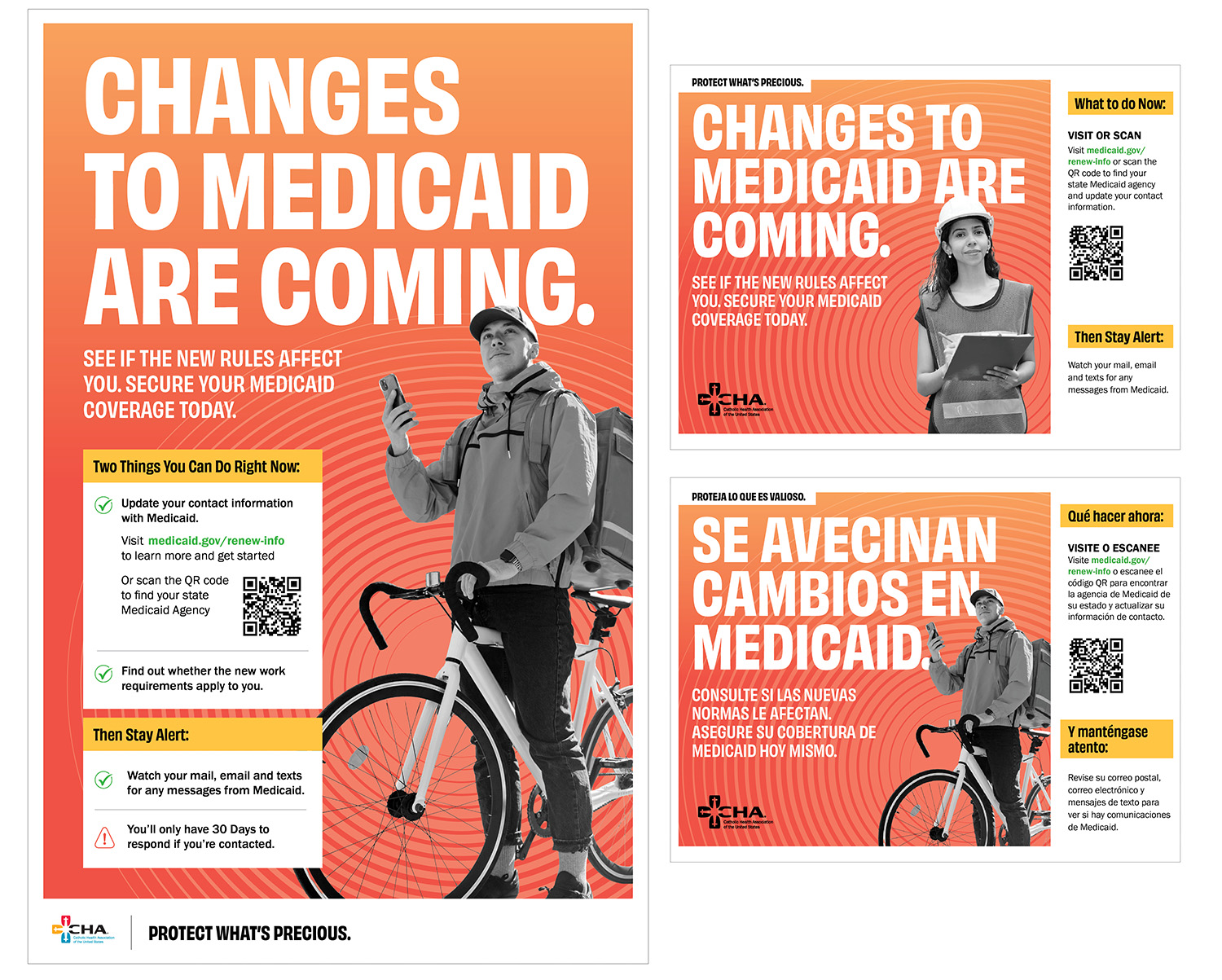
To help its members prepare patients for the changes in Medicaid, CHA created the Protect What's Precious Toolkit. The collection of resources includes downloadable posters and information cards for patients and a list of talking points for frontline employees.
Meanwhile, CHA's Washington-based advocacy team continues to urge members of Congress to rethink the funding cuts and changes because of the potentially drastic impact on healthcare nationwide.
Healthcare system leaders say they are relying on CHA's resources or are creating similar ones to educate patients on the changes. They also are staying in contact with the policymakers who voted for the changes in hopes of a reversal and with the state officials implementing the new rules in hopes of making them as little burdensome as possible.
Santore says Providence isn't giving up the fight to convince lawmakers to rethink the Medicaid cuts. "It's our hope that Congress will act in the next four years - hopefully next year - to mitigate the impact of these cuts on some of our most vulnerable populations," she says.
One point the system makes with lawmakers is that in many communities, Providence facilities are among the leading employers. If those facilities close or end services, it could mean a significant economic blow.
Cross worries that the Medicaid cuts will prove "unsurvivable for many small rural hospitals across states like Louisiana and Mississippi." He says even FMOL Health will be challenged, despite being on solid financial footing and led by a team that has proven resourceful at weathering tough times, as it did during the pandemic.
"But as a Catholic healthcare institution, we are unwavering in our commitment to be there for those patients that need us most, regardless of their ability to pay, and we're never going to back away from that," Cross says.
Boatwright says the projected losses in Medicaid funds will require HSHS to assess what is viable and sustainable in its care delivery. "We're going to remain committed to providing high-quality services and care," he says. "We just may have to do it with less of a footprint than we have right now."