

After the basement of her home in the Chicago suburbs flooded for the third time, Dr. Sheetal Khedkar Rao decided to find out why.
She learned that a warming climate had led to increased rainfall, and that construction of brick buildings and parking lots in former marshes, as well as an outdated drainage infrastructure, contributed to the repeated flooding.
"This was an aha moment for me, because it showed me how increasingly extreme weather was already impacting my family and my community," she said during a webinar hosted by CHA on March 26. The webinar was called "Heat, Floods, Breathing, and Bugs: Health Impacts of the Ecological Crisis and How Healthcare Can Respond."
Rao is an internal medicine physician and assistant professor of clinical medicine at the University of Illinois Chicago and teaches about sustainability and planetary health. She also works to increase the tree canopy and green spaces in the Chicago area through her nonprofit, Nordson Green Earth.
"In order to have healthy people, you need to have a healthy community based in a healthy environment and a healthy society," she said.
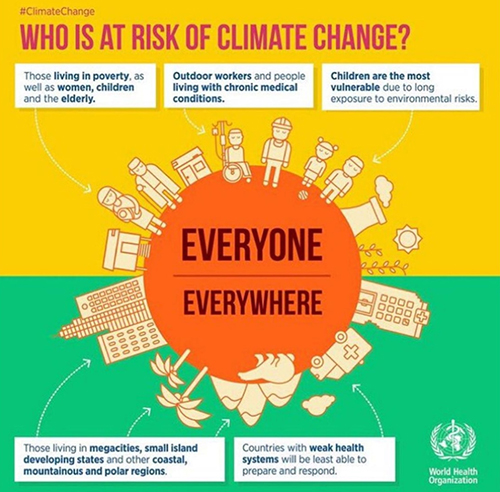
Rao explained how heat, air, water and vectors, including insects, have been affected by climate change, and how those factors impact nearly every social determinant of health. She said:
- Heat: Heat is the top weather-related cause of death in the U.S. and worldwide, and recent years have been the hottest on record globally. Fossil fuel use is the largest contributor to this problem.
She encouraged people to support a fair (or just or equitable) transition to renewable energy; vote for climate champions; plant native trees; limit activity when it’s hot outside; and come up with a backup plan for air conditioning in case of power outages.
- Air: Climate change leads to worsened air quality from allergens, wildfire smoke, and a type of air pollution called ground level ozone. Nearly all the world's population lives in areas that do not meet World Health Organization air quality guidelines. Warming extends growing seasons, putting more pollen in the air.
If air quality is poor, people should close windows, use air filters, and talk to youth sports coaches about the risks of playing outside. If being outdoors is unavoidable, wearing a KN95 mask helps filter out most types of air pollution.
- Water:
Warming allows the air to hold more water, which can lead to more extreme precipitation events. Flooding can cause injuries, damage property, make it difficult to get around, ruin crops, and cause soil erosion.
One study linked combined sewer outflows, where sewage water combines with storm water, during heavy rains to more gastrointestinal illnesses among children. She encouraged people to sign up for alerts from their water districts about water use, advocate for planting native trees and plants, and stock an emergency supply of filtered water.
- Vectors: A vector is an organism, usually an insect, that transmits microbes that cause disease. Tick habitats have expanded due to climate change, habitat loss, and rising deer populations, leading to an increase in Lyme disease. Doctors are also seeing an increase in many mosquito-borne illnesses like malaria due to climate warming.
Rao encouraged people to use an Environmental Protection Agency-registered insect repellent, avoid areas where these vectors are common, cover skin as much as possible, check pets and clothing for ticks, and shower after being outside in high tick areas.
She pointed out that health care is a big contributor to climate change, making up 8.5% of all U.S. emissions and nearly 5% worldwide.
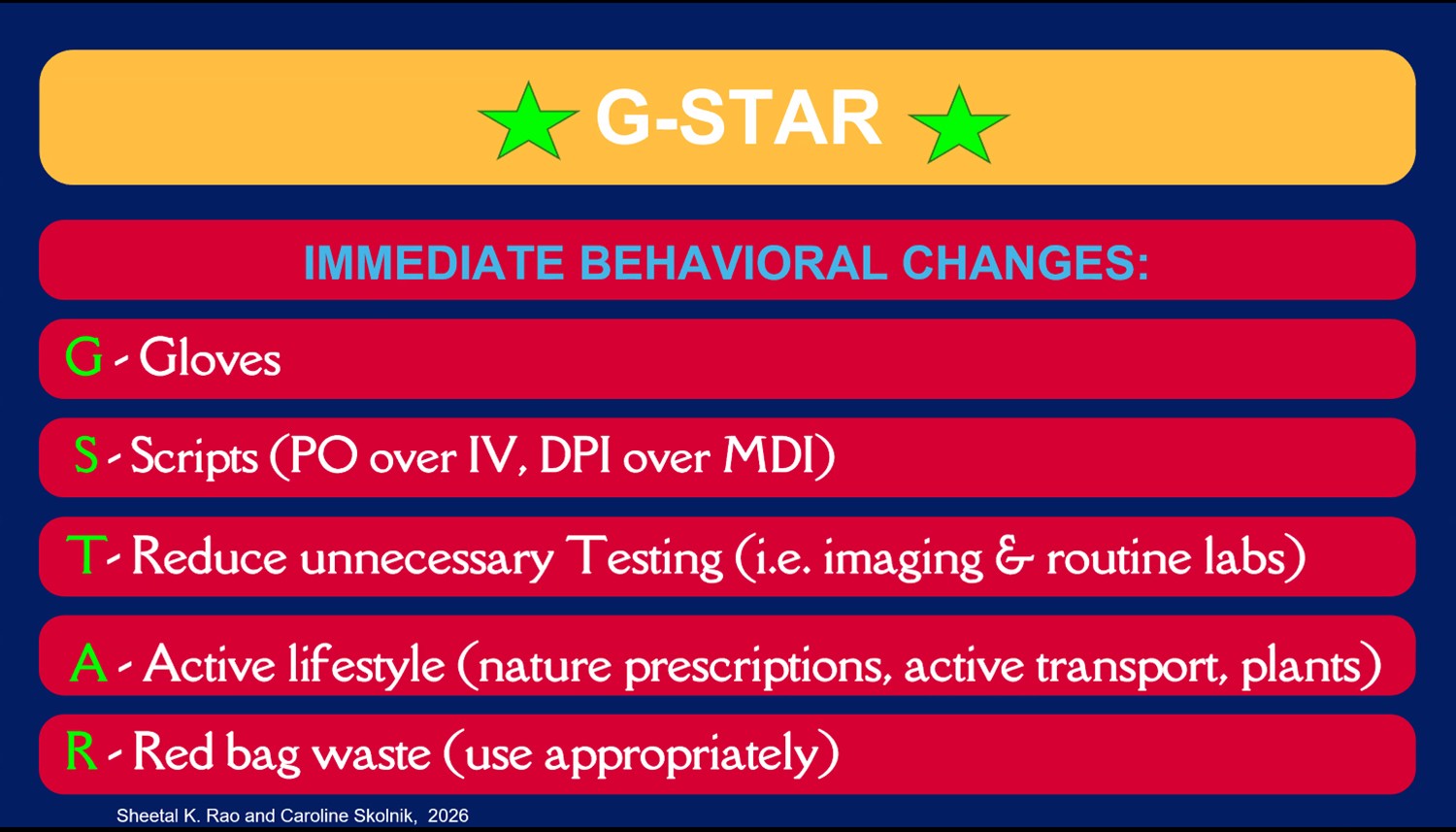
How can those in health care act? She shared an acronym she and colleague Dr. Caroline Skolnik came up with called G-STAR, which stands for gloves, scripts, testing, active lifestyle, and red bag waste. She encouraged clinicians to practice appropriate glove use to reduce unnecessary waste; switch intravenous medications to oral forms when medically appropriate; be judicious with testing such as labs and imaging; encourage patients to adopt a more active lifestyle and eat more plant-based meals; and learn appropriate use of "red bag waste," which gets incinerated, emitting planet-warming pollution. She also pointed out that most of these climate actions also save on cost.
Rao concluded the webinar with a cartoon highlighting how characters in time travel movies often worry that changing one small thing in the past would radically change the trajectory of the future. Urging listeners to flip this logic, she said, "I hope that you were able to find one small thing that you can change, starting today or tomorrow." Such a change, she said, might "radically improve something in the future" for the planet.