
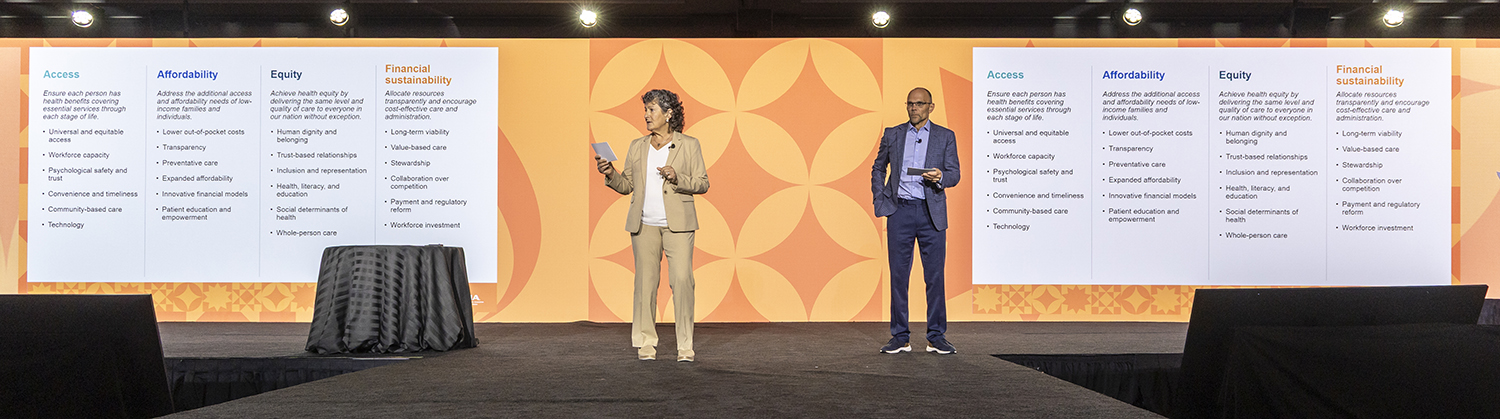
Among the thoughts shared at the Health Reimagined Listening Sessions was that care should be available when and where people need it, that providers should be transparent about costs and that healthcare systems need to find a path to long-term financial sustainability.
CHA President and CEO Sr. Mary Haddad, RSM, and incoming CHA board Chairman Joe Gage, chief administrative officer at Bon Secours Mercy Health Cincinnati, highlighted some of the ideas at the assembly's closing ceremony.
Sr. Mary said the CHA executive team would use the ideas to develop a practical roadmap to help "identify priorities, sequence our efforts, define ownership, establish milestones, and turn aspiration into meaningful progress. The future of healthcare will not be built by any one organization acting alone."
Gathering more input
CHA has been getting input over the last several months from members of its board and leaders of member systems during visits around the country. The organization is working with consultants to get more feedback over the coming months.
"Establishing that foundation is really important for us to then refine what a new vision for healthcare really looks like," Amy Ballance, vice president and chief of staff at CHA, said in an interview.
Katie Hurley, vice president, general counsel/compliance officer at CHA, said in the interview that the listening sessions showed "something needs to change, and everyone seems to agree on that."
Hurley added that she was encouraged that people were engaged and energetic during the discussions. "What this project is trying to get at is: How will we change it, and what will it look like? Those are the unanswered questions that we're trying to engage with our members to try to bring some clarity, so that we have some action steps that we can take forward on behalf of the ministry," she said.
Sr. Mary said the suggestions made in the listening sessions "demonstrated that the ideas do exist, the energy is palpable, the commitment is evident. Our responsibility now is to turn that momentum into meaningful change."
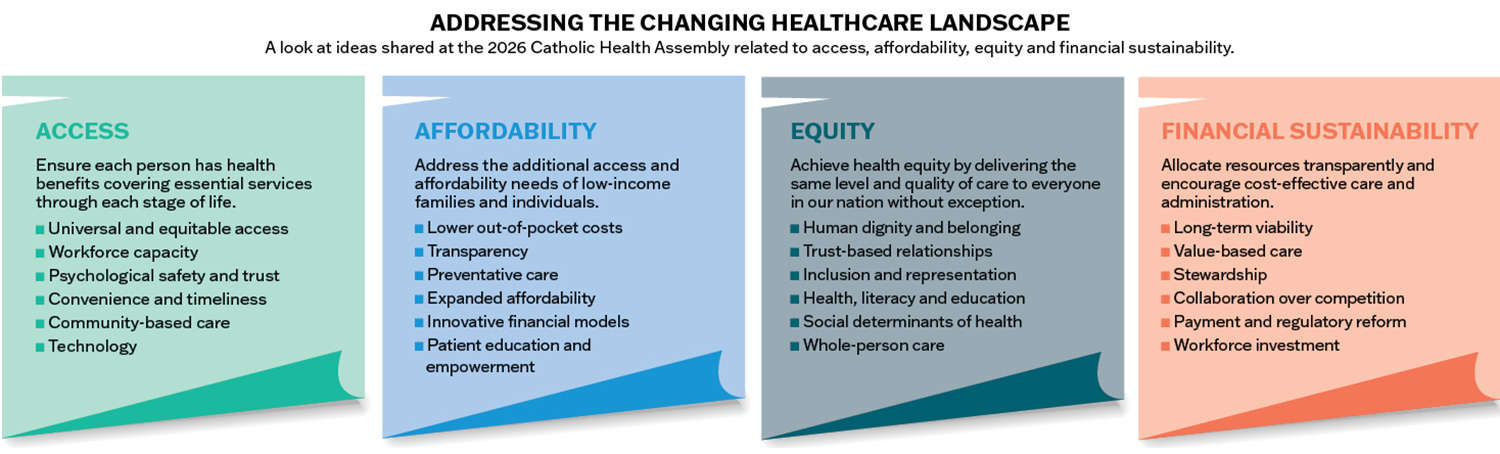
Here is a summary of the ideas from the listening sessions:
Access: "When we talked about access, we heard a consistent message: Access is not simply about affordability; it's about making care easy to reach, easy to navigate, and worthy of trust," Sr. Mary said at the assembly closing. "You all emphasize the importance of ensuring people can receive care when and where they need it."
Affordability: "We heard a reminder that healthcare costs are really creating challenges for people, hard challenges for families, for our communities," Gage said. "That's tough, and it's more real now than it's ever been. But in our discussions, we also heard you give us some solutions that we need greater transparency, that we need simpler experiences, that we need to make sure that people have access to preventative care. We need to make that affordable."
Equity: "Our conversations around equity bring forth something fundamental," Sr. Mary said. "Equity cannot be a separate initiative. It's integral to all that we do, and to our mission. It must be embedded throughout the entire healthcare experience. Breakout groups emphasized the importance of ensuring people feel seen, heard, understood and respected."
Financial sustainability: "We recognize that incrementalism no longer works, that we actually need sustainable systems that are going to create the capacity for us to fulfill our mission, not just today, but for generations to come," Gage said. "The participants' dialogue in the sessions reminded us that innovation without sustainability or scalability really won't work. But without our mission, without our values driving what we do and how we do it, it's worthless. We need new ways of doing things. We need sustainable ways of doing things."