
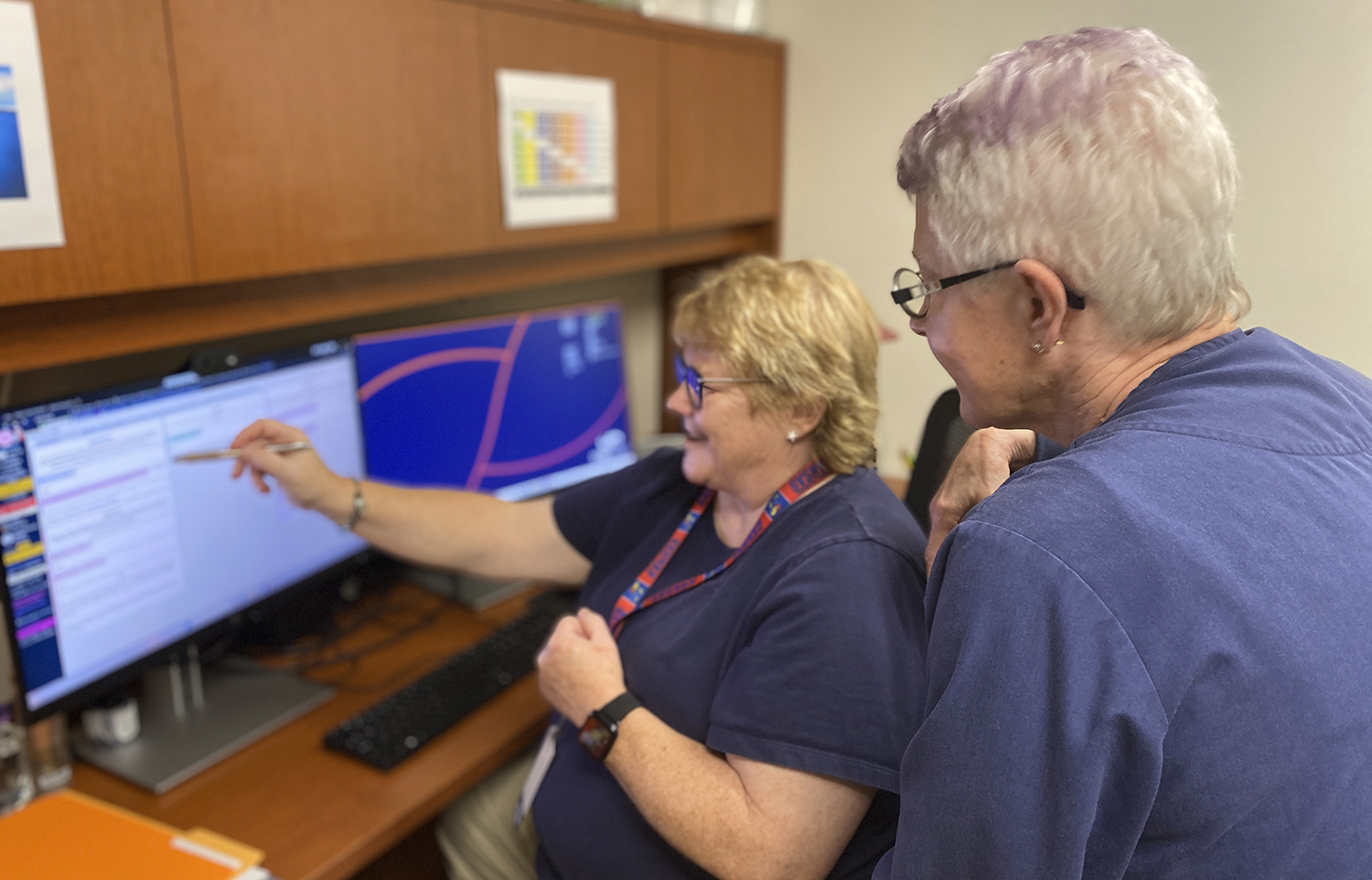
When leaders of SSM Health's Wisconsin region decided to give the Age-Friendly Health Systems care model a go, the initial idea was to pilot it at SSM Health St. Mary's Hospital — Madison. But before the launch, they decided to go bigger.
The age-friendly model is an initiative of the Institute for Healthcare Improvement and The John A. Hartford Foundation, two nonprofits focused on better health care, in partnership with CHA and the American Hospital Association. The model was designed to meet the challenge of caring for the nation's aging population, and the Institute for Healthcare Improvement has recommended starting the model in a single unit.
Chris Baker, Wisconsin region administrative director of nursing excellence and professional practice, is one of the SSM Health leaders who have championed age-friendly care. "We were already breaking the mold by doing it on 23 units at Madison," Baker recalls. "And then we thought, 'Let's just dream big. We're going to do it regionally.'"
Jo Goffinet, a clinical nurse specialist and another leader who guided age-friendly care's expansion across SSM Health in Wisconsin, says: "We realized this was an opportunity to break down silos across care settings and said we're going to go back to the drawing board and rebuild this the way we think we need to."
That was two years ago. Age-friendly care is now standard in all units of SSM Health's seven hospitals in Wisconsin and being integrated into outpatient care. SSM Health also is expanding age-friendly care across the other states it serves — Missouri, Illinois and Oklahoma.
Putting patients at center of care
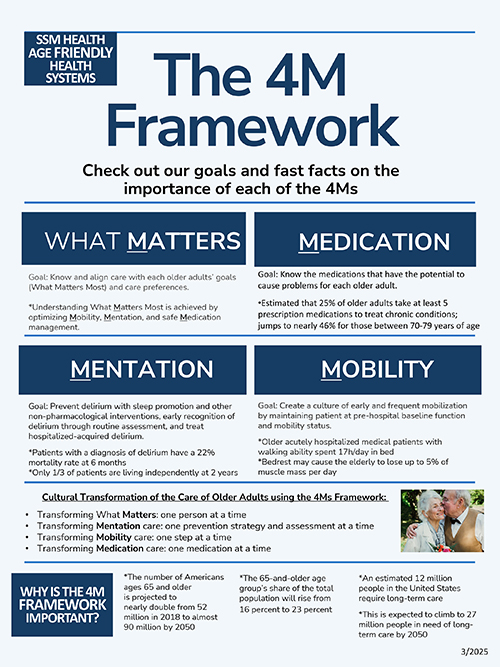
The age-friendly initiative hinges on providing holistic patient-centered care around the "4Ms Framework." The 4Ms are: medication, mobility, mentation and what matters to the patient.
Baker says age-friendly care "puts the patient and their family at the center of everything we do. We've always liked to think that we do that, but this makes it very explicit and gives it an organizing framework."
Goffinet notes that while the age-friendly framework was developed with older patients in mind, she and her colleagues saw from the start that "all our patients deserve this type of care." In particular, she says, they felt the "what matters" aspect of the model was foundational to all care, regardless of the age of the patient, and that the other 3Ms support that aspect.
"What we decided was that that framework made a lot of sense to us," she says. "It's really been our playbook."
The Institute for Healthcare Improvement said in a statement that over the last few years it had heard from health systems working to achieve systemwide spread of 4Ms care. To facilitate the process, in April 2024 it launched an Age-Friendly System-Wide Spread Collaborative to work with SSM Health and 29 other health systems.
"While we've seen great progress toward systemwide spread of age-friendly care, few health systems have achieved full-scale implementation to date," the statement from the institute said. "IHI commends SSM Health for their efforts to spread age-friendly care."
Tip sheet, dashboard
Rather than requiring coursework or other training for staff on age-friendly care, the model's champions at SSM Health have opted to integrate it into the fabric of care by slowly introducing the concepts through discussions with ministry-level nurse leaders. They have reinforced the 4Ms and checked on how the concepts are being put into practice through "go-and-see" visits and on-site coaching, if warranted.
A one-page tip sheet that SSM Health created for care providers covers "goals and fast facts" on the 4M Framework. For example, the goal for mentation is: "Prevent delirium with sleep promotion and other non-pharmacological interventions, early recognition of delirium through routine assessment, and treat hospitalized-acquired delirium." And a fact the tip sheet cites is that 22% of patients with a delirium diagnosis die within six months.
In June, SSM Health added a dashboard in its electronic health record that documents the 4Ms for each patient. Goffinet says any care provider who checks the dashboard "can identify what matters most to the patient, how much they've mobilized the day before, if they've had any delirium, and then what are those high-risk medications that we need to be addressing?"
Arielle Graves is a nurse at SSM Health St. Mary's Hospital — Madison and a member of the hospital's Professional Nursing Practice Council.
The med-surg unit where Graves works took the lead on incorporating the 4M concepts into care, such as making discussions of what matters most to individual patients and of their mobility levels part of care teams' daily rounds.
Graves says the concepts were added one at a time, which helped nurses see how they tied together. "I think that it was beneficial, because I think it made it stick a little bit easier," she says. "I don't think it was everything being thrown at nurses all at once."
The addition of the dashboard, Graves says, helps ensure age-friendly concepts are at the forefront of the minds of care providers and that the concepts are consistently incorporated into care.
"I think it's helping nursing kind of go back to being more patient-specific," she says. "I think that that's one of the things that brought me to St. Mary's to begin with, is I felt like our patients were less of a number. We're more patient-focused in general."
Rise in patient satisfaction
Heather A. Richardson is a nurse in the neuro-medical unit at SSM Health St. Agnes Hospital — Fond du Lac. She co-chairs the Nurse Practice Council there and serves on the council for the Wisconsin region.
Richardson says she hadn't been familiar with age-friendly care until nursing leaders began to introduce it in monthly meetings. She then helped bring the model and the 4M concepts into practice at St. Agnes. She credits the model, at least in part, for a rise in patient satisfaction scores. The unit had set a goal for a score of 62% last year. The most recent survey, released in June, showed 82% patient satisfaction.
"Whatever we're doing, it is working, and it really just kind of coincides to when we've started doing all of these other changes," Richardson says. "I can't 100% put them both together, but it's definitely not making it go the opposite way."
As to what the model looks like in practice, Richardson shares the story of a patient who had no motivation to get out of bed after surgery despite stating that returning to an active life at home was a goal. Richardson turned to her 4Ms tip sheet to point out to the patient that most older patients stay in bed 17 hours a day and that bed rest can cause elderly people to lose 5% of their muscle mass per day.
She told the patient: "If we're not getting you up for meals or mobilizing you that three times a day, you're falling into that statistic. And that's not good to get you back home to do those things."
Her encouragement changed the patient's perspective, Richardson says, and got him moving.
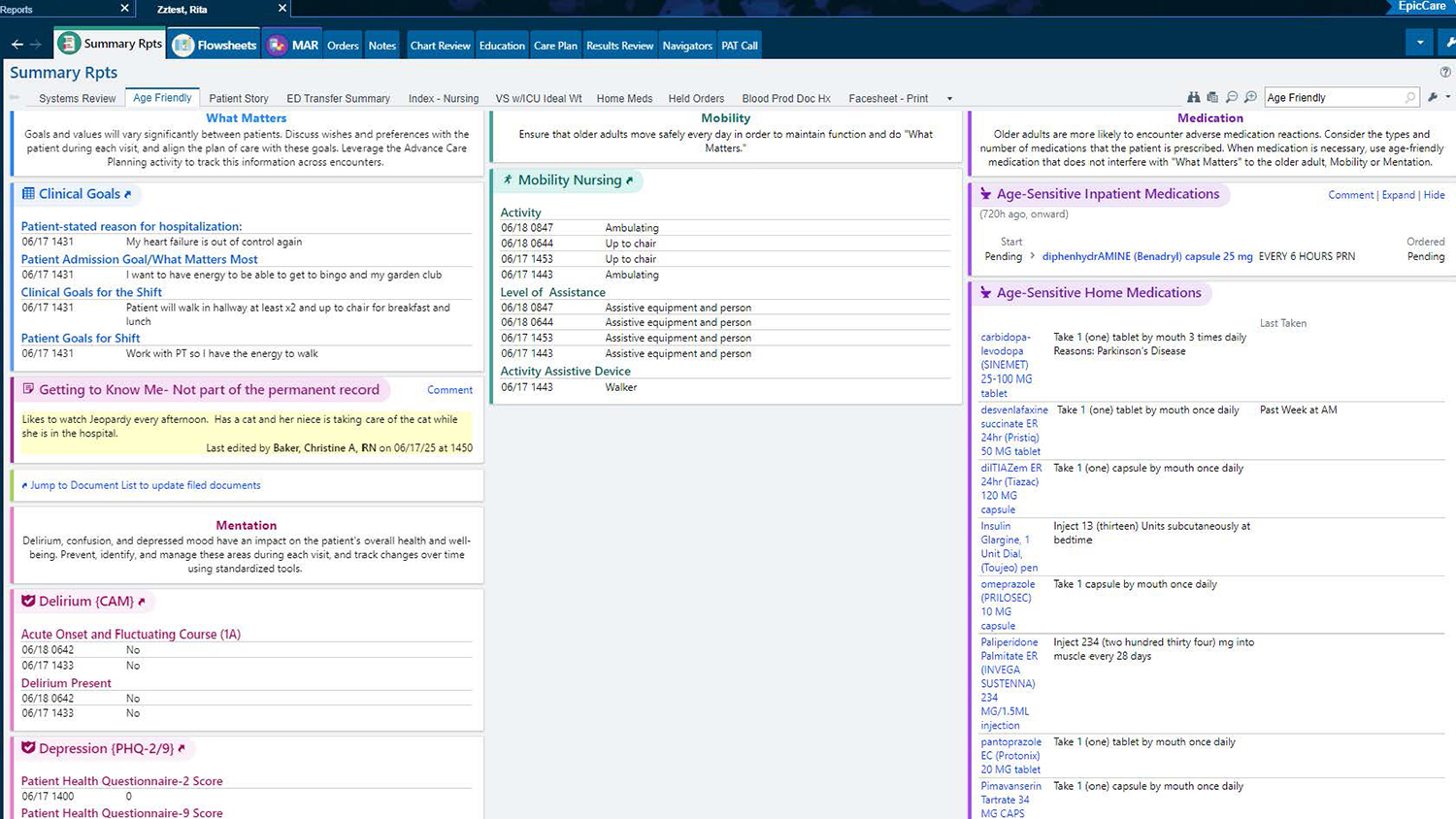
She is eager to see the age-friendly model — and access to SSM Health's dashboard — expanded to outpatient settings so patients continue to get the same goal-centered care after discharge.
"What matters most is good for outpatient and inpatient," Richardson says. "If we say what matters most to this patient is getting back and doing their garden, when they go into their follow-ups posthospital, we want their provider to know that's their goal, too."
'It just makes sense'
At the start of the year, the Centers for Medicare & Medicaid Services enacted a new Age-Friendly Hospital Measure for inpatient care that "seeks to ensure that hospitals are reliably implementing the '4M's', and thus providing evidence-based elements of high-quality care for all older adults." CMS is requiring hospitals to collect and report data based on the measure.
Goffinet and Baker say while SSM Health had a leg up in enacting the CMS measure because of its age-friendly efforts, the measure has added a sense of urgency to expand the framework. Goffinet says the expectation among many health care experts is that CMS is starting with hospitals and will then extend the measure across the continuum of care.
"We're going to be ready for if it does," she says. "It just makes sense."
Further reading:
Family credits SSM Health St. Mary's for solving mystery of father's illness, estrangement