
For years, the drastic changes in Randy Beeman's behavior mystified his family. But in time, the family got an answer, and Beeman got care that helped reestablish connections between him and his loved ones, all at SSM Health St. Mary's Hospital in Madison, Wisconsin.
"Once he got to St. Mary's, we knew that these people were going to do everything in their power to figure out what was wrong with him and they weren't going to stop until they did," says Kaitlyn Overman, one of Beeman's two daughters.
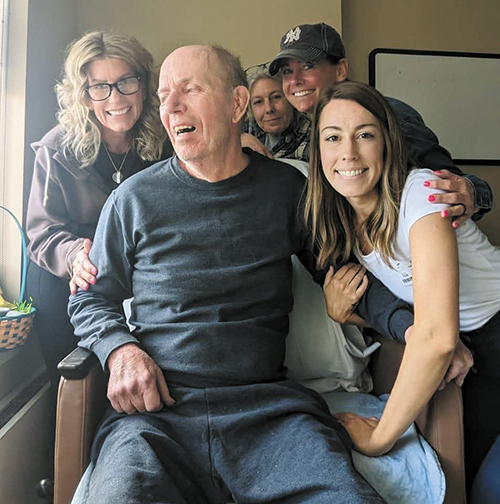
Beeman's spiral started in 2018 when he was 57. Overman says he began to pull away from his loved ones and cancel jobs that had been booked for the carpentry business he had owned for years with his wife.
"My dad's always been very kind, very soft-spoken, and all of a sudden, he was getting a little bit more angrier," Overman recalls. "We could tell something was wrong."
Within a few years, Beeman was living in seclusion and at times wandering the streets. Visits to doctors brought various diagnoses and prescriptions, but the devoted husband and father and doting grandfather his family had known was slipping away.
A shadow provides a clue
In 2023, Beeman wound up in jail for theft of a slushy. While in custody, he suffered a seizure. He was taken to a hospital, where an MRI spotted a shadow on the right side of his brain. He then was transferred to St. Mary's. During a weeks-long stay that included brain surgery, doctors confirmed his front right lobe was deteriorating. But even after his test results were shared with specialists from across the country, the cause remained elusive.
When Beeman was discharged, he moved into a group home that would accept someone with a seizure disorder and cognitive problems. "The first couple of months were OK," Overman says, "and then he started having a lot more seizures, and it got to where the staff were calling us, and they were crying. They were scared."
Beeman was losing weight and physically deteriorating in 2024 when he again was admitted to St. Mary's. Doctors performed a second brain surgery, this time going deeper and taking more tissue to sample. That tissue finally revealed the source of Beeman's tragic transformation: a bacteria that was destroying his brain.
The doctors told Beeman's family that what was happening to him was rare and most often seen in countries with contaminated water or other sanitation issues. How and why Beeman fell victim remains unknown.
Even as doctors began a regimen of antibiotics to kill the bacteria, they warned that the damage it had caused was irreversible. Still, Overman says there was a sense of relief because the family at last knew what was happening to their patriarch. "Once we found that out —hindsight being 20-20 — we thought that makes perfect sense," Overman recalls.
Special care
During the seven months her father spent at St. Mary's during his two stays, Overman saw the hospital's age-friendly care — with its focus on the 4Ms Framework (mobility, mentation, medication and what matters most) and holistic, patient-centered treatment — in action. For example, nurses would coax Beeman into walking with the promise of a visit to an office with a jar full of chocolates, his weakness. His caregivers also stayed in touch with the family to determine what mattered most as his health further deteriorated.
Along with her praise for his many other caregivers at St. Mary's, Overman is grateful for the palliative care team that advised the family that Beeman would need support for the rest of his life. She also is grateful to a hospice doctor who convinced the family that Beeman's condition was terminal and the best approach was to make him as comfortable as possible rather than pursue cures.
"It really made sense that, basically, he was suffering, and all of the poking and prodding wasn't doing anything anymore," Overman says. "So we had to make the decision of do we start hospice care at this point? And we knew in our hearts we had tried everything."
The family moved Beeman, now 63, to a nursing home in his hometown where he gets comfort care as a hospice patient and they can spend time with him.
"It means a lot to us to be able to help others, or just touch people with his story," Overman says. "It is very sad, but there's also good things sprinkled in. So I'm happy to share."
Further reading:
SSM Health expands age-friendly care initiated in Wisconsin across system