
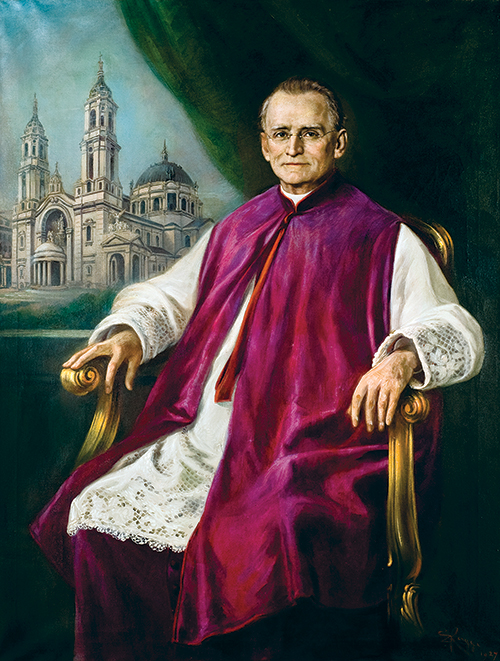
Fr. Nelson Baker was an ordinary man who did extraordinary things. His 60 years in the priesthood were spent sheltering the homeless, feeding the hungry, caring for the sick and giving hope to the destitute.
Nearly a century after his death, his legacy lives on in Western New York and beyond. Fr. Baker's mission of caring for those who need it most has flourished and grown. Today at OLV (Our Lady of Victory) organizations just outside of Buffalo, New York, individuals flock to its campus each year for healing — be it mental, physical or spiritual.
The organizations he founded include OLV Charities, a fundraising arm, and OLV Human Services, children and family programs that serve more than 12,000 individuals annually. He also spearheaded the construction of OLV National Shrine & Basilica, which draws 280,000 visitors each year and serves as home to a thriving parish community.
Fr. Baker — called the region's "most influential citizen of the 20th century"1 — was named a "Servant of God" by the Vatican in 1987, the first step toward canonization, more than 50 years after his death. This historic process took yet another leap forward in 2011, when, on January 14, Pope Benedict XVI named him Venerable Nelson Baker.
Although he came to the priesthood later in life than many men, his deep faith, a gift for fundraising, and a desire to respond to the vulnerable and those in need still inspires Catholics in the modern day.
WHO WAS FR. BAKER?
Nelson Baker was born on Feb. 16, 1842, in Buffalo to Lewis and Caroline Baker. Baptized a Lutheran like his father, Nelson's early faith took a new direction when he was nine years old. Influenced by his deeply Catholic mother, he chose to be rebaptized into her faith — a quiet but defining decision that would guide much of his life to come.2
After graduating from high school, Nelson joined his father and brothers in running the family store. He was bright, outgoing and sharp with numbers — the kind of person who seemed to find opportunities wherever he looked.
When the Civil War broke out, Nelson answered the call to serve, enlisting in the summer of 1863 at the age of 21. After returning home from the war, he slipped back into his familiar role at the store. Before long, opportunity knocked again. A friend, Joe Meyer, approached him with a proposal to open a feed and grain business that could tap into Buffalo's booming economy. Nelson agreed, and together they launched Meyer & Baker — a venture that quickly grew into a thriving success.
During those years, Nelson gave freely of his time, money and food to a nearby orphanage. He often said he felt God had blessed him and his family so generously that he was compelled to give something back. From time to time, the idea of becoming a priest crossed his mind. Still, he brushed it aside. He was getting older, and without the proper schooling, the thought seemed unrealistic. Yet, deep down, the calling never fully left him.
One afternoon, fate stepped in. Nelson spotted two boys struggling to carry a heavy sack along the road. He stopped his wagon to offer them a ride and asked where they were headed. "Limestone Hill — St. Joseph's Orphanage," they told him. Nelson knew the place and its administrator, Fr. Thomas Hines, well. After dropping the boys off, he stopped in to say hello. Their conversation took an unexpected turn — by the time Nelson left, Fr. Hines had promised to recommend him to the bishop for admission to the diocesan seminary.
In 1869, Nelson took a steamer trip through the Great Lakes, using the quiet moments along the journey to pray and reflect on his future. By the time he returned home, his decision was made. The first person he told was his mother, who, as it turned out, had secretly been praying for this very outcome. That same year, on Sept. 2, Nelson closed one chapter of his life and began another.
Though nearly a decade older than most of his classmates at Our Lady of the Angels Seminary in Niagara Falls, Nelson fit in easily. He quickly became a respected leader and excelled in his studies. But in November 1871, his path nearly ended — he fell gravely ill and was given last rites. Against all odds, he pulled through. After nearly a year of recovery, Nelson regained his strength and was soon accepted into the major seminary, more determined than ever to serve.
A STIR IN HIS HEART
In early 1874, Nelson came across an announcement for a pilgrimage to some of Europe's great Catholic shrines. The idea sparked something in him. After getting permission from the seminary rector, he set off that May, eager to see the places that had inspired so many before him.
One of the stops along the way was the Basilica of Notre-Dame des Victoires in Paris. During Mass there, Nelson felt something stir deeply in his heart — a moment of grace he would never forget. It was on that trip that he made a quiet but life-changing decision: to dedicate his ministry to promoting devotion to Our Lady of Victory. The title, also known as Our Lady of the Rosary, honors the Blessed Virgin Mary and traces its origins back to the Battle of Lepanto in 1571.
When Nelson returned home in July 1874, he resumed his studies with renewed purpose. After years of perseverance, prayer and preparation, he reached the milestone he had long dreamed of. On March 19, 1876 — at what many called the "advanced age" of 34 — Nelson Baker was ordained a priest at St. Joseph's Cathedral in Buffalo.
HIS MISSION
Fr. Baker was more than a little surprised by his first assignment. Freshly ordained, he was named assistant superintendent of the institutions at Limestone Hill under Fr. Hines — the man who had encouraged him to enter the seminary. The bishop believed Fr. Baker's sharp business sense would be an asset.

When he arrived in 1876, however, he was met with a harsh reality. St. John's Protectory and St. Joseph's Boys' Orphan Asylum were buried under a combined debt of $27,000 — and by 1881, that figure had ballooned to more than $60,000. Convinced the situation was hopeless, Fr. Baker asked to be reassigned. He spent a year serving a parish in Corning, New York, before the bishop called him back to Limestone Hill — this time as Fr. Hines' successor. It would be his home for the rest of his life.
Despite the overwhelming financial challenges, Fr. Baker returned with determination and faith. Almost immediately, creditors came knocking, demanding payment. Hoping to buy some time, he offered partial payments — all except one refused. Undeterred, Fr. Baker climbed into his buggy, drove to the bank, and withdrew every cent he had to his name to settle the debts.
Around that same time, inspiration struck. He founded the Association of Our Lady of Victory, a bold new fundraising idea built on personal connection. Fr. Baker wrote letters to postmasters across the country, asking for the names of charitable Catholic women in their communities. Then he reached out to those women directly, sharing the story of the children in his care and inviting them to join his mission for just 25 cents a year.
The response was overwhelming. The Association of Our Lady of Victory became a nationwide success. Within a few years, Fr. Baker not only erased the crushing debt but also expanded the facilities — adding a larger chapel and additions to the protectory and orphanage. His blend of faith, ingenuity and persistence had turned a desperate situation into the foundation of something extraordinary.
AN ANSWERED PRAYER
One evening, as Fr. Baker sat in his office worrying over the ever-growing heating bills for his institutions, an idea came to him: What if they could find natural gas right on the property? It sounded far-fetched, but he'd faced long odds before. True to form, he turned to prayer. Whenever a major decision loomed, Fr. Baker would spend the night in quiet reflection before a small statue of Our Lady of Victory, the same one he had brought home years earlier from France.
Catholic Health in Western New York Channels Fr. Baker's Caring Legacy
JUSTIN ROWAN, BCC, Chaplain for Catholic Health–Buffalo
The bright spirit of Buffalo, New York's, "Padre of the Poor" still animates works of mercy long after his time on earth.

Venerable Nelson Baker founded Our Lady of Victory Hospital in 1919 for maternity care, but widened its scope to the general public the following year. It served the people of South Buffalo and Lackawanna for seven decades before closing in 1999. Catholic Health, a regional health care system, then studied the contemporary needs of area residents to discern next steps.
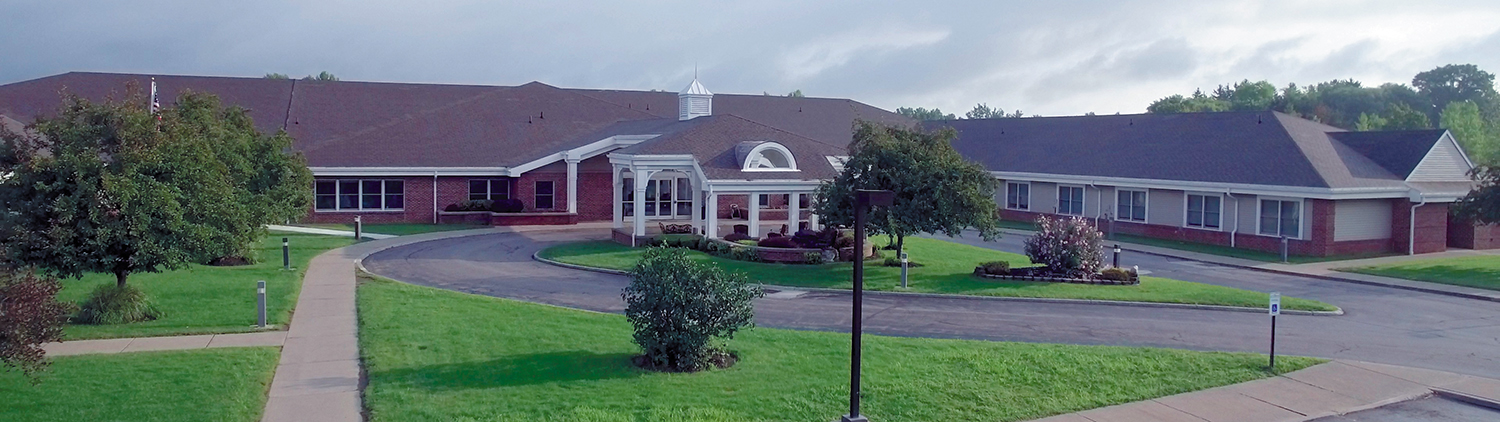
In 2008, Catholic Health relaunched the facility to include a comprehensive array of eldercare services. The former hospital now houses Mercy Nursing Facility (an 84-bed nursing home), laboratory services and apartments for seniors on limited incomes. In 2009, it became home to the Living Independently for Elders program, or LIFE, the system's version of PACE, the Program of All-Inclusive Care for the Elderly. LIFE has since expanded to two additional sites in Buffalo, at Villa Maria College and D'Youville University.
Father Baker Manor, a 160-bed skilled nursing facility in the suburb of Orchard Park, is named in his honor. Part of Catholic Health's Home and Community-Based Care, ground was broken on March 19, 1993 — chosen to commemorate Baker's ordination on the same date in 1876 — and the facility opened the following year. Offering both subacute rehab and long-term care, the system takes pride in the quality of care there and at its sister facilities in the region, Mercy Nursing Facility, McAuley Residence and St. Catherine Labouré Health Center.
Though the era of infant homes and orphanages is long past, OLV Human Services, the present form of the ministry Fr. Baker founded, continues to serve those in need through mental and behavioral health services, foster care, special education, dental care and an outpatient clinic. OLV Charities, the descendant of Fr. Baker's fundraising arm, supports these programs, as well as Our Lady of Victory National Shrine & Basilica, a summer camp and St. Gianna Pregnancy Outreach Center. OLV Charities is further involved in the ongoing cause for the canonization of Fr. Baker and the promotion of devotion to Mary as Our Lady of Victory. May that same Lady, in whom Fr. Baker trusted so much, obtain for him the crown of sainthood!
JUSTIN ROWAN is a board-certified member of the National Association of Catholic Chaplains and an Oblate of St. Benedict.
A drilling crew was contacted, and the foreman went to Fr. Baker at St. Patrick's Church to ask where they should begin. What happened next left everyone stunned. A grand procession emerged from the church — parishioners carried candles and prayed the rosary while they followed him into an open field. When they reached a spot that felt right, Fr. Baker stopped, sprinkled the ground with holy water, buried a small statue of Our Lady, and simply said, "Drill here."
His faith was rewarded. At an astonishing depth of about 1,100 feet, the drillers struck gas — and the "Victoria Well," as it came to be known, roared to life in 1891. The well produced enough natural gas to heat all of Fr. Baker's buildings and even provide warmth for about 50 local families. Incredibly, the well is still producing to this day — a lasting testament to Fr. Baker's faith, vision and remarkable trust in divine providence.
A GROWING CAMPUS
Around the turn of the 20th century, Fr. Baker came across a heartbreaking story in the local news. Workers dredging a nearby section of the Erie Canal had uncovered the tiny remains of infants and small children. Reports suggested that unwed mothers — terrified of judgment and rejection from their families and community — felt they had nowhere else to turn. The discovery horrified Fr. Baker. He knew immediately he had to do something.

His answer was the creation of the OLV Infant Home, a place of safety and compassion for unwed mothers and their babies. Everyone was welcomed — no questions asked. It was a radical act of mercy for its time, and not everyone approved. Many in the community argued that these women should "pay for their immorality." Fr. Baker, however, refused to be swayed by such cruelty. His focus remained on love, dignity and forgiveness.
When the infant home opened in 1908, it quickly became one of his favorite places on the campus. Each night, before turning in, Fr. Baker would stop by, quietly blessing the babies as they slept.
The ministry continued to expand in the years that followed. In 1919, a maternity hospital and nursing school were added to meet the growing need. More than a century later, those same buildings have found new purpose, redeveloped into a "senior neighborhood" that continues to serve the community in the spirit of care and compassion that Fr. Baker began.
A GREAT AMERICAN SHRINE
In 1916, tragedy struck Fr. Baker's growing "City of Charity." A fire tore through St. Patrick's Church, destroying its spire and badly damaging the sanctuary. The loss was painful for the entire community, but for Fr. Baker, it became the spark for something extraordinary.
After modest repairs kept the church usable for a few years, Fr. Baker celebrated the final Mass at St. Patrick's on May 7, 1921. Soon after, the old structure was taken down to make way for a new and far grander vision: a magnificent shrine dedicated to the Blessed Mother he had long served so faithfully called Our Lady of Victory.
He enlisted the talents of architect Emile Uhlrich and local contractor Edward Jordan, and together with more than 20 other firms, they began to bring his dream to life. To fund the effort, Fr. Baker turned once again to his beloved Association of Our Lady of Victory. True to form, its members responded generously, ensuring that the project moved forward.
In August of 1921, a crowd gathered at the corner of Ridge Road and South Park Avenue in Lackawanna to witness the blessing of the shrine's cornerstone. The moment was steeped in emotion — "Father Baker Boys," religious sisters and brothers, friends, neighbors and community members all joined Fr. Baker and Bishop William Turner in prayer and celebration.
Four years later, just in time for Christmas Mass in 1925, construction of the awe-inspiring shrine was complete. The following May, it was formally consecrated and named a minor basilica — only the second in the United States at that time. Later that year, on October 3, 1926, Pope Pius XI officially elevated it to the dignity of a basilica. Even the Cardinal Secretary of State at the Vatican took note, declaring that "among the churches of America, the Sanctuary of Our Lady of Victory is, for many reasons, to be counted as one of the greatest."3
PUBLIC MOURNS THE DEATH OF BELOVED PRIEST
By the summer of 1936, age had finally caught up with Fr. Baker. His health declined rapidly, and on July 29, at the age of 94, he slipped into a coma. That morning, surrounded by those who loved him, Fr. Baker took his final breath while being blessed by Rev. Joseph Burke, one of the many orphans he had raised, who would later become the bishop of Buffalo.
The response to his passing was unlike anything Western New York had ever seen. Media accounts described waves of mourners streaming to Lackawanna to pay their respects. More than half a million people braved the summer heat to honor the man who had given so much of himself to others. Crowds lined the streets five and six people deep as his funeral procession passed, and the basilica he had built was filled to overflowing for his funeral Mass.
Decades later, Fr. Baker's legacy continues to inspire. Those devoted to his cause for canonization remain in close contact with the Vatican and believe it's only a matter of time before he will be recognized as a saint.
HIS LEGACY LIVES TODAY
Nelson Baker was many things — an astute businessman, a Civil War veteran, a dreamer and a builder. But above all, he was a man of deep compassion and unwavering faith.
Fr. Baker left a profound legacy in Catholic health care by providing compassionate medical care to the poor and vulnerable. Individuals in the Catholic medical field can emulate his visionary leadership as he served as a model of Catholic charity and service throughout his life. Today, his work continues to inspire Catholic health ministries committed to dignity, healing and service to those in need.
In 2021, OLV National Shrine & Basilica embarked on a five-year Centennial Celebration (2021–26) to honor 100 years since its cornerstone was laid and to carry Fr. Baker's vision into the next century. The celebration's theme, All Are Welcome, invites people from near and far to revisit, or discover for the first time, the beauty, history and spiritual heart of the shrine. Events include special Masses, concerts, speaker series and more. The gatherings are meant to engage the community, deepen devotion and renew commitment to Fr. Baker's legacy of charity and faith.
For more information on Fr. Baker's life and legacy, go to www.olvbasilica.org or www.fatherbaker.org.
MSGR. DAVID G. LiPUMA is pastor and rector for Our Lady of Victory National Shrine & Basilica in Lackawanna, New York.
NOTES
- Jeff Z. Klein, "Heritage Moments: Father Baker's Miracle at Our Lady of Victory," Buffalo Toronto Public Media, April 9, 2018, https://www.btpm.org/heritage-moments/2018-04-09/heritage-moments-father-bakers-miracle-at-our-lady-of-victory.
- "The Father Baker Story," OLV National Shrine & Basilica, https://www.olvbasilica.org/the-father-baker-story.
- Richard Gribble, CSC, Father of the Fatherless: The Authorized Biography of Father Nelson Baker (Paulist Press, 2011).