
I needed a toothbrush. One simple, preferably soft-bristled toothbrush. And I could not find one anywhere in my apartment.
Ordinarily, this would not be such a problem. At that time, after nearly 20 years of living on my own with often debilitating lupus and other conditions, I was used to fending for myself. And, of course, these days, I could have ordered the much-needed item and multiples from an app.
Yet, this was before the easy, instant delivery systems that sprang up during the COVID-19 pandemic, and on this night, I could not get the toothbrush myself. I was felled by a significant lupus flare, nauseous from immunosuppressive medication, and weakened by an unidentified "bug" that made my limbs ache and my mouth feel like it had a permanent bad taste and furry lining. Thus, the reason why I needed the toothbrush. Oh, I was in a very bad way, but I still hung onto bleary hope that I could handle the situation by myself.
I dragged myself into the hallway and all but took apart the shelves of my storage cupboard to see if I had stowed away a spare toothbrush. I had to have one, I reasoned.
What seemed like hours later, I sat on the floor and stared at the contents of the cupboard and several closets, all now strewn about me. If I could have cried, I would have, but with Sjögren's syndrome also flaring, my eyes could not produce tears.
There was no toothbrush.
Another wave of the bug began to surface, and then I knew: I had to phone a friend.
I still hesitated, thinking that I didn't want to inconvenience anyone, but knowing that the real reason for my reticence was that I was embarrassed and fearful of rejection. Finally, trembling from the bug, the flare and the frustration, I dialed a night owl friend who lived nearby. I got voicemail.
I called two other people and didn't reach them.
Finally, the last person on my list, the most unlikely (I thought), answered. Apologizing between nearly every sentence, I explained my need for (Oh, didn't I sound ridiculous?) a toothbrush (How idiotic to not have one?) and braced myself for excuses and a gentle, but firm, refusal (Here it comes).
Instead, I heard, "Yes."
My friend was happy to help and willing to go to the late-night store, which was blocks away. Eager to bring anything else I needed, my friend said, "Don't worry about paying me back," and "Thank you for letting me help."
It wasn't until I hung up that I realized I'd been holding my breath.
ACCEPTING A HELPING HAND
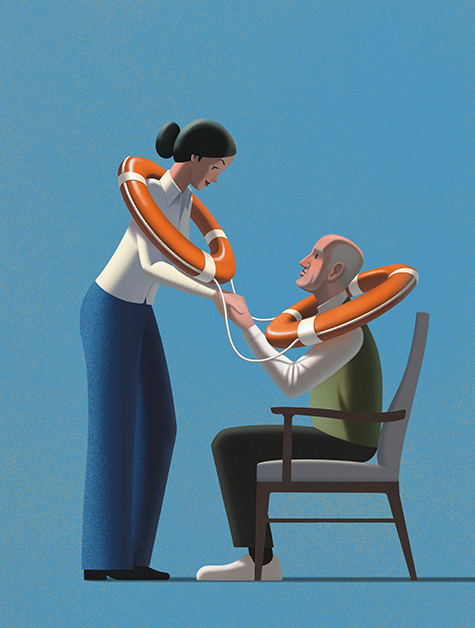
The notion of me helping someone who was helping me might sound roundabout, but it struck me then, as it does now, with a force beyond a more standard consideration that caregiving is all about the caregiver. The person in need of care is indispensable, too, if the full meaning of "love one another" is to be manifest in us. Or, to put it another way, without people to care for, we would not be able to care.
Caring for others is at the heart of the Christian life. It is what Jesus did and what he taught others to do. In the Gospel of John, we encounter Jesus' exhortation: "I give you a new commandment: love one another. As I have loved you, so you also should love one another. This is how all will know that you are my disciples, if you have love for one another." (John 13:34-35)
In the Acts of the Apostles, we learn of how the early Christian community, people of the "Way," were "together and had all things in common; they would sell their property and possessions and divide them among all according to each one's needs." (Acts 2:44-45)
Throughout Church history, caring in ways grand and intimate has fostered countless works of mercy, inspired professional medical practitioners and the growth of hospitals, encouraged uplifting social change in dark eras of history, and moved adult children to care for parents in their later, vulnerable years.
However, to be a caregiver, there has to be a recipient of care, and most times (not all times) the person with the need has to accept someone's proverbial outstretched hand. Therein lies the problem for overly independent, proud or (dare I say it) stubborn individuals bent on resisting help at all costs. Those of us who think we can do it all ourselves might balk or outright reject the hand extended and the love it represents or spend agonizing hours in denial and frustration before giving in (for example, my toothbrush incident). How often do we think that the more we distance ourselves from someone's willingness to help, the more we deny that someone the ability to exercise their Christian calling? Someone who helps us is being helped by us, too.
Early Christians understood the delicate, yet powerful, connective tissue of community that is the caregiver-care receiver nexus. From these formative times, Catholic health care providers, especially religious, learned to first see Christ in the patient and know that the patient would see Christ in them, in the form of a caregiver. This way of relating unfolded a profound, multidimensional mutuality of having "love for one another" that has had a profound influence for centuries, exemplified in my friend's willingness to bring me a toothbrush — and thank me for it!
GAINING UNDERSTANDING THROUGH VULNERABILITY
Yet, sometimes, this relationship is obscured by our framing of caregiving as one-sided: the take-charge, rational approach of the person trying to help, for example, an adult son or daughter deciding "Mom isn't safe at home, so we have to move her" that dismisses the reactions to gradual or sudden vulnerability by the one needing care. High emotions on both sides can be akin to the development of dramatic weather conditions during the tornadic season in the Midwest, fomenting a crisis of colossal and, perhaps, unreasonable proportions. However, as I experienced in a "perfect storm" of chronic illness — a plaguing bug, late hours and personal frustration — such a reaction is not impossible, nor is it irrelevant.
To be a caregiver, there has to be a recipient of care, and most times (not all times) the person with the need has to accept someone's proverbial outstretched hand. Therein lies the problem for overly independent, proud or (dare I say it) stubborn individuals bent on resisting help at all costs.
As the caregiver to my mother, I witnessed this kind of tempestuous resistance to receiving help in all forms. God bless her, she fought aging and infirmity with every ounce of her being — which made caring for her nothing short of arduous. However, having lived my own version of "I can do it on my own," I understood the questions beneath the refusals. I had asked them myself in my own way: First, I ask for a toothbrush, then what? How much longer will people be ready to help before they get tired of me asking? What if people think I'm really slipping, if I forget to have an essential item on hand? What if, someday, I really need help, and it's not there?
My own experiences of vulnerability helped me to be more aware of the layers of emotion in the dear mother for whom I cared. Of course, she did not want others to assist her with her daily activities; she'd been just fine for more than 80 years. Absolutely, she had survived her own personal storms without someone guiding her or (worse!) carrying her along.
I was not there to "boss her around," but to walk beside her, reassure her of my love and to listen. As I blurred the lines of "caregiver-care receiver" and looked upon the whole experience as holy and more circular than linear, my approach with my mother softened in a grace-filled way. I became more patient, and I was able to walk with her companionably — all gifts received through the act of giving.
The experience of needing help and of giving care is also a relational dynamic that, much like the caregiver-care receiver nexus, prepares us to recognize our own vulnerabilities and opens us to others. By doing so, we better enable ourselves to love someone else who needs care.
Scripture recognizes the important role of the person who needs care. The lepers in Luke 17:11-13 defy purity laws and meet Jesus as he enters a village to ask him to heal them. "The whole town" brings people in need of cures to Jesus in Mark 1:32-34, and in Mark 9:14-29, a desperate father seeks Jesus' help for his son who is sick.
These examples and others help us understand that seeking and accepting care goes hand in hand with caregiving. Through our experiences of vulnerability, we learn, when it is our turn, how to better care for someone else. And the more we participate in this continuum of mutual caring, the more we strengthen the Christian community and truly love one another.
MAUREEN PRATT is the founder of The Peace in the Storm Project, a national, parish-based ministry of accompaniment for caregivers and persons living with chronic illness and ongoing pain. She is also the author of several books, including Peace in the Storm: Meditations on Chronic Pain and Illness and Peace in the Storm for Caregivers.