
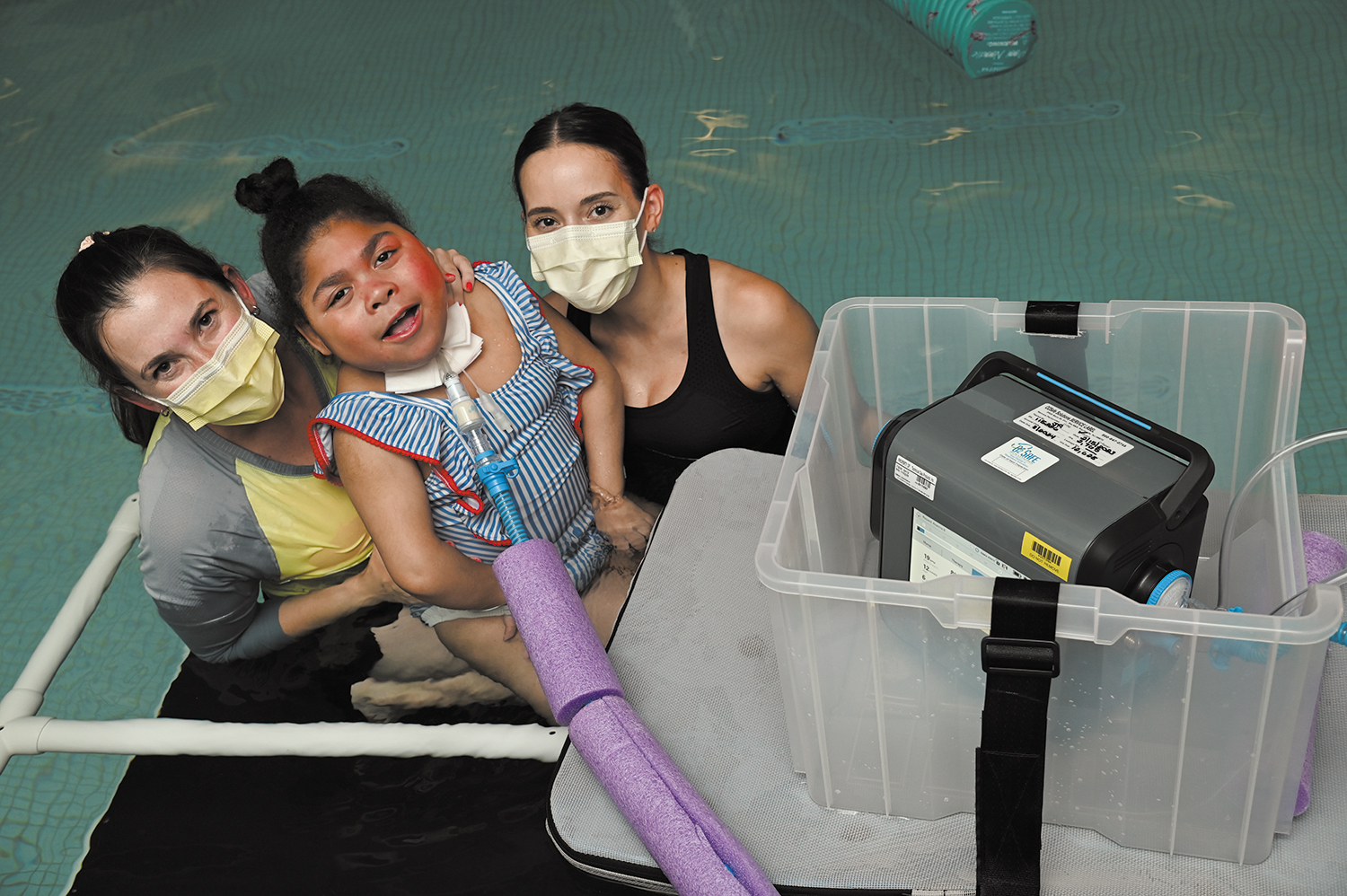
To allow for a hydrotherapy session for a 12-year-old resident of Elizabeth Seton Children's Center in Yonkers, New York, staffers act in concert with one another. Before Abigail Gonzalez even reached the pool, administrators and employees here raised money to cover a battery-operated, portable ventilator for her. Specialists in adaptive equipment at the center constructed an apparatus with a floating raft cushion, plastic boxing and pool noodles to keep the breathing equipment dry as it floats in the pool, and to keep the child's airways clear.
A lift has been used to lower the girl into the 92-degree water, and occupational therapists Antonella Gini and Maritza Rodriguez cradle her head and part of her body above water and part below. They do this so that she can better feel the differences between gravity on land and floating in the water, and because sensations like this can improve respiratory mechanics, as the center's Director of Respiratory Services Yelena Yadgarova explains. Certified nursing assistant Devi Ready monitors the child's health while she's in the pool. Abigail's complex diagnosis includes neuromuscular scoliosis and cerebral palsy with spasticity that affects her arms and legs.
"She's obviously comfortable, awake, engaging with us. That's a positive," Gini says. Abigail's having "the recreation of being free, of being a child, and just having the experience of being in the pool," adds attending pediatrician Linda Volpe. The hydrotherapy pool — in a humid room with mosaic tiled walls that include a sea turtle and sea horses — can be customized with bubbles, and the lights brightened or dimmed depending on a child's response. Today, soft string music plays, and it takes a beat before it's clear it's a Taylor Swift song playing — the preferred soundtrack of many a 12-year-old girl.
There's room for 169 youth at this long-term care center. Due to the medical complexity of their health, children often stay here for years receiving care for complex genetic disorders, physical and intellectual disabilities, and life-threatening medical conditions.
Children with severe disabilities who receive interventions are living longer than they used to, in large part due to medical and technological advances. Yet, staff at Elizabeth Seton Children's Center found that when children aged out of their facility at 21, about one-third of them died within the first year or two.1 They say the facilities the teens and young adults moved into did not have the same staffing levels and supports needed for around-the-clock care of the medically fragile.
REENVISIONING WHAT'S POSSIBLE
To respond to this need, the organization is building the Elizabeth Seton Young Adult Center on its other campus, about 13 miles northeast of the center in White Plains, New York. A ground blessing was held in August 2025, and the five-story, $156 million Housing and Urban Development-financed project is slated to open in 2028. Additional fundraising is ongoing.
Elizabeth Seton Children's Chief Executive Officer Patricia Tursi says, "It gives parents and guardians peace of mind to know that their child will be cared for." The young adult center will be unique in the number of medically complex young adults it cares for with room in time for 96 residents, and because the facility, unlike other nursing homes, will be designed for young adults.
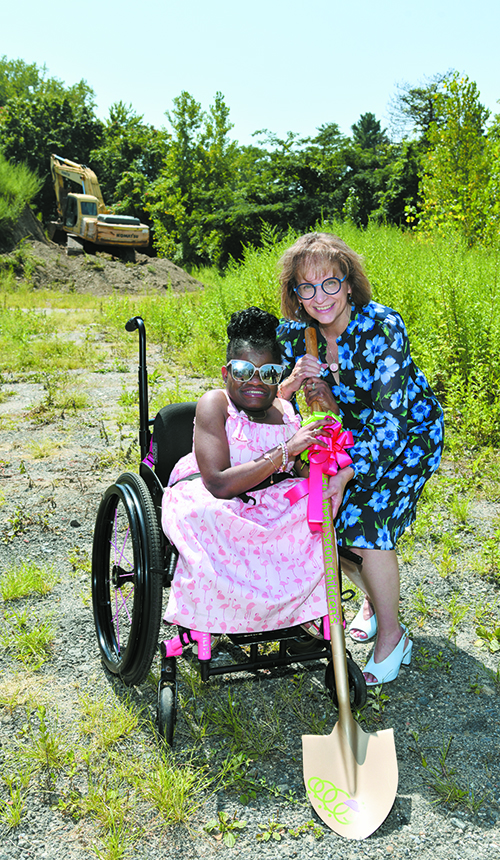
Stephanie Gabaud, 28, is among those who has been advocated for and planning the young adult center. A resident of Elizabeth Seton Children's, Gabaud, who has spina bifida, came to the center as a baby, returned home for a time and has now lived in the center for years as her medical needs warranted. Well-known for her work raising awareness about the center, she champions this project, and says it will make a real difference for young people. She talks about dances and games, 3D-printing and a chapel designed with windows to celebrate the young people who reside at Elizabeth Seton and the religious figures who hold meaning for them.
Gabaud, who has been blessed by Pope Benedict XVI and Pope Francis, says her faith is incredibly important to her. She feels spiritually close to figures like Elizabeth Seton, and Gabaud has drawn from her faith before, during and after incredibly complex surgeries and painful recoveries. "I just feel the Holy Spirit going through me," she says.
CAREGIVERS WITH AN EYE FOR DETAIL
Care this complex can be an endeavor of inches, rather than yards. When residents who staff care for are nonverbal, as almost all the children and young adults at Elizabeth Seton Children's are, care providers gauge their muscle tightness, breathing rate, vocalizations and eye movements to understand how they're feeling and what kind of day they're having. Paul Butler, DMin, director of spiritual care and mission integration for the organization, explains of the staff as a whole, "They're so attentive to details, the way a child moves their eyes, moves their head."
Art teacher Allison Klein says, "After 10 years, you know what some kids appreciate or don't appreciate." Each child is unique in how they communicate. She knows sign language for those who can sign, and also the personal reactions and responses of individual students. Today, she is building sculptures with residents and explaining gesso — a mixture used in art to coat surfaces — to them, as she shows a virtual video tour of a sculpture park on a screen behind her. "I've fallen in love with them," she says of the children. "I came here and said, 'Now I know where I belong.'"
From the outside, the center blends in with the hotels, strip malls and offices around it. But it's surrounded by a garden and adaptive playground, and inside a chapel and brightly decorated classrooms show the distinctions. Much of the artwork is placed up high or on the ceiling for youth in wheelchairs or beds who may have an easier time looking at the ceiling rather than the floor. Classrooms have specialized equipment built into them, including oxygen and suctioning equipment for when it's needed.
BUILDING ON TRADITION
The Sisters of Charity Ministry Network sponsors Elizabeth Seton Children's. The sisters' charism calls for them "reaching out to the most vulnerable and reading the signs of the times," says Butler. Elizabeth Ann Seton founded the Sisters of Charity in 1809 in Maryland. The sisters' many endeavors include the founding of schools and hospitals, and the Sisters of Charity of New York's roots of the current-day Elizabeth Seton facilities tie back to The New York Foundling, which cared for medically fragile children and still provides many social services. In 2005, the children's center became independent of The Foundling, with separate governance. Elizabeth Seton was canonized in 1975, the first U.S.-born saint.2
"I've fallen in love with them. I came here and said, 'Now I know where I belong.'"
— Allison Klein
The vision of the sisters, the years of advocacy and New York state's commitment in recent decades to funding for people with disabilities have allowed Elizabeth Seton's services to grow. "New York is a maverick in funding and providing this care," Tursi says. She says about 99% of the center's current residents receive Medicaid funding. The state then passed legislation in 2021, establishing the specialty nursing home as a demonstration program for medically fragile young adults aging out of pediatric care. It also allowed teenage and young adult residents to remain with Elizabeth Seton Children's until the new center is complete. It's expected that learnings from the young adult center may be shared more widely with other organizations caring for young people with medical complexities.
AN ADAPTIVE SCHOOL DAY
At the existing center, the elevators are referred to as "the school buses," as employees bring children in wheelchairs and on ventilators from the "neighborhoods," rooms where they sleep, down to the ground floor classrooms. Nurses, teachers, aides and therapists work together throughout the school day. In a prekindergarten classroom, kids learn about the days of the week, with adaptive equipment like a large, mobile button a child can tap to hear a prerecorded message from the teacher related to the day's lesson. In another room, children play football, with staffers placing the football in children's hands and throwing it for those who are unable, aiming for a target with a net. An assistant places one of her hands against the hand of a child as they clap together to celebrate a touchdown.
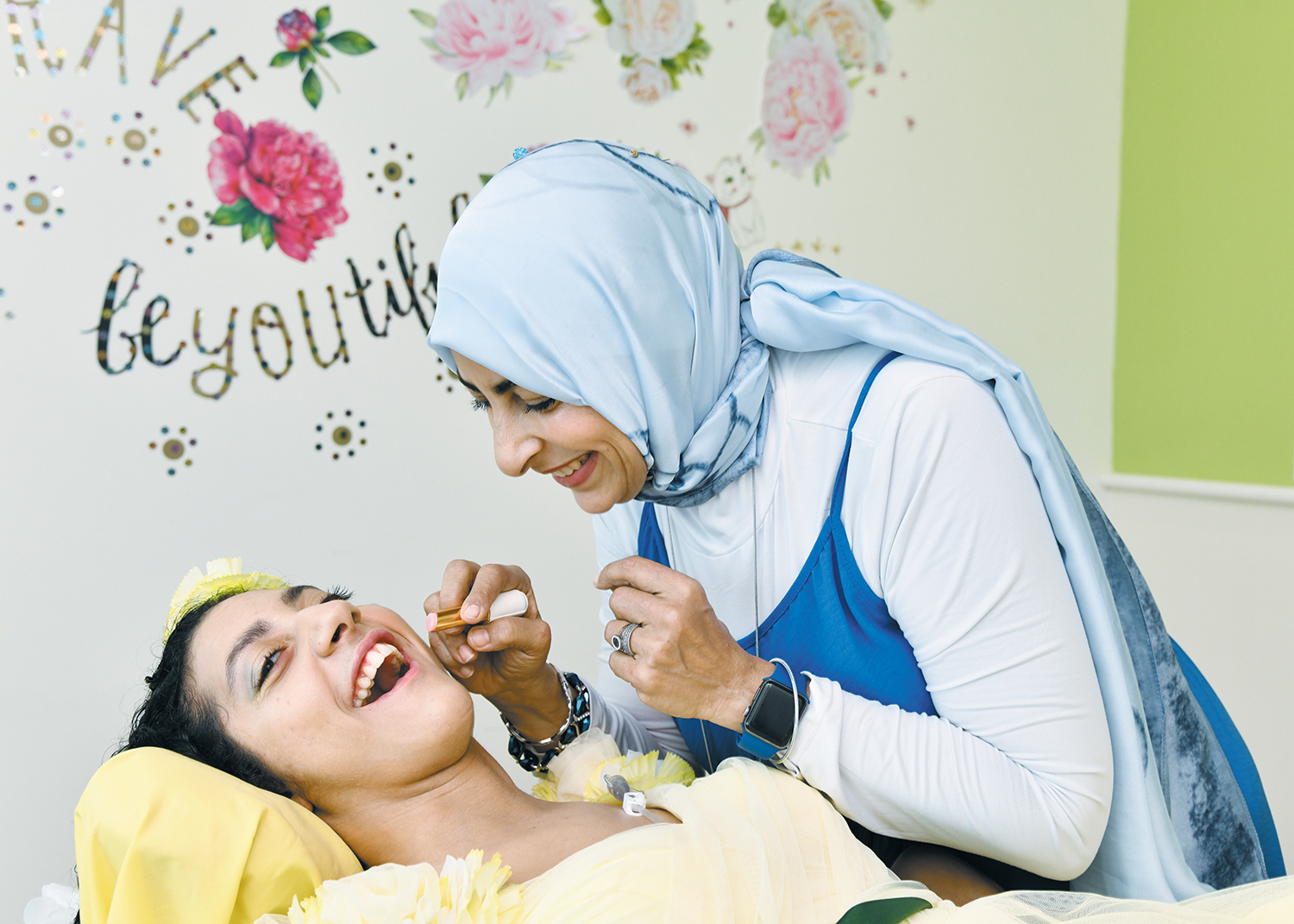
In a gaming room with large screens, the Nintendo settings for Super Mario Kart allow for modifications that make it easier for young people with different abilities to play. One resident uses an adaptive joystick, while another is in a wheelchair next to a therapeutic recreation assistant who plays on his behalf. "We have some residents that don't do the active gaming, but they feel the competition," explains James Maxson, director of creative arts therapies and a music therapist. The center also has a room for music therapy, including devices that allow children to hear or feel different sound waves, the pluck of piano strings or percussive beats. Therapists work with children in these rooms to rouse or soothe them, while assessing and conducting range of motion and breathing exercises.
Elizabeth Seton also cares for children at its White Plains location's school and rehabilitation center. Children come to this campus during the day, spending time in class and receiving services like occupational therapy and physical therapy, learning braille and using adaptive ways to communicate. Staff say these methods can range from basic to high tech, from using an eye gaze board to simple sign language to voice output technology. The students let their teachers know, "I'm here. It's me," says the principal on this campus, Stephanie Harris.
Building support and connections for families remains important, with an approach of, "Welcome to the family. We're here to help you and your child," Harris says. Parents and guardians can participate in a virtual meet-up group for parents.
Dr. Maria Pici, chief medical officer at Elizabeth Seton Children's Rehabilitation Center, located in the same building, says the center's approach is to combine therapies that work together for a child. As therapists hold one child alongside an exercise ball, she says movement is important, as when children move, they can develop a goal and work toward it. For some children, that goal may be working to sit or stand, and that can be helpful for their care and function.
The majority of children at this school also transfer out of these programs or graduate to other schools as they make progress. The new center to be built on these grounds will be for young adults who need high-acuity, around-the-clock care. Anticipation for it is high.
SHARED APPROACH TO CARE
Hugh and Renee Kelly are parents to three children, 15-year-old twin boys and 20-year-old Sophie, who currently lives at Elizabeth Seton Children's and needs care as a young adult. Sophie laughs and smiles when she's happy, cries or makes a face when she's sad. She enjoys cuddles and kisses from her family. "She really thrives when she listens to music, has music therapy or when she's with other kids," her dad says.
She has a duplication of the third chromosome that affected normal brain development. She has seizure disorder, microcephaly, vision and hearing loss and uses a gastrostomy tube. For 11 years, her family cared for her in a two-bedroom apartment in Jackson Heights, New York. "We did it because we didn't think anyone [else] could provide the level of love and care that she needed," Hugh says. Moving her to Elizabeth Seton Children's "was one of the hardest parenting decisions I've ever made in my life."
But of Elizabeth Seton Children's, he says: "It's a place of healing, love and hope." For severely compromised and sick children, families can rest assured their child receives care 24 hours a day. "For someone not a child, and not an elderly person, finding an appropriate care facility for them doesn't exist until they build this one," he says of the young adult center.
He described how many people feel a level of hurt when encountering a child with special needs, and may be inclined to turn away, rather than wrap their arms around them, whether literally or figuratively. But the Kellys say that is what the staff at Elizabeth Seton Children's do. They especially credit the Sisters of Charity for living out their mission in a committed and authentic way, and say those who work at the center create a place that offers joy, with an annual prom with homemade decorations, lip sync competitions, word games and crafts. The new center will provide the next step of complex, and also loving, care. Hugh says, "We're grateful we don't have to have any anxiety about that."
BETSY TAYLOR is the editor of Health Progress. She previously was a reporter at several newspapers and at the Associated Press. She spent the fall of 2024 at Stanford University as a program affiliate of the John S. Knight Journalism Fellowship.
NOTES
- Lisa Eisenhauer, "Center Would Fill Care Gap for Profoundly Disabled Young Adults," Catholic Health World, September 1, 2019, https://www.chausa.org/news-and-publications/publications/catholic-health-world/archives/september-1-2019/center-would-fill-care-gap-for-profoundly-disabled-young-adults.
- "The Life of Saint Elizabeth Ann Seton," Seton Shrine, https://setonshrine.org/elizabeth-ann-seton/.