

When I joined the Mission team at CHA in January 2020, one of my first major projects was to lead a comprehensive revision of the Mission Leader Competency Model. The model had remained unchanged for nearly a decade and no longer reflected the evolving responsibilities of mission leaders in Catholic health care. Recognizing the importance of this work, we convened a diverse work group that included mission leaders, human resource professionals, leadership development experts and others. To ensure the model was grounded in real-world insights, we also conducted focus groups with CEOs, senior mission leaders, sponsors and additional partners across the ministry.
The result was an enhanced model that elevated three critical competencies — operations, strategy and advocacy — underscoring the increasingly strategic and integrative role of mission leaders. We also reinforced that general leadership competencies are essential for mission leaders, as they are for their peers, and these are now woven throughout all seven core mission competencies. A notable example of this integration comes from Catholic Health based in Buffalo, New York, which developed the Mission-Differentiated Leadership Competency Model. Their approach illustrates the reciprocal value of embedding mission into leadership expectations at every level, reinforcing mission as a central, unifying force throughout the organization.
ANNUAL EVALUATIONS AND PLANNING: HARNESSING SACRED PURPOSE TO SHAPE THE FUTURE OF CATHOLIC HEALTH CARE
BART RODRIGUES, MDiv, MA, MBA, JOYCE MARKIEWICZ, RN, BSN, MBA, and LAURA CIANFLONE, MA
At Catholic Health, we stand at a pivotal moment, charged with leading with clinical excellence and a sacred purpose rooted in the healing ministry of Jesus Christ. As the presence of vowed religious diminishes and lay leaders take on more significant roles, the question arises: How can we uphold our mission while meeting the operational demands of modern health care? Our answer lies in the Mission-Differentiated Leadership Competency Model.
This innovative model equips a mission-differentiated leader in Catholic health care to embrace and manage the paradoxes and complexities of business and mission, as well as the balance between margin and mission. It tailors specific competencies and behavioral expectations to career ladders or leadership stages. It is designed to drive the organization's sacred purpose, vision, mission and values, and we believe it has the potential to shape the future of Catholic health care.
CLARIFYING LEADERSHIP EXPECTATIONS ACROSS DISCIPLINES AND CAREER STAGES
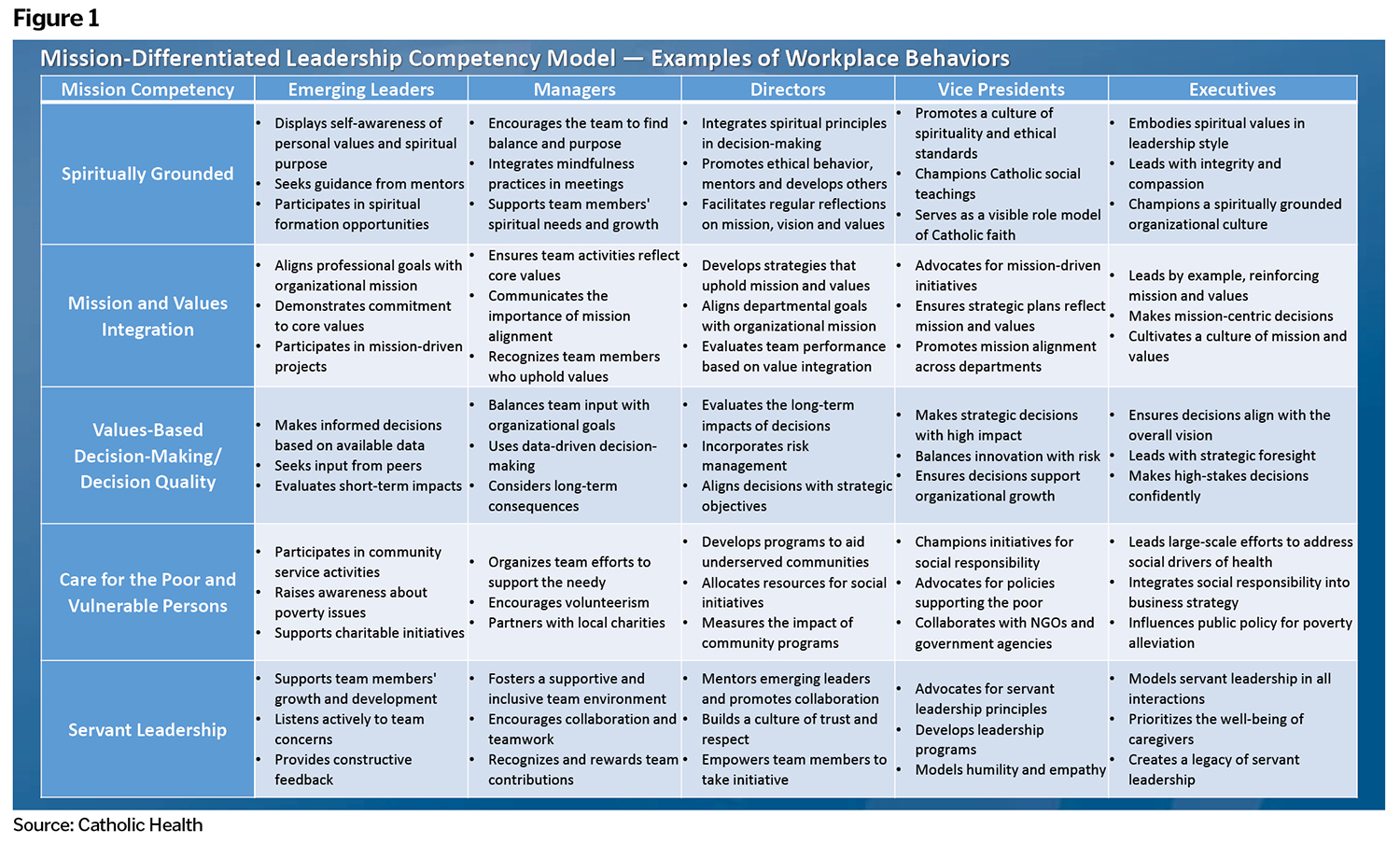
Our leadership development consultancy partners, FranklinCovey and Korn Ferry, helped us define measurable behaviors and performance expectations for leaders at every stage of their careers — from emerging leaders and supervisors to managers, directors, vice presidents and senior executives. This clarity fosters both alignment and progression, enabling leaders to understand not only what is required of them today but also what will be expected of them as they grow, both in business and in the sacred purpose of our work. It guided the development of the Mission-Differentiated Leadership Competency Model, which outlines five core mission competencies and their observable behaviors (see Figure 1 above, with more details about the model available here). These competencies are now embedded in our annual leadership performance reviews.
This tailored, scalable model reflects Catholic health care's dual nature — as both a sacred mission and a complex business — reinforcing Catholic Health's shared commitment to its future. By engaging in a strategic collaboration to develop the competency model, we wanted to instill confidence in our performance evaluation process and strengthen the direction of our organizational development initiative. The competency model built on existing work at Catholic Health related to leadership development and ministry formation.
Organizational Development: Catholic Health's Leadership Enhancement and Development program and our Ministry Formation program are two interdependent pillars within our organizational development framework. Together, they provide a holistic approach to personal and professional growth, ensuring that mission integration is not only understood but actively embodied in daily operations and leadership practices.
The Leadership Enhancement and Development program was launched a couple of years ago to support the professional development of leaders across our system. Through this yearlong program, participants learn to build highly effective teams, navigate change and deliver exceptional results, thereby developing their leadership skills and advancing their careers.
Ministry formation programs offered through CHA and internally within our system at Catholic Health create experiences that invite those who serve in Catholic health care to discover connections in the purpose between the "personal why" (personal purpose) and "organizational why" (organizational purpose). They serve as a wellspring for personal renewal and professional resilience, ensuring that our leadership practices remain faithful to the Church's healing ministry.
Our Ministry Formation program has adopted CHA's Framework for Ministry Formation. We are building on this framework by incorporating our model's five core competencies: spiritually grounded; mission and values integration; decision quality and values-based decision-making; care for the poor and vulnerable persons; and servant leadership. Each competency includes a behavioral framework that articulates observable behaviors at various proficiency levels, fostering both accountability and growth, as embedded in annual performance evaluations for leadership.
Embedding mission competencies and observable behaviors into annual performance strengthens the case for the importance of ministry formation amid ongoing economic challenges. By leveraging our model's competency and behavior framework, ministry formation proposes a set of integrated elements and a shared language that supports the organization's mission and Catholic identity, driving cultural transformation.
Annual performance evaluations, competencies and behaviors: Competencies define the necessary knowledge and skills, while behaviors describe how leaders apply those competencies in practice. By evaluating both competencies and behaviors, organizations gain a holistic view of a leader's contribution, ensuring they not only possess technical expertise but also demonstrate the interpersonal and professional qualities needed to deliver high-quality patient care.
Performance reviews that affirm and reward desired behaviors can significantly contribute to employee satisfaction and retention. Leaders are evaluated not just on outcomes, but on how they achieve those outcomes in alignment with Catholic identity and values.
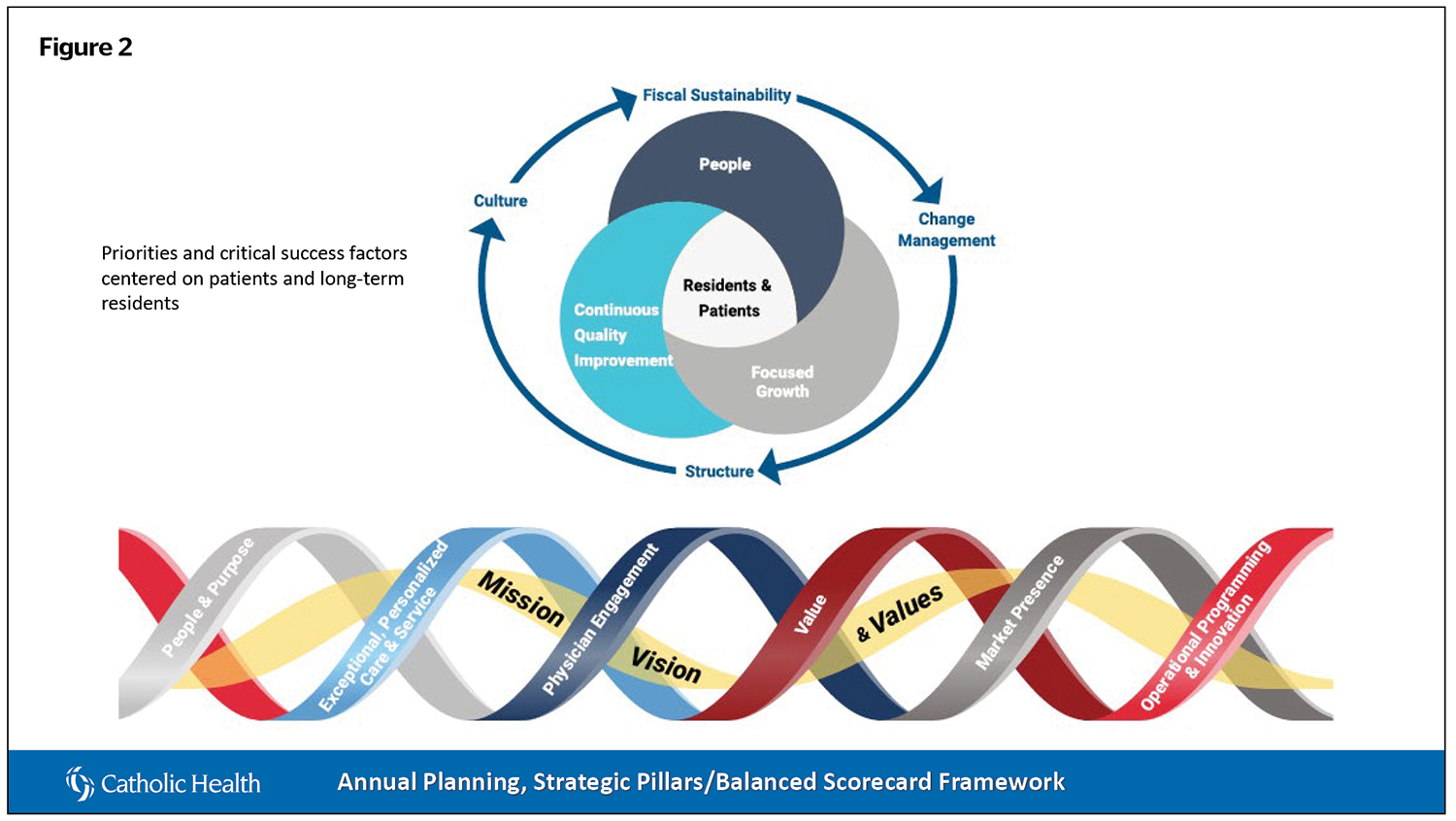
Annual planning, integration and balanced scorecard: Rather than treating mission as an add-on or as a parallel track to operations and business, both mission and business aspects are embedded like a ribbon, woven together and integrated, serving as the core of our six strategic pillars (see Figure 2 above): people and purpose, exceptional personalized care and service, physician engagement, value, market presence, and operational programming and innovation.
Our priorities — people, continuous quality improvement and focused growth — are centered on patients and long-term residents. At the same time, we are mindful of critical success factors, such as structure, culture, fiscal sustainability and effective change management in our annual planning and balanced scorecard efforts. What distinguishes this Mission-Differentiated Leadership Competency Model is its integration not only into our annual performance evaluations for leadership but also into our annual balanced scorecard priorities. (Such scorecards allow for strategic planning and management at organizations.)
Health care is evidence-based — the need for data, measurement and influence: In today's evidence-based health care environment, Catholic Health continues the shift from paper to digital, which enables us to more effectively support our mission by aligning leadership development with both our spiritual values and strategic goals.
By capturing insights from annual self-assessments and manager evaluations, we can now track competency growth across both mission-driven and operational areas, identify emerging leaders, and design coaching, mentoring and formation programs grounded in real performance data. This approach enhances accountability and transparency, ensuring that individual goals are meaningfully aligned with our organizational priorities. Most important, this transformation fosters a culture of continuous learning and improvement, essential to our promise of delivering high-quality, person-centered care rooted in the healing ministry of Jesus.
A COMMITMENT TO LEGACY
We have much work ahead of us to fully embed the vision established here, which requires partnership and collaboration among mission, human resources, leadership and other stakeholders. It is a multiyear initiative that is worthy of the effort. We aim to establish clear expectations, create a nurturing environment, foster well-being and career growth, promote increased engagement and retention, improve performance and facilitate professional development that enables our workforce to flourish.
Commitment, accountability and sustaining a sacred legacy: As lay leaders assume roles traditionally held by religious members, shared accountability becomes essential. The competency and behavior model supports online 360-degree evaluations and reinforces the legacy of Catholic health care sponsors. As the Church entrusts more leadership to the laity, this framework becomes essential. It is not only a response to an internal need, but also a proactive measure and a strategic foresight, aimed at securing the future of Catholic health care.
This proactive approach should reassure the skeptics about the future of Catholic health care. This work is also a testimony to hope. By equipping leaders who can carry forward the ministry with integrity, compassion and competence, Catholic Health demonstrates a commitment to both its legacy and its future.
DENNIS GONZALES, PhD, is senior director, mission innovation and integration, for the Catholic Health Association, St. Louis. At Catholic Health, based in Buffalo, New York, BART RODRIGUES is executive vice president and chief mission and ethics officer. JOYCE MARKIEWICZ is president and chief executive officer. LAURA CIANFLONE is senior vice president of human resources.