
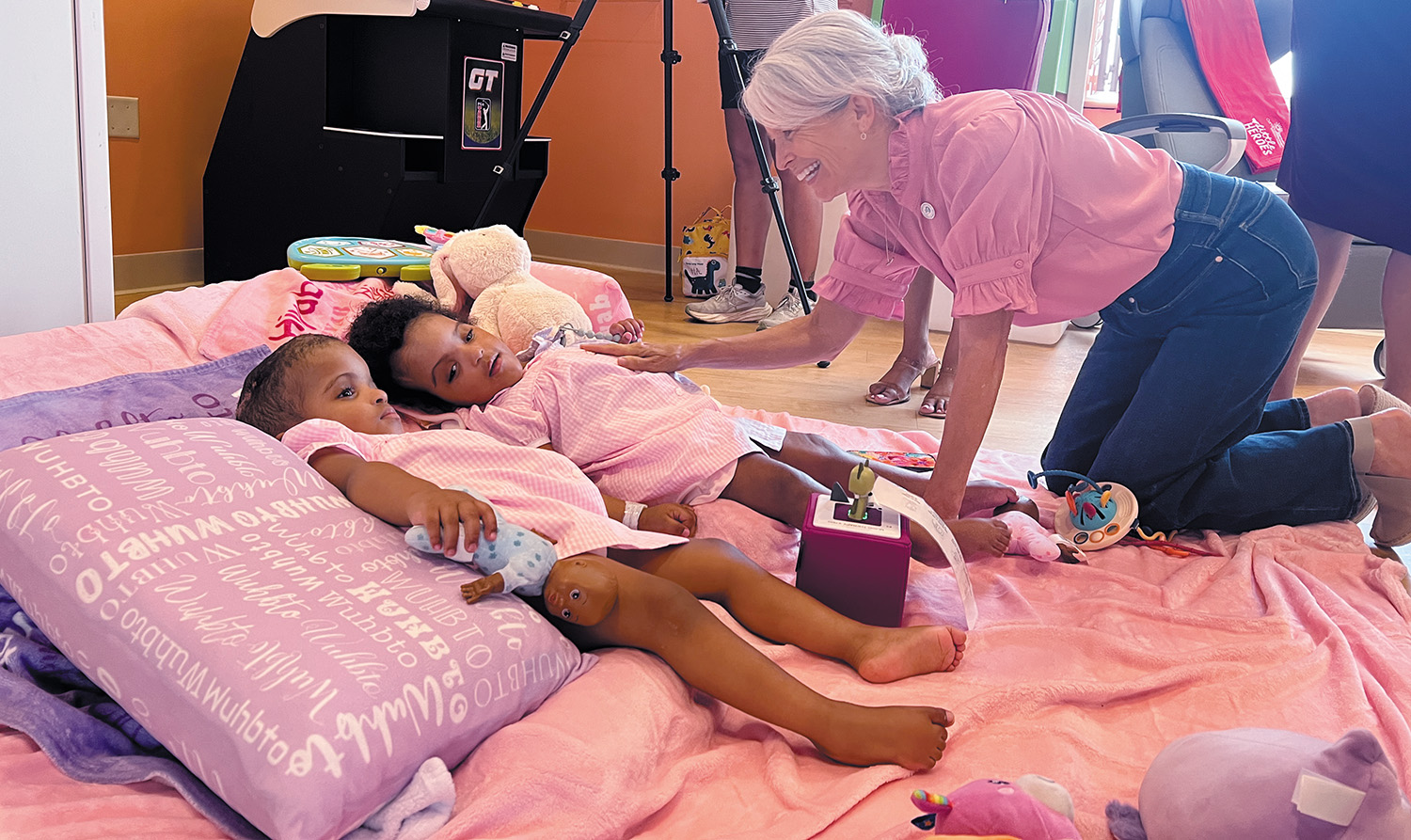
ST. LOUIS — By all accounts, Hiyab and Wuhbto are wide-eyed, twin 2-year-old girls who love to play together, kick and smile to music, and work on learning to sit up.
"They're also starting to do all the things that toddlers are known for, like refusing to take a nap, taking each other's toys," said Dr. Nick Holekamp, chief health transformation officer at Ranken Jordan Pediatric Bridge Hospital in suburban St. Louis, where the twins are undergoing rehab.
Such normalcy wasn't possible just six months ago. The girls, from the Tigray Region of Ethiopia, are craniopagus twins, meaning they were born fused at the skull. Surgeons at SSM Health Cardinal Glennon Children's Hospital in St. Louis successfully separated them at 2:31 a.m. Feb. 25 in a 25-hour surgery.
More than 60 caregivers — surgeons, pediatric hospitalists, intensivists, nurses, imaging specialists, therapists, anesthesiologists, and more — were involved in the operation.
"This achievement reflects SSM Health Cardinal Glennon Hospital's commitment to providing highly specialized pediatric care for those facing the most complex medical conditions," Dr. Hossain Marandi, president of the hospital, said at a press conference Wednesday. "It is also a testament to the expertise, compassion and dedication of countless caregivers who came together with one goal in mind, creating the best possible future for these two beautiful girls."
He credited the partnership of World Pediatrics, Lola Children's Home in Ethiopia, Ronald McDonald House Charities, Ranken Jordan and other organizations and individuals for their part in helping the girls.
An 'exceedingly rare' operation
Craniopagus twins are found once in every 2.5 million live births and represent just 2-6% of all conjoined twins.
Separation is risky and complex.
"Even though this has been done before, it's exceedingly rare," said Dr. Kevin Chen, plastic surgeon and director of the 3D lab at Cardinal Glennon, which was used extensively to plan the numerous surgeries needed to separate the girls and rebuild their skulls.
Only 32 craniopagus separations have been performed in the last 30 years, and only 62 in the last century, Chen said. In most surgeries in the first 50 years, one or both of the twins didn't survive.
"So we've been advancing the way that the surgery has been done significantly over the last couple decades," he said, "and even with that, with a couple trailblazers before us, a lot of the things were unknown, and a lot of things were being discovered and figured out for how it was going to work for us."
The hospital separated craniopagus twins in 1984. Devon and Jevon Wilson, of Washington Park, Illinois, were separated in a 10-hour operation. A leader of that effort, neurologist Dr. Richard Bucholz, advised the present-day team.
The medical team is working on several articles about the separation that they hope to publish in journals so that others may learn.
A phone call and an X-ray
Dr. Andrew White, chief medical officer of the hospital, first got a phone call about the twins about two years ago, when the girls were several months old. He had worked in Ethiopia before and he coordinated with the nonprofit World Pediatrics to fly the twins to St. Louis in March 2025, when they were almost a year old. World Pediatrics has connected more than 29,000 children to advanced pediatric care that they would otherwise not have had access to.
Ethiopian Airlines removed six rows of seats from a plane to safely accommodate the girls and those traveling with them. The Cardinal Glennon doctors had only an X-ray of the twins' skulls to study before seeing the girls in person.
"At its heart, this is a story of local and global collaboration coming together on behalf of two children," White said.
All the organizations and others pitched in to pay for the effort.
Because of social and visa issues, the twins' parents could not join them. The Lola Children's Home in Ethiopia has been working with the family to care for the girls and sent representatives to stay with them.
Planning the medical care for the girls took months, requiring extensive imaging, simulations and multidisciplinary reviews, said Dr. Joanna Kemp, a neurosurgeon at Cardinal Glennon.
"This case demonstrates what can happen when experts from multiple disciplines come together around a shared goal," she said.
Besides the actual separation, the girls' care involved at least other six other operations. Four surgeries involved separating blood vessels, Kemp said. The twins' brains were largely unconnected, save for a couple small fused areas. Surgeons placed balloon expanders under their skin to allow it to stretch and provide enough coverage for their skulls once they were separated.
The twins were conjoined at the widest part of their skull and facing opposite directions, Chen said as he held up one of several plastic 3D models used to help plan the surgeries.
"So they're missing the most bone, the most skin possible, and we scraped and scrounged just to maximally get as much skin as we could, so that the separation can be successful," he said.
The surgical team tried to be consistent with their models: using the color blue for Hiyab and red for Wuhbto. A tiny screw doctors inserted on the side of Hiyab's skull helped doctors distinguish the girls on imaging and X-rays.
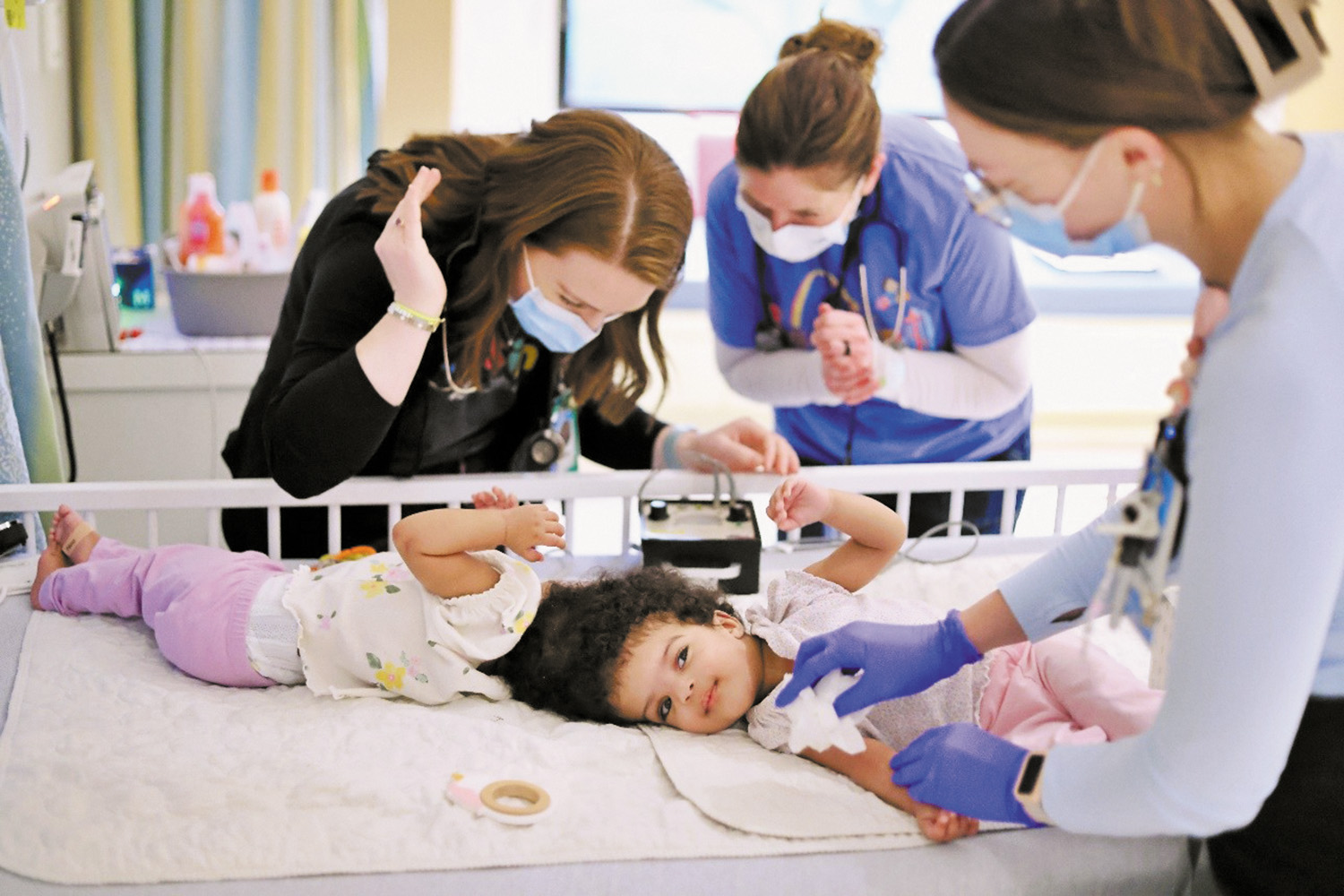
Since the successful separation, Wuhbto has undergone cranial reconstruction surgery, and Hiyab faces a similar cranial reconstruction later this fall.
"While there's still more work ahead, each step is focused on supporting their continued growth, development and quality of life," Chen said.
Distinct personalities
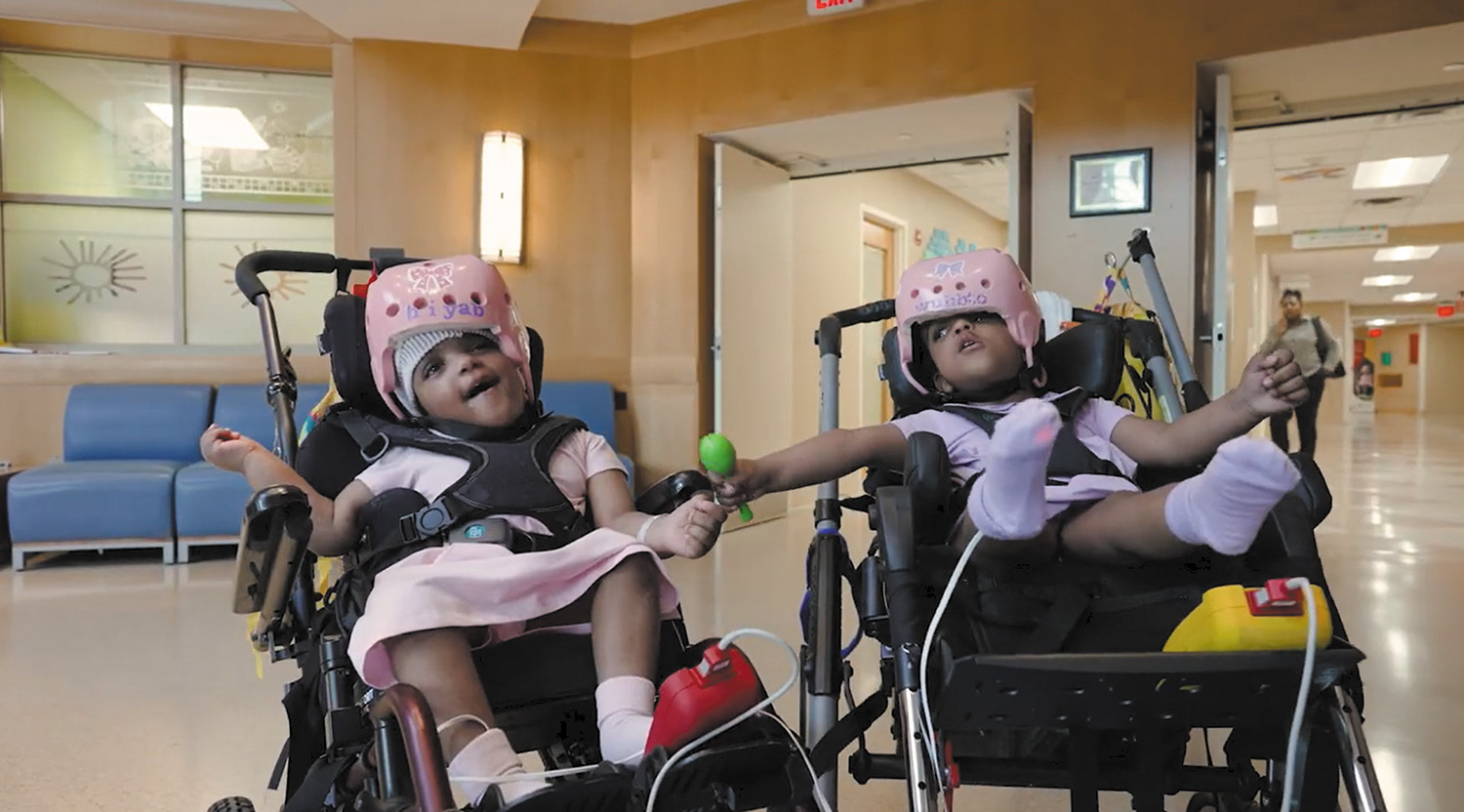
The girls spend much of their time at Ranken Jordan, working on individual therapies and skills such as sitting upright, eating, speaking, socializing and playing with other children, said Holekamp. They visit Cardinal Glennon for healthcare needs.
"They've gone from being conjoined at the head in such a way that they were always fully reclined and couldn't even see each other, much less interact functionally with each other," he said. "Now they are beginning to be able to sit and move on with their lives independently."
Kate Corbett, a senior program director with World Pediatrics, is one of the girls' main caregivers.
She said that while the girls love a lot of the same things — playing, singing songs, being outside — they are also very different. Wuhbto, affectionately known as Woobs by her caregivers, "is outgoing, feisty and rambunctious in the best way," Corbett said. She is "always moving," and seems "about to hop out of her wheelchair" when she hears her favorite song, "Dance, Dance, Dance."
Hiyab is a "sweet, social young lady who welcomes you in immediately," Corbett said. "She is so smart, and understands all of our silly, funny jokes, and just smiles. And our best days are when she gets the giggles and just can't stop laughing.
"So they're just both so smart and so joyful."
Corbett said she was honored to be in the room the day the twins first saw one another, a few weeks after the surgery. Caregivers finally were able to put the sisters in bed together. "Never before had they been able to snuggle up to each other and reach for each other, and be together in that special, sisterly way," she said.
Looking to the future
When the girls return to their family in Ethiopia — in the not-too-distant future, doctors hope, and perhaps in their own airplane seats — they will join their parents and two brothers, who stay in close touch with caregivers. Caregivers frequently hold up their phones to the girls to play videos made by the family or connect them over FaceTime.
They will also reunite with the family they have made at Lola Children's Home in Ethiopia, which has also provided and coordinated care for the girls. Abebe Fantahum, founder of the home and guardian of the twins, smiled broadly as he spoke for a video that was played at the press conference.
"When I think about Hiyab and Wuhbto's future, I see two joyful girls continue to grow, learn and discover who they are as individuals," he said. "My hope is that they will return home knowing how deeply they are loved, both in Ethiopia and St. Louis. Dear, beloved community in St. Louis, these girls are here because you chose to care."
Watch: Global team of caregivers tell the story behind the complex procedure (YouTube)