
"Somebody said to me one time, 'If you help change the perspective for one doctor to help them feel better, how many families will you impact through just that one person?'" said Rev. Greg Hershberger, an Anglican priest who is the manager of spiritual care for four Ascension Florida hospitals in the Gulf Coast area. "That's pretty humbling to think about. If I have one doctor who enjoys their career better because they have more support, even better."
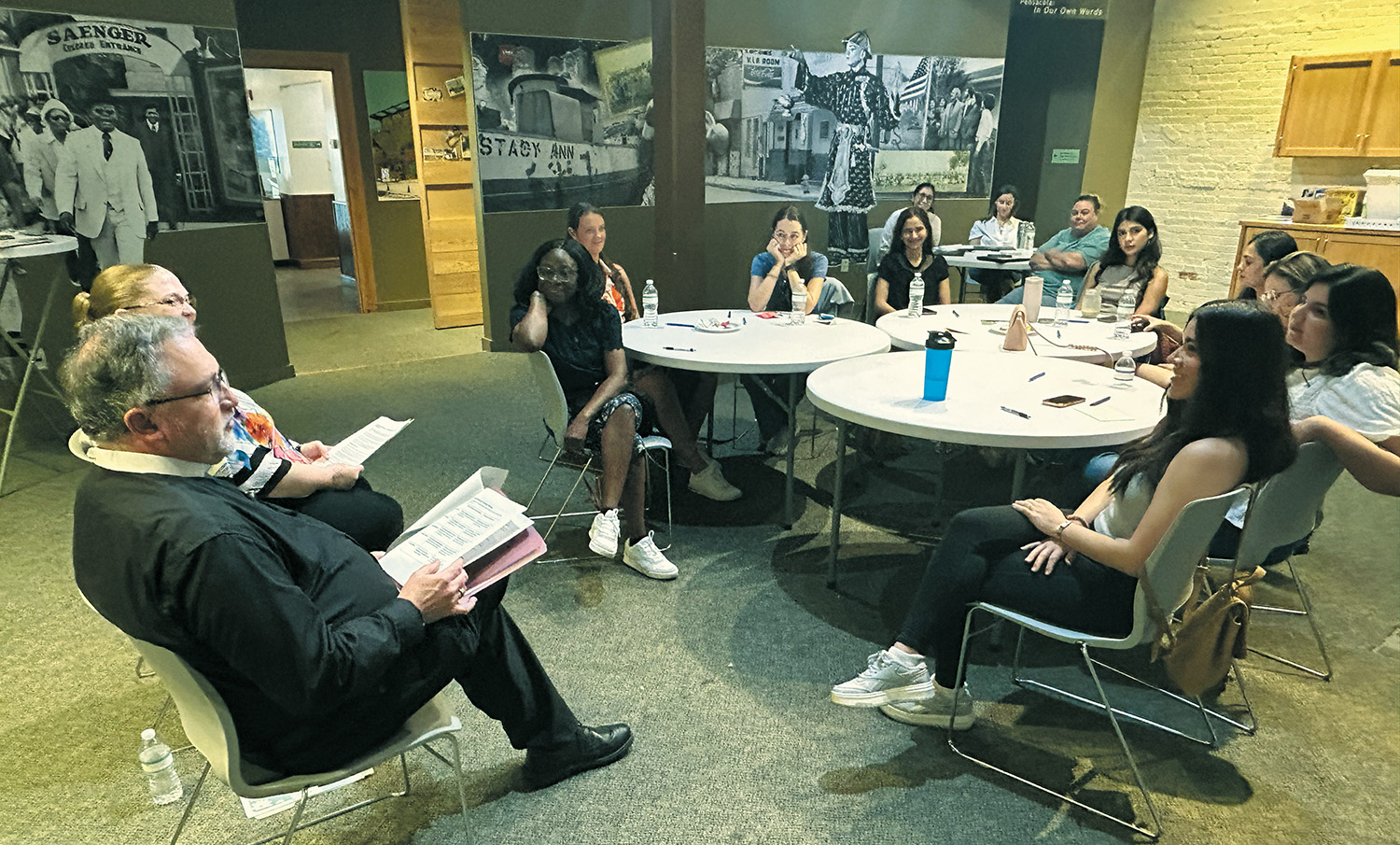
Rev. Hershberger and members of his team, including spiritual care specialist in clinical education Cristy Sutton, have developed an in-person training program called Compassionate Conversations to teach physician residents how to deliver a devastating diagnosis and how to integrate spiritual care into a family's worst moment. The program started in November 2025 after a trauma surgeon requested that the spiritual care team talk to trauma residents about how to have difficult conversations with families and how to care for themselves before, during and after those conversations, Sutton said.
The program is spreading to other parts of Ascension Florida and has the potential to be replicated and used in other parts of the Ascension market. It started as an hour-long session every quarter with trauma and general surgery residents and is now a yearly conversation with OB-GYN, emergency medicine, internal medicine and pediatric resident groups. The program runs for two hours, with Sutton and Rev. Hershberger as instructors, and has expanded over time with discussions about case studies and issues physicians struggle with. As of mid-September, they have held seven seminars with a total of 68 residents.
Building on a framework
Compassionate Conversations grew out of another effort called Breaking Bad News, which was an interdisciplinary approach that focused on the SPIKES protocol, a six-step framework used by healthcare workers to deliver difficult or bad news to patients and their families. SPIKES stands for Setting up the interview, assessing the patient's Perception, obtaining the patient's Invitation, giving Knowledge and information, addressing Emotions with empathy and Strategy and Summary.
Compassionate Conversations builds on that framework, focusing on integrating the spiritual part of difficult encounters. Participants discuss how to use mindfulness prior to entering the room, while in the room and after leaving.
Rev. Hershberger said a colleague mentioned that dealing with an encounter and talking about it can be awkward. "That's a really honest way to approach it," he said. "That's what we're trying to do, is give people a safe place to say out loud some of the things that are challenging about it and just reflect for a moment on why it is challenging. And if we do it several times in a day, how do we maintain our own health?"
Careful language
One component of the training involves the language best used in difficult conversations. For example, Sutton said, the training encourages doctors to use the word "died" rather than "passed" or "expired" because families may not understand what those words mean. It helps the families understand that their loved one has died, she said.
"But it's not just death situations that we talk about," Sutton said. "It's also those situations where a patient comes in as a trauma and they have a non-survivable brain injury, a patient comes into the hospital and is diagnosed with a terminal condition, or a patient comes in and is diagnosed with a chronic illness. It's about helping them to understand the gravity of the situation. What does non-survivable, terminal or chronic mean?"
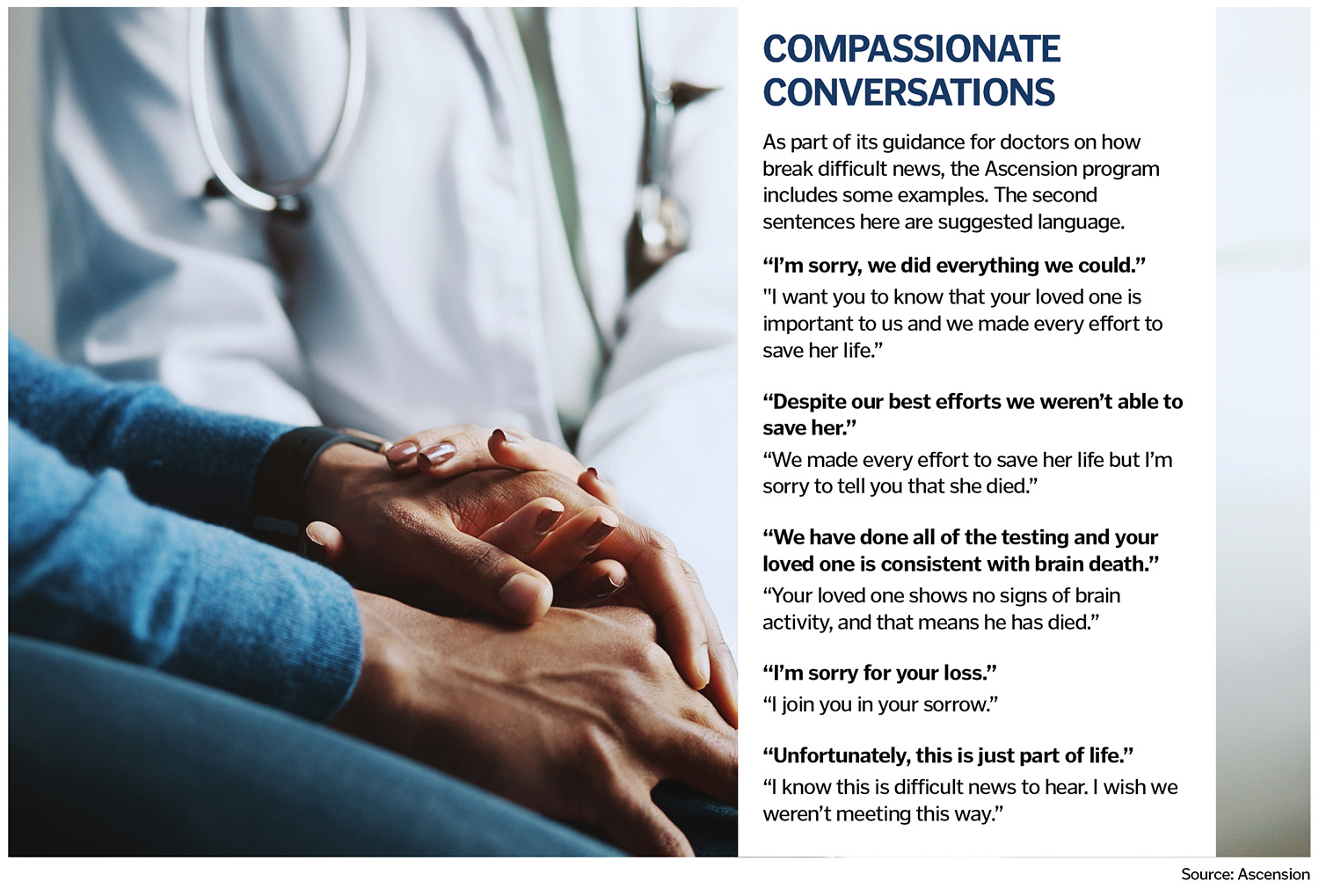
The training includes a resource that offers alternative ways of saying certain things when speaking to patients and families. For example, instead of saying, "Unfortunately, this is just a part of life," a clinician could say, "I know this is difficult news to hear. I wish we weren't meeting this way."
Using phrases like, "at least they didn't suffer" or "at least they lived a long life," minimizes the family's grief and can make it seem invalid, the handout says.
The spiritual care team encourages doctors to ask for a chaplain to accompany them for difficult conversations. Before the doctor arrives to share news, a chaplain often can spend time with the family to get an idea of what the family understands at that point, and a chaplain can brief the doctor.
"So, if a family thinks the person's getting better and you (as a physician) know they've died, that's a huge gulf to jump," Rev. Hershberger said.
Having a chaplain in the room can help the doctor pick up a family's reaction as the doctor speaks, and the chaplain can provide extra support. Also, the chaplain often can spend more time with a family afterward when the doctor cannot.
"It's challenging to be the person who gives the news, and then also the comforter, and then the explainer," Rev. Hershberger said. "I always tell physicians it's not that we're doing it wrong. It's just that one person was never able to do all those things at the same time."
Now that this program is in place, the chaplains see more moments of connection with doctors after they meet with families and patients, even if it's just a 30-second interaction in a hallway. Doctors and residents are asking the spiritual care team to come back for quarterly debriefings, so they can talk through those encounters further.
What grounds this work, Ascension spiritual care leaders say, is helping physicians know they are not alone in dealing with the most difficult conversations they have to deliver. Also, the work goes beyond supporting patients and their families to include the well-being of Ascension physicians and clinical teams.
"We're just acknowledging the physician and saying, 'That was tough. You know, I'm with you,'" Rev. Hershberger said. "They often remark that's a very meaningful exchange because it's private. It's not formal. But we're just acknowledging the moment."
Expanding the program
The Compassionate Conversations program launched in Pensacola, expanded to other Ascension sites on Florida's panhandle, and more sites have requested it. It now extends past the health system: the Eglin Air Force Base chaplain corps in the western Florida panhandle is training alongside the Pensacola team for trauma response.
Sutton and Rev. Hershberger developed a presentation that they hope to deliver next year for the Association of Professional Chaplains. They hope to support physicians everywhere during difficult moments.
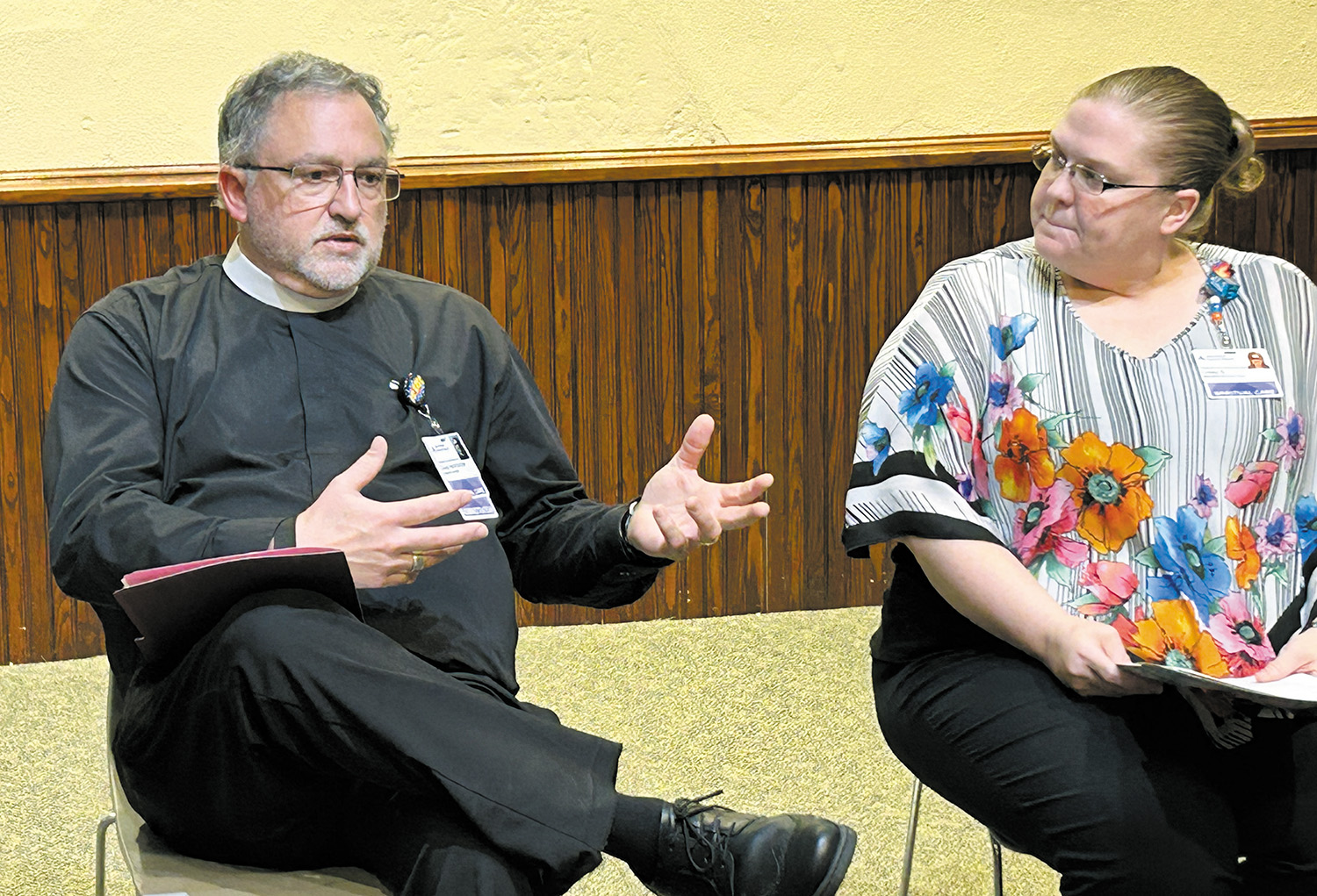
Sutton and Rev. Hershberger used a boat analogy to explain the concept behind the training. Medical professionals and people in spiritual care can join patients and their families in their boat if invited, or they can push the patients and their families away.
"The boat experience isn't always fun," Sutton said.
The boat can have holes, take on water and be buffeted by strong winds, but people don't want to take that ride alone, she said.
Rev. Hershberger said climbing into a boat has to be done carefully. "Jumping in, you're going to tip the whole thing over. So somebody stabilizes it while the other person gets in, but everybody has to work together, right? That's kind of how I see it," he said. "We're always aware of our own needs, but also making space for someone else."