
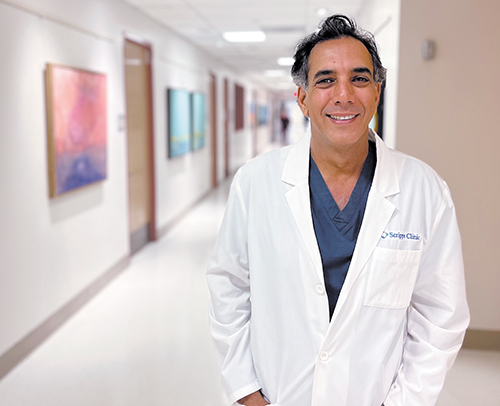
Like many doctors around the country, over the last several years Dr. Sean Daneshmand has seen more women with complicated pregnancies, such as gestational diabetes, preeclampsia, or with chronic medical issues including high blood pressure and cardiovascular disease. More expectant mothers are obese or severely depressed.
Daneshmand, medical director for the Scripps Clinic Maternal-Fetal Medicine Program for San Diego-based Scripps Health, started the Fourth Trimester Continuum of Care program last fall to address the needs of these women.
The program is designed to identify high-risk mothers before they give birth and help them get the care they need shortly after they deliver — in the "fourth trimester." In 2024, about 9,000 babies were delivered at Scripps Health's hospitals across San Diego County. Two of its five hospital campuses, Scripps Mercy Hospital San Diego and Scripps Mercy Hospital Chula Vista, are Catholic.
"New moms, as you know, always put their baby's health above their own," he said. "And we need to make sure they take care of themselves in order to be there for their child. We know that women truly are the CEOs of our community. They really are the centerpiece of the family and society. So we need to go the extra miles to take special care of them."
Worsening outcomes
Daneshmand cited a Blue Cross Blue Shield report that says pregnancy complications increased by more than 16% from 2014 to 2018. The report says that among pregnant women, there has also been a 35% increase in major depression, a 31% increase in hypertension, and a 28% increase in Type II diabetes.
In the United States, pregnancy-related deaths continue to rise, with one 2025 study citing cardiovascular disease as the leading cause, accounting for more than 20% of maternal deaths. Another study says the prevalence of chronic hypertension in pregnancy has doubled from 2007 to 2021.
"Unfortunately, I don't think the trend is leading towards a healthier society, whether it's activity, whether it's diet," he said. "But we know that physical, preexisting conditions before pregnancy have been on the rise."
Building bridges
In the Fourth Trimester program, when clinicians identify risk factors in a pregnant woman, they flag them in the patient's chart, Daneshmand explained. After the woman delivers her baby, an automated message goes to her primary care team to schedule an appointment, in addition to their two usual postpartum visits with their obstetrician/gynecologist.
"Rather than relying on the moms to initiate the appointment, we make sure that we're proactive with follow-up with their primary care physician soon after the delivery," he said.
Also, at the baby's pediatric visits, the pediatrician is prompted to ask the mothers about their health as well.
"Essentially, we're building a bridge to get patient care," he said. "And this includes a close collaboration between maternal-fetal medicine, primary care, administrative leadership and obviously others."
While it's too early to analyze the data collected so far from the program, Daneshmand personally knows patients with severe hypertension who have benefited.
A broader effort
The Fourth Trimester Continuum of Care supplements other Scripps Health initiatives to help pregnant mothers. In recent years the system has added:
- Two dedicated patient navigators who work with women in high-risk pregnancies, which Daneshmand said is rare in a maternal-fetal medicine specialty. The navigators help coordinate tests and appointments and answers patient questions. "It makes sense to have something like this, because stress has consequences that we're not aware of," he said. "We still don't understand the biological effects of stress, not only on the mother herself, but also on the child. So we're doing everything we can to make sure that this mom has someone to talk to, and there's someone in charge who is collaborating and making sure that those questions are addressed."
- A neonatal intensive care unit partnership between Scripps and Rady Children's Hospital in San Diego. The partnership has been in place since the mid-1990s. If a mother has a complicated pregnancy, the baby often will spend time in the NICU at Rady's. "This is very important to the families, because they receive specialized expertise at Rady Children's, with Rady Children's experts," Daneshmand said.
- Close partnerships with local community health clinics, specifically those run by San Ysidro Health, a federally qualified health center that has more than 50 clinics and program sites across San Diego County. The clinics serve a largely Hispanic community, and Scripps provides maternal-fetal medicine services to those patients, including care for high-risk pregnancies. "This improves equity, obviously expanding these services and access to these moms," said Daneshmand.
Daneshmand hopes the initiatives can serve as a model for other health systems. He's passionate about his work because of the connections he makes with his patients during pregnancy, a very "raw and real" experience for mothers. Their unconditional love for their child starts the minute they see the heartbeat, he said.
"And regardless of where we come from, our political views, all the differences that people see in the world, all of us love our children the same way. We all want the best for our children, and that's what unites us." he said. "For us, it's how do we make sure that society is better as a whole? We have to focus on moms."