

Clatsop County in Northwest Oregon already had a shortage of child care options when the pandemic greatly exacerbated the problem.
Concerned about the situation, a collaborative of leaders from public and private organizations convened to assess the problem and come up with solutions.
Providence St. Joseph Health's Oregon region is a backer of the Clatsop Child Care Retention and Expansion Program. Providence Seaside Hospital is in Clatsop County. The collaborative has used public and private dollars to issue grants to stabilize and expand child care providers in the community, teach them to run their businesses more smartly, train their staff and provide scholarships to parents to subsidize the cost of the care.
In five years, the collaborative has succeeded in expanding child care options, but much work remains for future grant cycles.
"There's an economic boost when you no longer have families at risk of not having child care," said Amanda Shelley, a child care provider who used grant dollars from the collaborative to establish the Magical Moments In-Home Child Care and Play School in Seaside, Oregon.
Shining a spotlight
Eva Manderson, director of Northwest Regional Child Care Resource and Referral, said a lack of child care long has been an issue in Northwest Oregon, but the pandemic "shone a spotlight" on the problem.
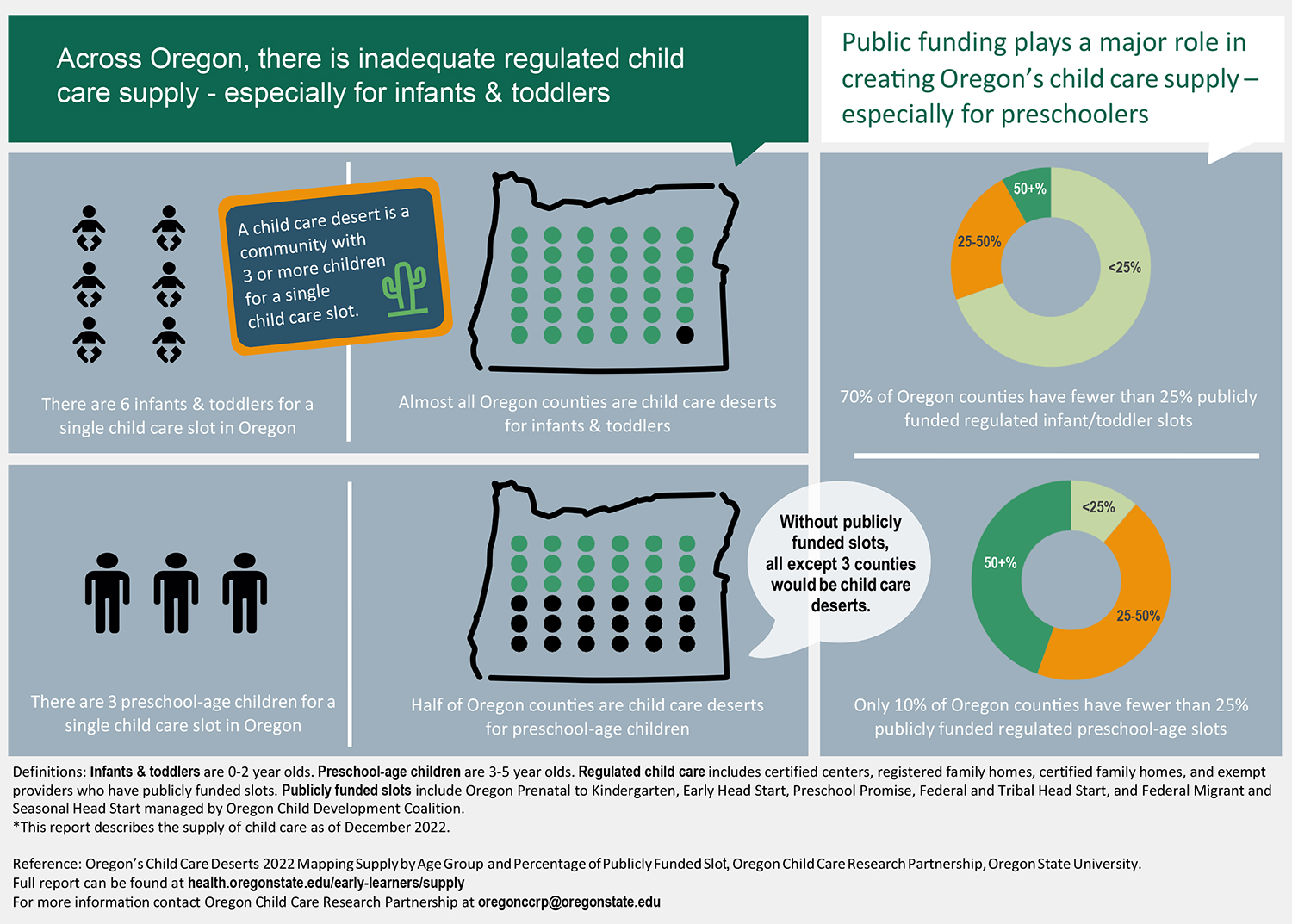
According to a 2022 study by Oregon State University, most Oregon counties are child care deserts for infants and toddlers, and half of the counties in the state are deserts for preschoolers. A child care desert is a county where there is just one licensed child care slot available for every three or more children.
Manderson explained that when COVID hit, local governmental agencies in Clatsop County closed all regularly operating child care programs. The programs were allowed to reopen as emergency child care facilities if they could commit to different rules and standards. "Many programs took that time to close permanently due to the rising standards needed to stay operational and in compliance," Manderson said.
She added that many long-time child care providers retired or changed professions around that time.

Dan Gaffney, a retired school administrator who helped lead the collaborative, said in the early days of the pandemic, the child care strain became a crisis in Clatsop County. The community was at risk of losing essential first responders and medical personnel because they had no child care available. Unlicensed providers opened to fill the gap, parents sought the help of relatives, and some people posted pleas for help on Facebook. For most families, there were no ideal options.
Manderson said the situation revealed that "the child care industry exists in a fragile balance."
At the start of the pandemic, Shelley had about a decade of child care experience. She was working at a child care facility and had a baby of her own. She saw that she and others were locked out of the market when they sought child care for their own children because of the high cost.
She added that, as is common nationwide, providers in Clatsop County were having trouble recruiting and keeping good staff because they couldn't pay much on the low margins of a small child care facility. "You could get paid more at Taco Bell," Shelley said.

Stabilization
Gaffney had retired pre-pandemic after decades of work in education in Northwest Oregon and had been volunteering his expertise locally to address early childhood education shortfalls. He connected with other community leaders in the early days of the pandemic to address concerns about the severe lack of child care.
This group formed the collaborative of more than a dozen local leaders, including some associated with the county, the schools, health care and early childhood care and education.
They canvassed the community to assess the situation and then came up with the solution of stabilizing and expanding the child care facilities through grant-making. The group has secured about $1 million in funds since 2020. Providence Oregon contributed $200,000 and has provided in-kind support through data analysis by its Center for Outcomes Research and Education.
The Clatsop Child Care Retention and Expansion Program has completed four grant-giving rounds since 2021. The grants have been used to establish or stabilize child cares, coach providers in good operating practices, improve the quality of facilities and subsidize the cost of care for parents. In August, the collaborative's advisory board approved the fifth grant round, which will allot $155,000 to nine child care providers, $141,660 for tuition for families, and $13,500 for professional development for teachers. Child care center owners who receive the grants will take part in courses on how best to run their businesses.
Seeking supporters
The expansion program has added more than 300 child care slots in the county. Thanks to this program — as well as some other local efforts that government entities undertook — the community no longer is a child care desert for preschoolers. It is still one for infants and toddlers. The Clatsop Child Care Retention and Expansion Program has made expanding infant and toddler care a focus.
The collaborative is looking at how to improve and build upon its work. It is exploring how best to secure "micro donations" from local businesses to fund continued expansion.
"Local businesses have been getting interested in our work because they realize you don't have reliable employees if you don't have child care available," Manderson said.
Capacity-building
Joseph Ichter, senior director of community health investment for Providence Oregon, said a key reason Providence decided to support the expansion program is that economic security is a top priority identified in Providence Seaside's community health improvement plans, and child care availability and affordability is an aspect of economic security. Also, Providence recognized promise in the collaborative's early success and wanted to accelerate that progress.
Ichter noted that child care operators who receive grant funding from the program agree to provide data to the Clatsop Child Care Retention and Expansion Program. That program is working with Providence's Center for Outcomes Research and Education to process the data and analyze it to figure out how to continually improve the child care providers' work and to give them the opportunity to increase their capacity.
Fun in the sun
Shelley is one of nearly a dozen providers who have gotten grant funds to expand. She opened her in-home child care in 2024 when she received a grant. The grant enabled her to hire her partner as well as a friend to work at the child care, making it possible to care for more children.

Shelley said her child care prioritizes outdoor fun for the 16 kids she and her team take care of daily. The kids get lots of fresh air, hands-on activity and sunshine. She said this has been a welcomed environment for families with kids who had trouble adjusting to more structured environments. She said without her child care, multiple families would have had nowhere to go. She also offers the flexibility needed by families with odd work schedules.
Gaffney said enabling providers like Shelley to expand is good for the community over time. "If you really want to retain and preserve quality of life in the U.S., you must invest in our kids," he said, "or you can't expect to have as positive a future as it could be."