
Over the next half year, Bon Secours Mercy Health is outfitting select staff with wearable panic buttons, or duress badges. If the employees feel that their safety is threatened, they can double-tap the buttons to discreetly summon help.
The health system is making the devices available to most patient-facing team members in emergency departments and behavioral health units and at on-campus medical practices at its 50 hospital locations across Florida, Kentucky, Maryland, New York, Ohio, South Carolina and Virginia.

Bon Secours Mercy Health is using the technology because of increasing threats or incidences of violence against health care workers in recent years, says Jodi Pahl, Bon Secours Mercy Health chief nursing officer for workforce, outcomes and experience of care. "Nobody wants to go to work and be scared of being there," Pahl says. "With this new technology, there is more peace of mind for our staff. They can get help when they need it. They're not by themselves. Someone has their back."
'It really breaks our heart'
According to a 2024 National Nurses United report, 81.6% of nurses experienced some form of workplace violence in the year prior to the study, and 36.2% had been physically hit at work.
Pahl says, "Nurses and caregivers go into this profession to take care of folks, and it really breaks our heart to hear of any caregiver, any provider, and really anybody in our facilities or medical group practices being harmed or injured either emotionally or physically."
Bon Secours Mercy Health began around 2023 exploring solutions beyond its existing protective measures. It put out a request for proposals for wearable protective devices, technology that Pahl says is being used increasingly in health care facilities in the U.S. After research and a pilot program at two Bon Secours Mercy Health locations, the health system signed on with 911Cellular.
Securing the scene
Pahl says the technology is "relatively inexpensive," especially given the importance of the investment. As Jeff Dempsey, president of Mercy Health — St. Vincent Medical Center, says in a press release about the panic badges, "This investment is one more way we're creating a secure, supportive environment where our teams can thrive, and our patients can heal." St. Vincent Medical Center, a Bon Secours Mercy Health hospital in Toledo, Ohio, is deploying the panic buttons throughout late September and early October.
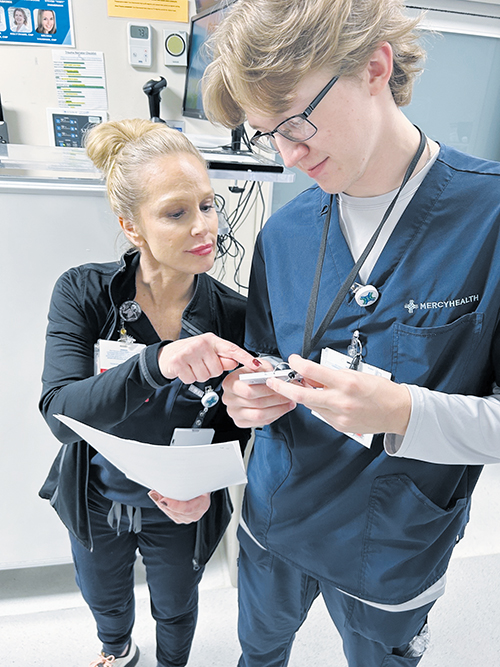
Bon Secours Mercy Health is funding the technology through a well-being grant connected with the system's associate health plan. The investment "reflects the ministry's larger commitment to associate safety, wellness and engagement," the release says.
911Cellular staff work with technology and security departments to connect the duress badge system into each facility's WiFi network and configure the technology to send wireless signals when activated. Those wireless signals let campus security officers — and any other designated protectors — locate the distressed employee. Each facility chooses who will get the signal; most facilities alert a house supervisor or charge nurse in addition to campus security. Smaller facilities likely also summon local police.
When responders arrive after an alert, they secure the scene and then determine whether additional team members need to be called, such as behavioral health experts, social workers, spiritual care staff or local police.
Discreet technology
Each Bon Secours Mercy Health facility that adds the technology can specify the number of badges they need. Employees put on their badge when they begin their shift then return it for their replacement to use after shift change.
Pahl says education and training have been essential to the rollout of the badges. Her team secured leadership buy-in and has been engaging each facility to start acclimating the staff to the technology before they use it. A mandatory educational video for staff explains how the panic buttons work, the need to ensure they are sufficiently charged, and the need to tap twice when activating the device. Each facility will conduct monthly drills to practice using the technology.
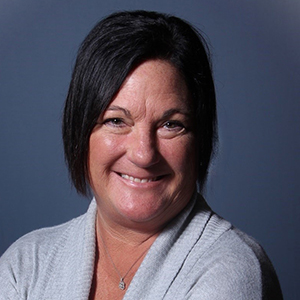
Katy Stringfellow is chief nursing officer at St. Vincent Medical Center. That facility was so enthusiastic about the wearable duress badges it used its own grant dollars to expand the program throughout the facility, not just at units included in the systemwide rollout. St. Vincent Medical Center is deploying 300 badges by mid-October. Stringfellow notes that upfront trust-building was needed before the badge rollout because some staff feared that the devices would track their movements. She and her team have reassured staff that the device only tracks their location when activated.
Stringfellow says the devices are discreet, so unlike some ways of hailing help, the double-tap of the button likely will not further escalate a brewing situation.
Pahl says even though the technology has not yet been used long, it is already proving its value. An employee at a Bon Secours Mercy Health site recently was cornered in a room by a patient and family, and tension was growing. After that staff member activated the device, a security officer quickly arrived to de-escalate the situation.
Broader efforts
Pahl says employee and patient safety and security are of utmost importance to Bon Secours Mercy Health, and so there are numerous safety approaches, practices and programs already in place or coming soon. The wearable devices "are one additional tool in the toolbox," she says.
Bon Secours Mercy Health has a system-level violence prevention committee, and each facility has its own committee with representation from frontline workers. This group shares experiences and best practices in the hopes of making their campuses safer.
Additionally, all patient-facing staff receive ongoing training in de-escalation.
Also, many facilities already were using stationary duress buttons — normally located in a discreet location. All have code systems for quickly calling a multidisciplinary team of responders. At St. Vincent Medical Center, calling a certain code on the overhead address system brings security, the charge nurse, a hospital social worker and a chaplain to de-escalate a situation.
In addition, several Bon Secours Mercy Health facilities are using grant dollars to install weapon-detection systems powered by artificial intelligence, similar to what many concert venues use.
Pahl says Bon Secours Mercy Health facilities also are going well upstream of potential violent incidents by promoting spiritual and behavioral health and well-being, so staff and patients alike are well-grounded before a potentially triggering situation arises.
Pahl says, "Mental and spiritual health are so important for our patients and staff … and it's a true collaboration among disciplines to support great mental health for our staff and great behavioral health for our patients."
Stringfellow says, "It's about staying one step ahead — it's about prevention."