
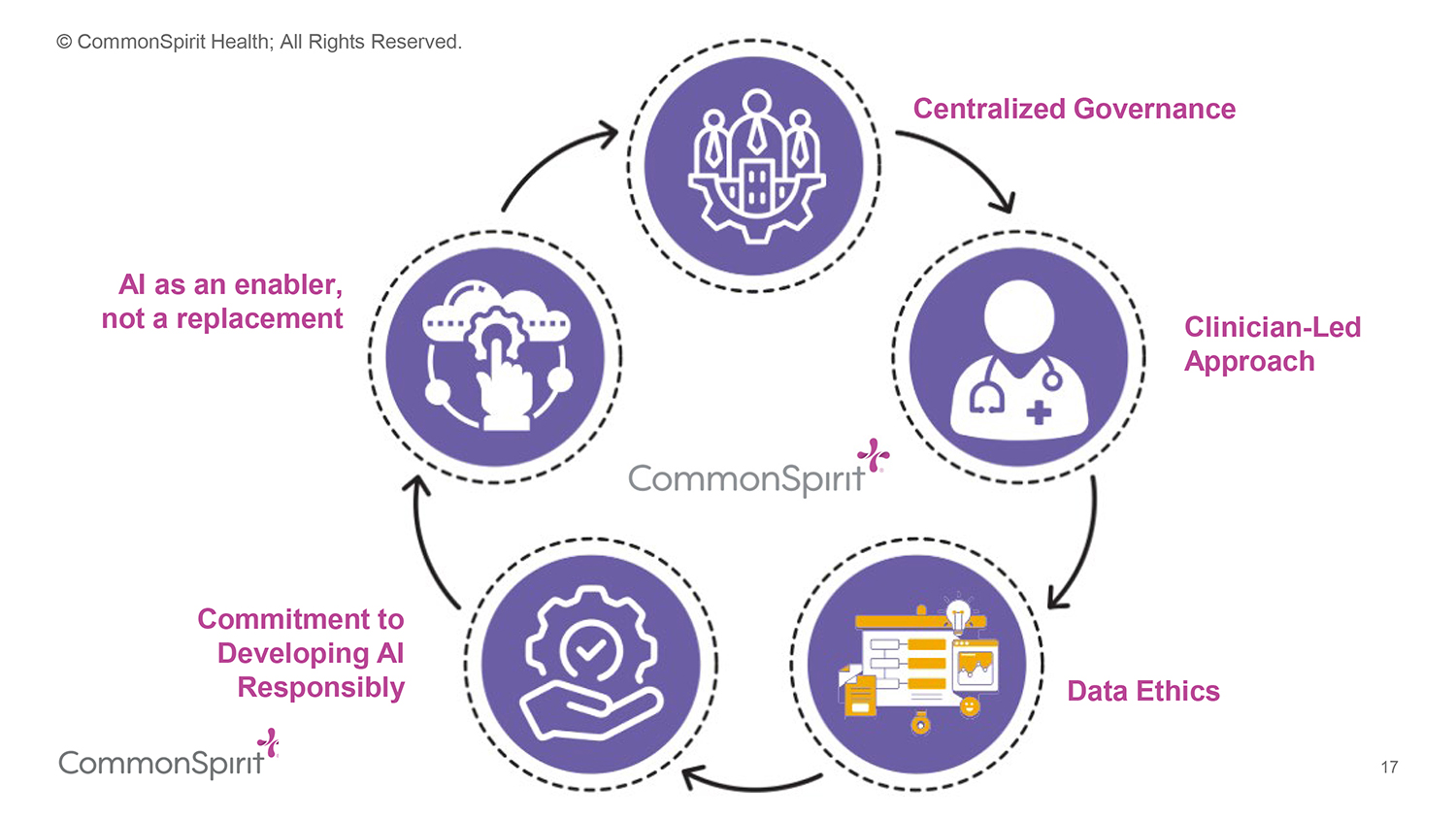


Dr. Marijka Grey, system vice president, ambulatory transformation & innovation — physician enterprise at CommonSpirit Health, and Anita Ho, vice president of ethics for CommonSpirit's California region, say the system has a standardized framework and centralized governance for the use of its own data and for artificial intelligence tools.
They discussed CommonSpirit's considerations for evaluating and using data and technology during a webinar in August presented by the Center for Theology and Ethics in Catholic Health, which CHA sponsors.
Here are some of the central points Grey and Ho made during the webinar.
What is AI? "AI is a tool, and I tend to think of AI, instead of artificial intelligence, as augmented intelligence," Grey said. "It's an intelligence that is there to augment our care overall."
How CommonSpirit views AI: "We utilize AI as an enabler, not as a replacement, to really make sure that it is enhancing our teams rather than replacing them," Grey said.
Monitoring AI: Grey and Ho explained that CommonSpirit has various data and AI program management and governance structures, including a multidisciplinary team — called Enterprise Data and AI Governance — that reviews and evaluates the system's use of its own data and AI tools. "We have colleagues from innovation, regulatory compliance, privacy, cyber security, legal, mission and ethics, of course, as well as corporate responsibilities to make sure that in everything that we're doing in AI that we are really thinking from a much more diverse and multidisciplinary perspective," Ho said.
The clinical role of AI: Grey shared three questions CommonSpirit asks when evaluating the clinical role of AI tools.
- Just what type of AI are you talking about? "Not all AI is created equal. You have bots which are robotic process automation — which is basically a task that you as a human used to do repetitively that we teach a bot or robot how we do it — to unsupervised machine learning, where the machine is actually learning on its own, without any human supervision. And of course, the more autonomous the AI is, the bigger the inherent risk and in health care, as in any other hyper regulated industry, we tend to be risk averse, which is a good thing."
- What problem are we solving? "As you look at AI, you really want to know what's the problem it's solving because, of course, there are so many problems that we need to solve in health care, that you may not want to start with the more complex ones, but you may want to start with what seemed to be simpler, but will actually give more of a lift for your organization."
- How do we reopen the sacred space? "As you think of AI and what AI you're going to use, really think of how it can return your clinicians to that sacred space, take off the burden from them, so they can return to what they went into medicine for, which is taking care of the patient."
Ethical perspective: Ho said CommonSpirit is "trying to think about AI ethics across the continuum, across that whole AI development-to-implementation life cycle."
Ethical considerations: Ho shared that CommonSpirit keeps six principles in mind while thinking about technology development and implementation.
- Promoting the common good
- Promoting accountability and safety
- Promoting justice and equity
- Preserving equal human dignity and respect for all persons
- Ensuring responsible and responsive data sharing
- Transparency
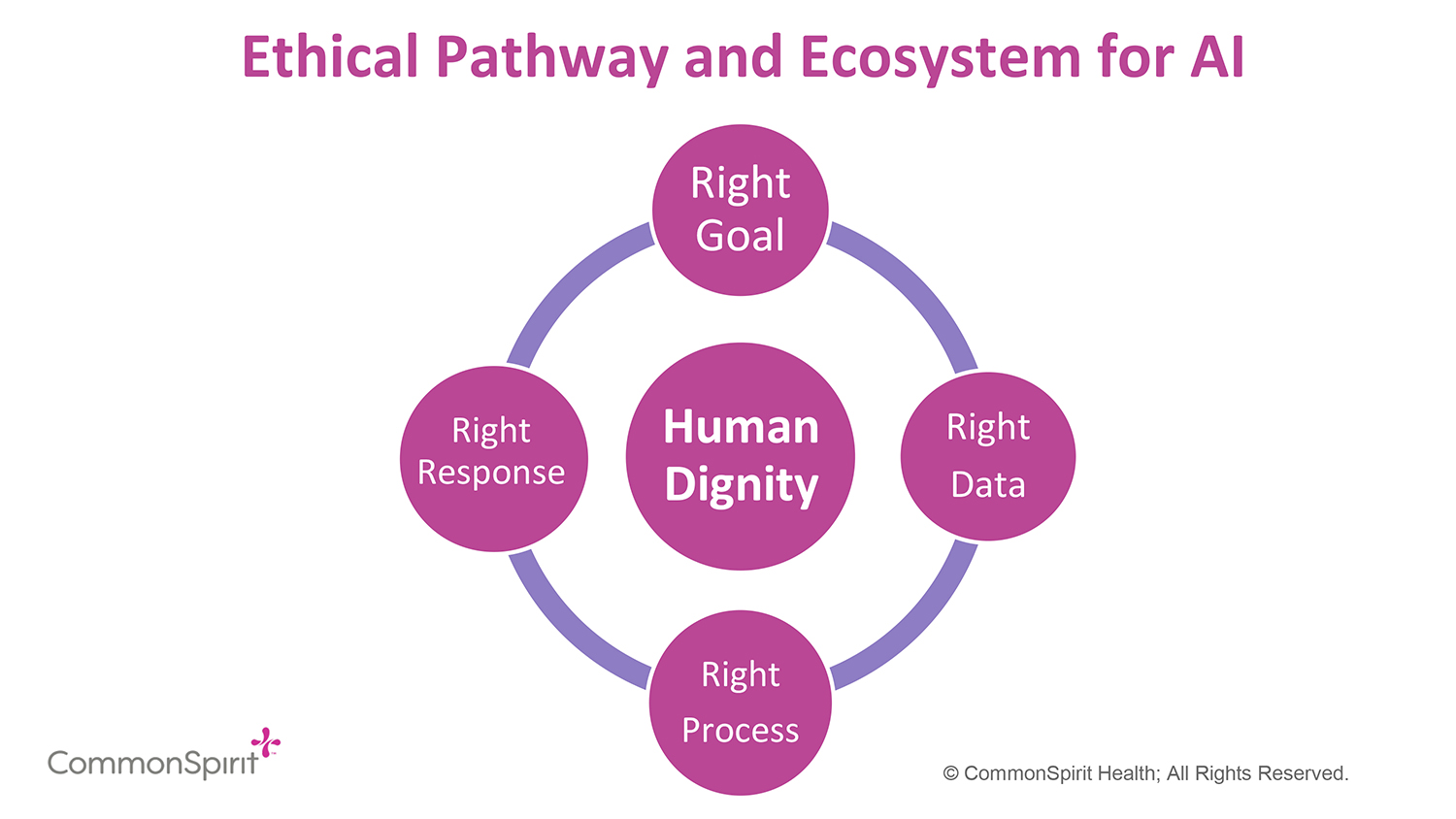
Centering dignity: "We're really still figuring out how to think through human dignity, in the center, in relation to everything that we're doing regarding data, regarding using AI," Ho said. "It's really thinking about an AI ethical pathway, an AI ecosystem."
Saying no: "In some of our evaluations, there have been situations where we actually had really made a complete stop into the development or negotiation with vendors in relation to certain tools when we have questions in relation to whether human dignity may be violated because of privacy concerns or other kinds of considerations," Ho said.
Equity and accuracy: "We really think about, how do we minister to those who are sick and suffering? How do we accompany them?" Ho said. "Even when we are using various kinds of tools we need to make sure that we are still keeping the dignity of human persons in mind and recognizing that there may be a diversity of perspectives and diversity of data and experiences that are really important as we are developing our tools, so that we can make sure that these tools will be equitably applied and accurate for all populations."