
Catholic Health World Articles

October 14, 2025

At inaugural conference, California social and health care ministry leaders network, celebrate their work

Participants at the Pilgrims of Hope: Serving the Vulnerable conference on Oct. 9-10 in Garden Grove, California, attended Mass each day at the Christ Cathedral of the Diocese of Orange.
GARDEN GROVE, CALIF.— About 275 people from California and beyond recently came here for the Pilgrims of Hope: Serving the Vulnerable conference that celebrated the state's Catholic social and health care ministries.

The title of the conference reflected Pope Francis' theme for the Jubilee Year 2025. Organized by Catholic Charities of California, the Alliance of Catholic Health Care, the Knights of Columbus, Mercy Housing, and the Society of St. Vincent de Paul Los Angeles, the conference was a first and highlighted contributions of those and other organizations.

Participants heard from leaders at the forefront of Catholic services, including health care, nutrition security, immigration, housing and disaster relief. The gathering was Oct. 9-10 at the Christ Cathedral campus of the Diocese of Orange.

Julie Sprengel, president and CEO of CommonSpirit Health California Region, and Erik Wexler, president and CEO of Providence St. Joseph Health, showed a video and interviewed one another during a session on the history, mission and challenges of Catholic health care. Photo by Event Image Services
In his welcoming remarks, Msgr. Gregory Cox, the president of the executive committee of Catholic Charities of California and executive director of Catholic Charities of Los Angeles, pointed out that California, with a population of more than 39 million, has 49 Catholic health care systems and hospitals, which served more than 9.9 million people last year. Catholic Charities of California served more than 1.2 million people in 2023, according to its website.

Msgr. Cox talked about how the giant sequoias in Northern California have roots that go barely below the surface, yet they withstand strong winds. The trees grow only in groves, and their roots intertwine underneath the surface.
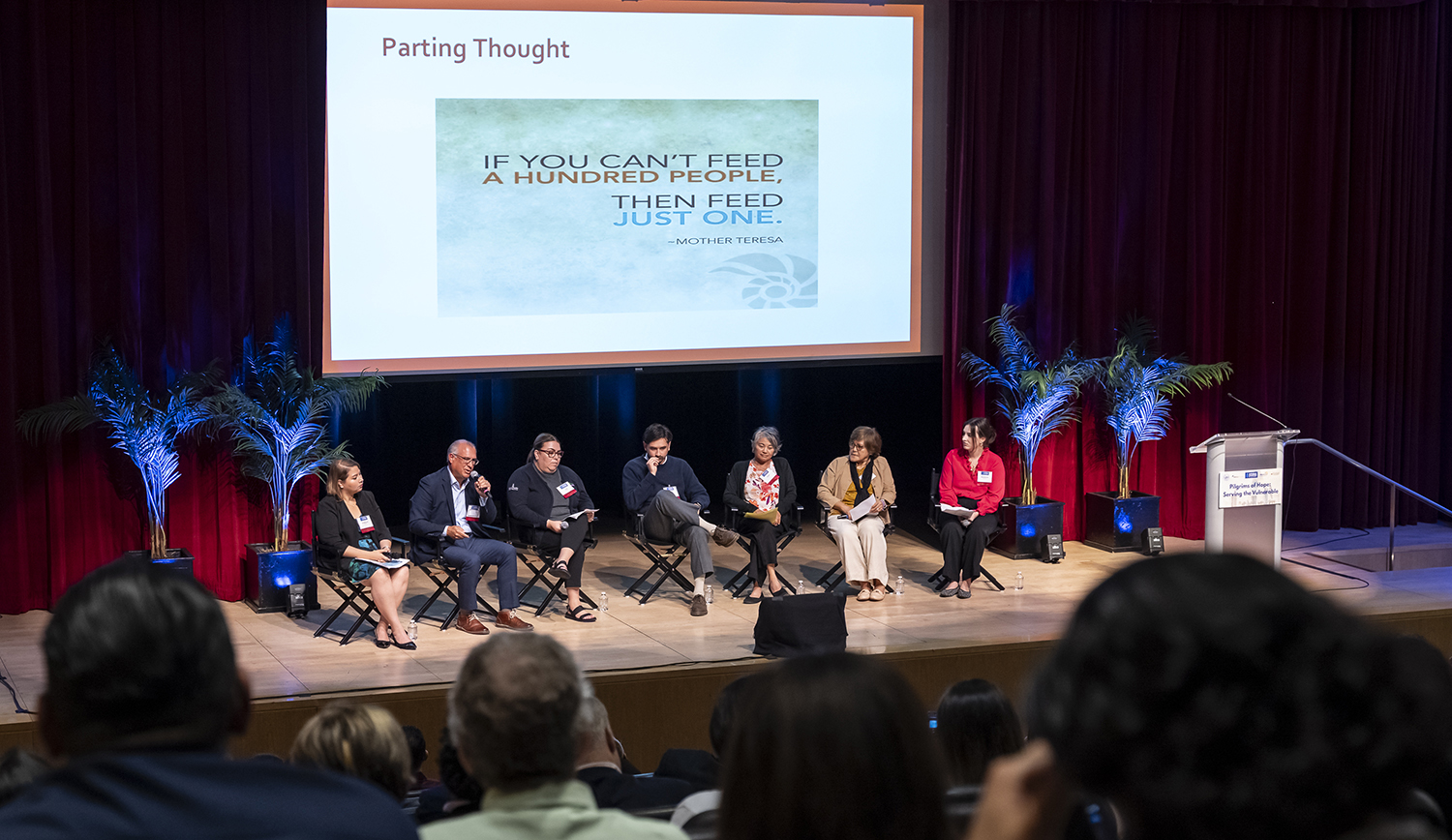
Panelists speak about nutrition security and how they approach needs throughout the state. Many of the programs are supported by Catholic Charities of California. Photo by Event Image Services

"Like the sequoias that grow in groves, Catholic health care and Catholic social services grow in communities of faith," he said. "Together, our roots of faith and love for the poor and vulnerable are intertwined with each other, so that when the strong winds of lack of resources, legal battles and challenges and despair come, we hold each other up."

Here are some takeaways from Catholic health care providers at the conference:

  • Erik Wexler, president and CEO of Providence St. Joseph Health, and Julie Sprengel, president and CEO of CommonSpirit Health California Region, interviewed one another during a session on the history, mission and challenges of Catholic health care. Wexler spoke about health care facing a "poly-crisis" of issues, including cutbacks from federal programs, commercial payers reimbursing at low rates and the workforce shortage. But these are also the best of times, Wexler said. "This is when we can truly transform, but we've got to keep ourselves focused in a way that we continue to serve those who are vulnerable," he said. Sprengel said she was concerned about new work requirements for Medicaid recipients, and the administrative burden that will require. "All of us are going to have to think differently, and I think that's one important way where we can collectively come together," she said. "How do we ensure that those who are eligible for coverage are able to make that happen?"
  • Kenya Beckmann, chief philanthropy and health equity officer of the Providence South Division, pointed out that 90% of new information has been generated in the past few years, and that she, like others, is overwhelmed. "When I think about the value proposition of Catholic health care and why that's important, and of Catholic social services, is that there's a permanency about it," she said. "Those aren't things of the day. Those are things of eternal, right? Those are things of human dignity. Those are how we work together and how we show up."
  • Rachelle Reyes Wenger, system vice president of public policy and advocacy engagement at CommonSpirit Health, encouraged all present to see each other as not just as an arm of Catholic health care, but also as one body that is the healing ministry. "The world needs us so very badly right now," she said. "Julie and Erik have very much told you, in a very nice way, how much we are in peril. You guys are feeling it. It's real. The pain is so real right now, and our body is so strong when we are doing things together."
  • Gabriela Robles is president and chief executive of the St. Joseph Community Partnership Fund, the grant-making foundation of Providence, and chief mission integration officer for the Providence South Division. She spoke about growing up in the 1980s in a large immigrant community in Los Angeles, where the challenges of legal status, poverty and language barriers were similar to those of today. The church was the center of everything, she said. "So while we had challenges, we had assets: We had faith, we had hope," she said. The charisms of Providence's founding sisters have influenced how she handles her dual roles, she said. "It's about bringing people together. It's about setting the table and having people come to the table. It's really identifying challenges in partnership with others."
  • Tammy Shaff, director of community health at Dignity Health St. Joseph's Medical Center in Stockton, California, spoke about a program called the Connected Community Network that helps clinicians easily link patients to resources such as housing and food assistance. The closed loop referral system allows everyone to see if a service provider has followed up with a family or individual. There are nearly 1,000 different programs on the network, she said. "The beauty of the CCN is that it brings the community together, because collaboration is key," she said.
  • Jennifer Tanner, system director of real estate growth for CommonSpirit, said the system partners with organizations like Mercy Housing to address the need for affordable and senior housing. Rising construction costs challenge everyone, but she finds hope in the fact that she's hearing more people outside the health care setting talking about social determinants of health, and that others are learning that having stable housing is the best preventive health care. "There are a lot of minds trying to get creative," she said. "And I do like when real estate minds get around and start talking about it, so that gives me hope that something's going to happen."
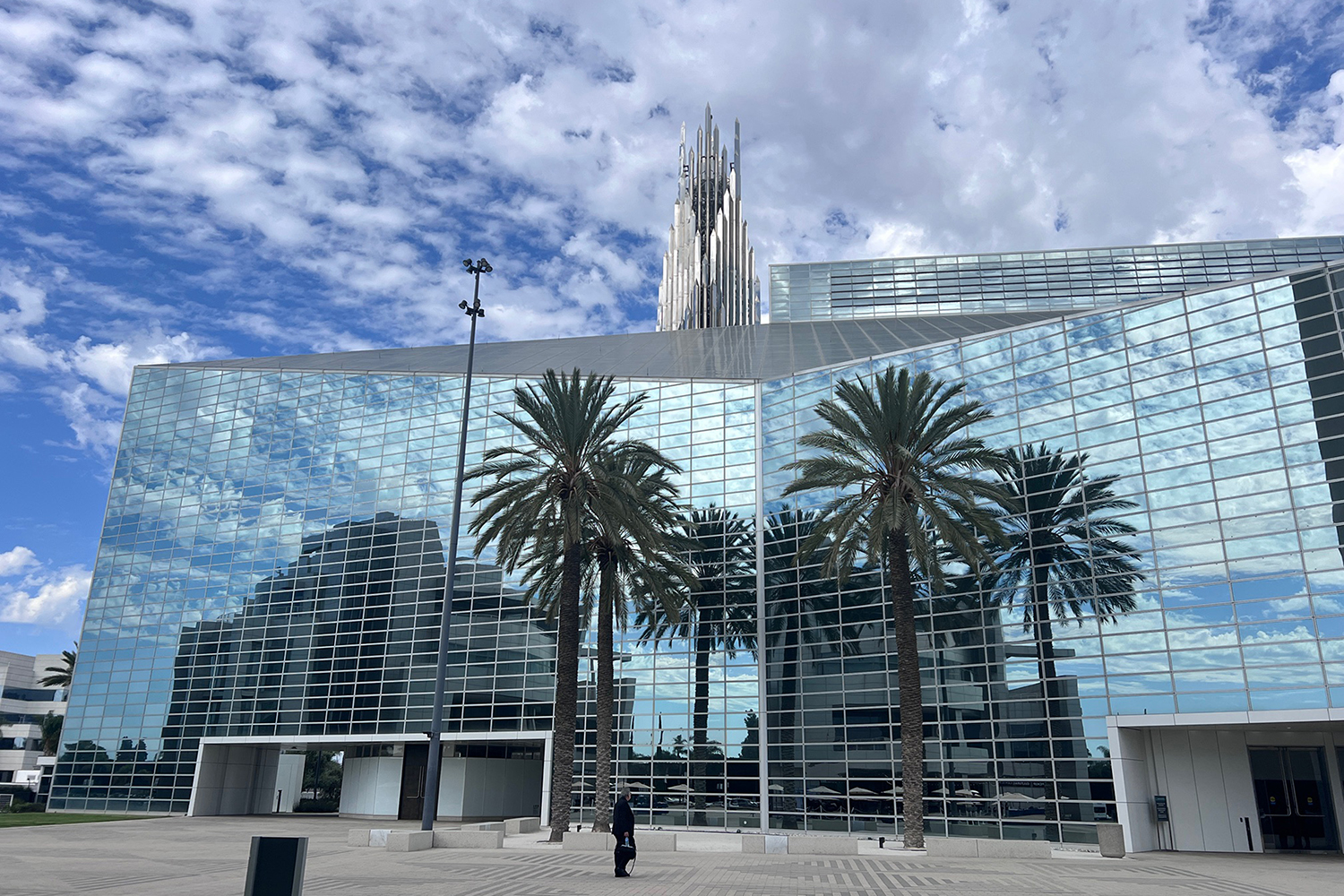
The conference took place on the Christ Cathedral campus of the Diocese of Orange.
 
'Faith is at the heart of what we do': Social service ministries share how they address needs of poor and vulnerable

While health care got a spotlight at the Pilgrims of Hope: Serving the Vulnerable conference, many social service leaders spoke about their ministries that address homelessness, nutrition security, immigration, housing and disaster services.

Immigration: There are 14 Catholic Charities agencies that provide immigration services in nearly every corner of California, for people from dozens of countries. That work includes clients who have lived in the United States most of their lives.

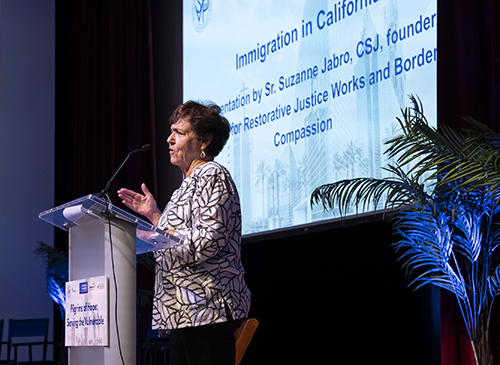
Sr. Suzanne Jabro, CSJ, spoke about immigration and her work at the Mexican border at the conference. Photo by Event Image Services

Their work with Mexican immigrants has changed over the last several months, however. One shelter that received about 1,500 people in one day before the Mexican border closed nine months ago now receives about five people a month.

Sr. Suzanne Jabro, CSJ, is the founder of Center for Restorative Justice Works, which helps families separated by crime and the criminal justice system, and Border Compassion, which accompanies people across the border into Mexico for an immersion experience serving migrants at the Cobina Posada del Migrante Shelter.

She quoted Fr. Gregory Boyle, a Jesuit who says about accompaniment: “You go to the margins not to make a difference, because then that’s about you. You go to the margins so that the folks at the margins make you different.”

Homelessness: There are more than 771,000 people who are homeless nationwide, with 24% of them in California. About 42% of the people who are homeless in California live within the Archdiocese of Los Angeles. Many Catholic Charities-supported organizations serve different populations in the city: Angel’s Flight in Los Angeles for homeless and at-risk youth; the Elizabeth Ann Seton Residence for homeless families and a growing population of single fathers with children; Good Shepherd Center for homeless women and children, including those fleeing domestic violence; and St. Margaret’s Center, a community center that provides a range of emergency and supportive services for more than 10,000 people each year.

Those who run those organizations talked not only about how they serve people who are homeless but also about the need to prevent homelessness. Deana Payne, program director for the Good Shepherd Shelter, cited one study of California domestic violence survivors that said 60% who fled went to live on the street or in their car, because there was nowhere else to go. She and other advocates maintain that “by addressing domestic violence, addressing gender-based violence, you are addressing homelessness.”

Zack LaGuardia, program development director of St. Margaret’s Center, described the many types of people who come for help. “Most participants come to us already in crisis, and our first response is to meet them with dignity and compassion. But if crisis response is the front line of our work, prevention is the long game. Prevention is what keeps a family from being evicted from their home. It gives a teenager the stability to finish school instead of falling into homelessness. Prevention is what ensures that fewer people end up in that line to begin with.”

Disaster relief: Since 2018, Catholic Charities of California has supported more than 1.5 million survivors of disasters in 45 counties, distributing millions of dollars in aid. People on one panel emphasized the importance of community collaboration, preparedness, and long-term recovery efforts, despite diminishing federal resources.

Catholic Charities of California is the state-appointed management agency for the FEMA-funded Disaster Case Management Program. It has served through the last 10 federally declared disasters in California.

Angela Di Novella, executive director of Catholic Charities of the Diocese of Monterey, pointed out that many agencies help families for five to eight years after a disaster such as a wildfire, because it takes such a long time for families to recover. “As Pope Francis called us to serve those of the peripheries and away from our center, we do it with compassion and dignity,” she said.

Norma Lacy, director of community-based programs for Northern Valley Catholic Social Service, said that recovery isn’t just about replacing things. “It’s rebuilding lives with dignity, giving hope in a time of hopelessness,” she said.

Nutrition security: While California produces nearly half of the nation’s fruit and vegetables, more than one in five Californians, or about 8.8 million people, struggle with food insecurity.

Jeff Negrete, executive director of Catholic Charities of the Diocese of Fresno, said food assistance accounts for the largest share of services provided by Catholic Charities agencies.

“Our agencies send children home with backpacks of food for the weekend or ensure that they eat during the summertime,” he said. “We deliver meals to homebound seniors, and we work with residents to establish community gardens. We travel to rural areas with culturally sensitive food and deliver meals to our homeless brothers and sisters.”

Food program leaders described networks that include parishes, food banks, retail stores, and volunteers. Some programs also include wraparound services or a component of socialization, such as a community dinner for seniors.

“We know that when they come in looking for food, it is a symptom of much bigger or other challenges that they are experiencing,” said Ana Guzman, program manager for the nutrition assistance services at Catholic Charities of the Diocese of Stockton.

Said Fred Buzo, director of advocacy and community engagement for Catholic Charities of Santa Clara County: “Faith is at the heart of what we do. Distributing food and serving nutritious meals to seniors is more than just doing a good deed. It’s faith in action.”

— VALERIE SCHREMP HAHN
CHA Publications

Reprint Requests

Would you like permission to reprint an article from one of CHA's publications? To do so, please use our online request form. Please allow our team 1-2 business days to respond to your request.