
If a patient has dark skin, it's sometimes difficult to spot the early warning signs of a pressure injury, commonly known as a bed sore.
Early warning signs of skin damage that might present as redness might be obvious in a patient with light skin. But the same skin damage can be easily overlooked, not even visible or a different color on dark skin, possibly leading to a more severe pressure injury, infection, severe pain, and even death.
While caregivers nationwide have gotten better at preventing infections and accidents like falls in the hospital, pressure injuries haven't necessarily waned, said Cynthia LaFond, senior director for nursing research at Ascension.

"As patients become more acutely ill in the hospital, the number of severe injuries has increased. So it is truly a challenge," she said.
St. Louis-based Ascension, one of the largest Catholic health systems in the United States, closed the gap in severe, stage 3 or higher, hospital-acquired pressure injuries between patients with light and dark skin tones in fiscal year 2026, the system announced in August. It also saw a 38% reduction overall in less-severe stage 2 and more severe hospital-acquired pressure injuries, or at least 444 fewer cases.
Pressure injuries are staged by severity, with six stages. Stage 1 and 2 are the least severe and stage 3 or higher are the most severe. While skin remains intact in stage 1, the more severe stage 3 and higher include tissue loss that could expose fat, muscle or bone. A study by Ascension's National Nursing Research Team helped lead to the system's improved results. It was published in the November-December 2025 issue of the journal Nursing Outlook.
The Ascension nurse scientists looked at the research available on pressure injuries in patients, collected their own data, and helped roll out education and information systemwide to teach caregivers what to look for. As part of their research, they evaluated skin tone assessments in an international collection from more than 55,000 patients.
Early warning signs of a pressure injury in dark skin may not look red, but it might change color or feel different, LaFond pointed out. She is one of four nurse scientists who work for Ascension, conducting research and spreading what they learn.
She said different patients have to be looked at differently. For example, she noted that when heart attacks were first studied, primarily men were in the study pool, so their symptoms were taken to be universal. But doctors later realized that the heart attack signs for women were vaguer and often overlooked.
"This is a very similar situation where studies were done primarily on individuals with light skin, or they just didn't measure skin tone at all, and so we didn't know," LaFond said.
Even though race is noted in electronic health records, that information isn't enough: People who identify as Black can have light or dark skin tones, she pointed out. And much research on pressure injuries up to this point hasn't accounted for that, she said.
Using Past Research
Ascension's study found that patients with dark skin tones were up to four times more likely to develop pressure injuries more severe than patients with light skin tones.
"Decades of research show that individuals who are Black experience higher-stage pressure injuries than other racial/ethnic groups," says the background of the paper. "Investigators primarily attribute differences to difficulty visualizing early injuries in dark skin tones. Yet, few have actually measured skin tone."
Key to those assessments is the Monk Skin Tone Scale, a 10-shade color spectrum developed in 2019 by Ellis Monk, a Harvard University sociology professor, in partnership with Google. The spectrum is designed to accurately measure and represent the diversity of human skin tones and to end racial and skin tone biases in technology and medicine.
A previous six-point scale focused heavily on lighter skin tones. When artificial intelligence, facial recognition, cameras and medical devices like pulse oximeters detected dark skin tones, the scale often misidentified people or performed poorly because they weren't tested across the range of skin tones.
The Ascension study took a close look at the link between the Monk Skin Tone Scale assessments and a pressure injury stage, using an international database. The researchers found that patients with medium to dark skin tones had a two- to fourfold risk than patients with light skin tones of developing a stage 2 injury, which is an open wound, or a more severe pressure injury that can extend into deeper tissue or bone.
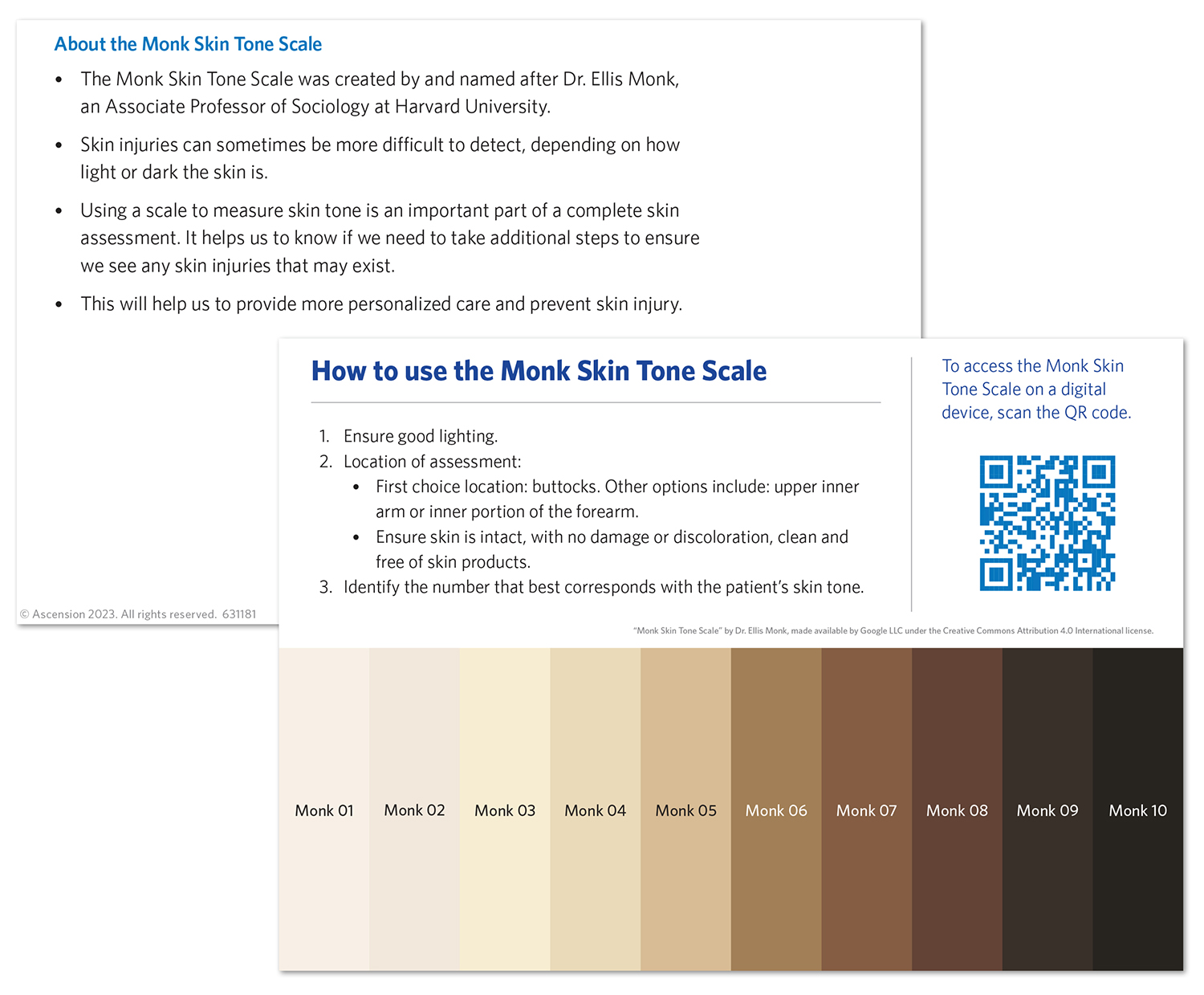
Ascension nurses who work with patients to assess pressure injuries now use a printed card with the Monk Skin Tone Scale. If needed, they do a hands-on assessment, or palpation, of the areas where they suspect there is an injury to look for additional symptoms, LaFond said.
"In the act of measuring skin tone, you're also making clinicians just sort of cognitively aware that, oh, this is someone who I may have to treat differently or approach more thoroughly for my assessment," she said.
On the back of the card, first rolled out with clinicians in 2023, are an explanation of what the tool is, how to use it, and tips for how to talk about it. Leaders coached clinicians on how to sensitively discuss the issue with peers and patients, LaFond said.
At the same time, the nurse scientists began collecting and analyzing their own data.
LaFond remembers a wound care nurse in Illinois who shared that patients thanked her for the extra assessment.
"That has really stuck with me," she said. "I mean, everybody wants to have healthcare to see and treat them as an individual. This means genuinely paying attention to their personal details and using that complete picture to provide the right care."
A Ripple Effect
In 2023, Ascension leaders spoke with executives at Baxter International, the healthcare solutions company that maintains the international database of assessments of pressure ulcers and injuries that the nurse scientists used. Clinicians from systems around the world fill out the survey for the database to inform their own quality improvement efforts and contribute to international research.

With Ascension's encouragement, Baxter incorporated the skin tone measurement into the assessments. The Ascension team worked with Baxter to create training that was added to its website on how to collect skin tone measurements and assess patients. It's a great ripple effect she is excited about.
"We want all patients, all humans, to flourish," she said. "And so, how might we be able to share this and work with others to contribute?"
Mary Sitterding is Ascension's vice president of nursing practice, education, quality and research. She sees this work as advancing Ascension's vision to serve the poor and vulnerable.
"It's about our moral obligation, not just chasing a safety standard, not just chasing an external benchmark, but our moral obligation to human dignity," she said. "That is, human dignity not only to the patients and the families and the communities that we serve, but also our nurses, our physicians, our dedication to their development. This is who we are."