
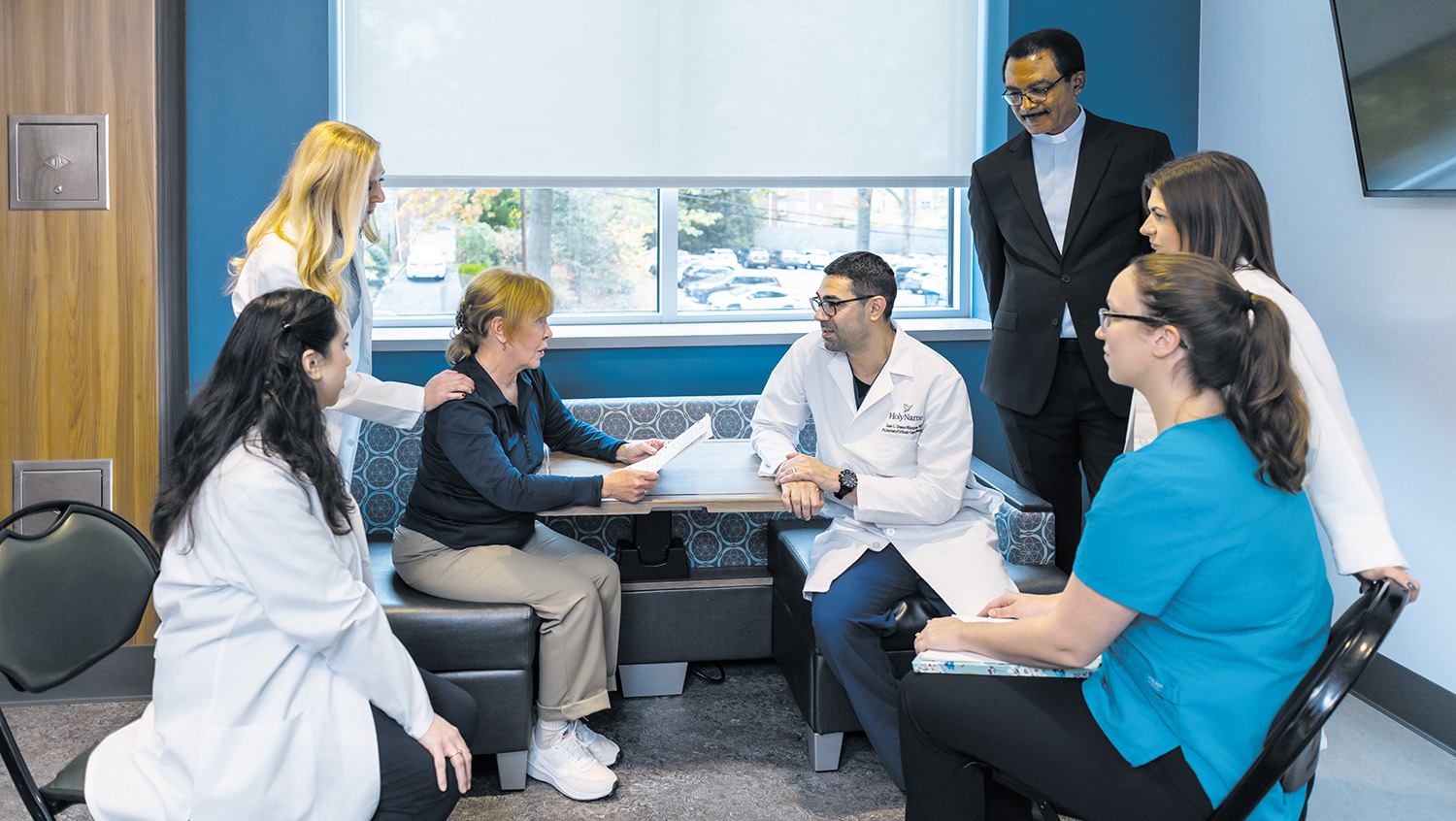
When Holy Name Medical Center made palliative care screenings standard protocol for patients admitted to its intensive care unit, the goal was for the screenings to result in a 30% increase in palliative care consultations.
"I think we anticipated a big increase, far higher than our goal, but we were shocked to see it was a 139% increase in consults from 2023 to 2024," says Lauren Boniello, nurse manager of Holy Name's 19-bed ICU.
In real numbers, palliative care consultations rose to 275 last year, compared to 115 in 2023.
Other metrics also point to positive changes related to the screenings. For example, more ICU patients accessed palliative care and the unit saw a drop in "code blue," or cardiac crisis, events from 19 in 2023 to 14 last year. Also, a survey found that 75% of the ICU staff thought the palliative care screening process had a positive impact on them.
Lisa Blumer, palliative program manager, says the findings reflect how views are changing toward palliative care, which is focused on holistic comfort care based on a patient's needs and goals. She sees those changes even among fellow care providers. In the past, her team hadn't been welcomed by the ICU staff, but now they have what she calls a "beautiful collaboration."
"It's a fairly new medical specialty, so we can see a whole shift in the culture that not only are we present in the ICU, but we are really meshed in the ICU care for the patients," Blumer says. "I think it was a culture shift in a positive way."
A health equity issue
Blumer and Boniello championed the protocol that led to palliative care screenings becoming standard for ICU patients at Holy Name and got the buy-in needed from leadership and colleagues at the hospital in Teaneck, New Jersey. The screenings started in September 2023.
Blumer says in the past some patients might have known about palliative care or been informed about its availability by providers, but that wasn't true for every patient. She and Boniello saw education about and access to palliative care for all patients as a health equity issue.
"It aligns with our hospital mission and the mission of the Sisters of St. Joseph of Peace that started our hospital to make sure that we're paying full attention to underserved patients and removing any barriers to care by standardizing it," Blumer says, "and then to really alleviate suffering and make sure that we're providing care that's not just body, but the mind and the soul."
The Holy Name palliative care team includes Blumer, a doctor, a social worker, two nurse practitioners, two nurses, a palliative care pharmacist and the director of pastoral care services. Their services cover medical, spiritual and social needs. The team members round with their ICU counterparts to assess whether supportive services, for example, spiritual guidance or transportation assistance, would benefit them.
The palliative care and ICU teams both got education on the palliative care protocol, which is based on the Palliative Care Referral Criteria developed by the Center to Advance Palliative Care. The information technology staff created orders in the electronic records system that prompt the protocol upon admission of a patient to ICU.
Services available immediately or later
The screenings of patients — or, for patients who are unable to speak for themselves, whoever can speak for them — are done within 48 hours of admission, most often by the social worker on the palliative care team. The screenings cover a variety of factors such as the patient's medical history, current condition and their goals for care.
If the screening indicates that patients could benefit from palliative care, they and their family are invited to have a consultation with someone on Blumer's team to explain the services available to them, which are generally covered by insurance. Those services include care from a multidisciplinary team of providers who are trained in pain and symptom management and emotional and spiritual support, as well as access to a neuropsychologist, an on-site pharmacy and transportation support.
Blumer says sometimes patients turn down the offer of palliative care, but at least after a consultation they or their families are aware of what the care includes and that it's an option. "They might not need us now," she says. "We provide education about the care, and if they'd like to access any of our services in the future, they're invited to do that, also."
While the palliative care screening process has been standardized at Holy Name, Blumer says the care itself is customized to give patients services that meet their specific needs. The individualized care continues after patients move from the ICU to other settings, such as other acute care units, rehab, outpatient or hospice.
Mindset shift
Blumer explains that her team is focused on patients' quality of life whereas the emphasis of the training of the ICU medical team is sustaining life.
Boniello notes that it sometimes requires a "mindset shift" for ICU staffers to consider that extending life is not always the only valid goal. Comfort can be the goal of care. Once ICU specialists embrace the tenets of palliative care, she says, it can ease their burden as care providers.
"The ICU nurses, I think in general and individually, they've benefited from this program that we put together, because they've been able to take a step back and say, 'Hey, it's OK if I can't save everyone, that may not be everyone's outcome, but how we can support them to get them to whatever outcome that maybe is really the goal?'" Boniello says.
Boniello sometimes reminds ICU staffers that the unit's patients are often at the lowest moment in their lives and that caring for patients with complex medical conditions can be traumatic. "I think palliative care is kind of there to provide additional support that the bedside nurses would love to give to patients, but we may not necessarily have the time to do that," she says.
An ongoing expansion
Holy Name's efforts to expand knowledge about and access to palliative care are ongoing. Goals of its efforts include enhancing data collection, automating screening and consultation orders, and expanding the program as appropriate to other units and settings.
Boniello and Blumer have spoken at conferences to discuss how Holy Name set up its protocol and how successful it has been.
"We are happy to share, and we're happy to collaborate with other organizations and other leaders who would like to implement it as well," Boniello says.
Blumer believes the protocol that Holy Name has put in place has been mutually beneficial to the palliative care and ICU teams and to their patients.
"The collaboration between the ICU team and our team has been really, beautifully patient-centered, patient-focused, making sure that the patient and the family have the best outcomes from their experience and their time here at Holy Name," she says.