
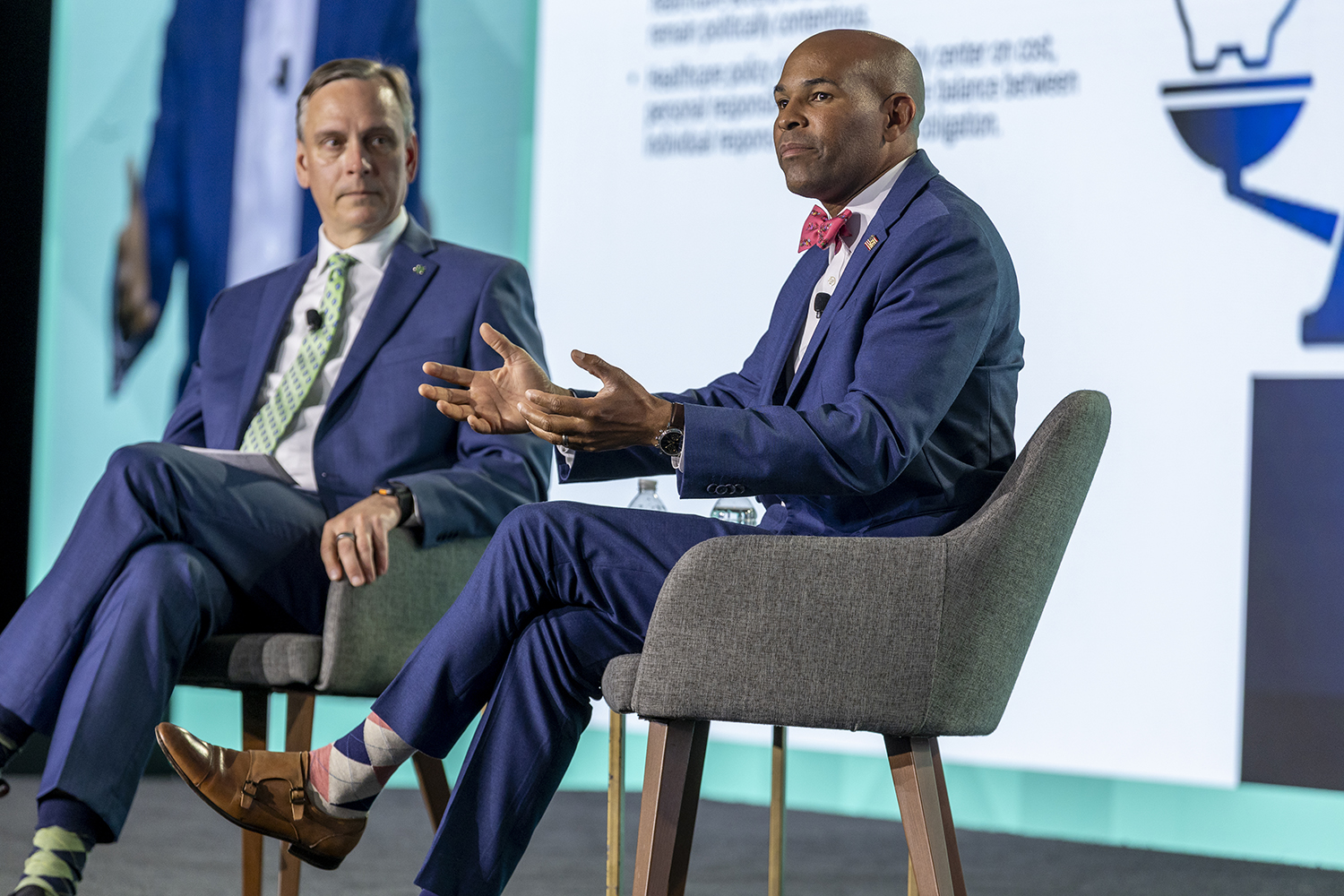
ST. LOUIS — At the opening session of the 2026 Catholic Health Assembly here, CHA President and Chief Executive Officer Sr. Mary Haddad, RSM, challenged ministry leaders to ask themselves "Who are we called to be?"
The assembly's opening keynote speaker, Dr. Jerome Adams, gave his audience some key concepts to consider as they answer this essential question. Adams, who served as the nation's 20th surgeon general, said it's his vision that the country can promote human flourishing in which everyone has the opportunity to make healthy choices and be the best version of themselves. He said Catholic healthcare could play an instrumental role.
"We are stewards of a system under strain, but we are also the architects of what comes next," Adams said. "So the challenges are real — and I don't shy away from any of the challenges you all face — but the opportunities are even greater. And so, go out and grab those opportunities!"
Standing united
The 2026 assembly, with the theme "United for Change," drew close to 500 attendees to the Marriott St. Louis Grand from June 2 to 4. The biennial gathering this year included three nationally known keynote speakers, a dozen breakout sessions, a panel discussion on human flourishing, listening sessions on reimagining healthcare, and an award ceremony for outstanding ministry leaders. Eight church leaders, including Cardinal Blase J. Cupich, archbishop of Chicago, Archbishop Robert Casey of Cincinnati, and Archbishop Mitchell Rozanski of St. Louis, attended this year's gathering.
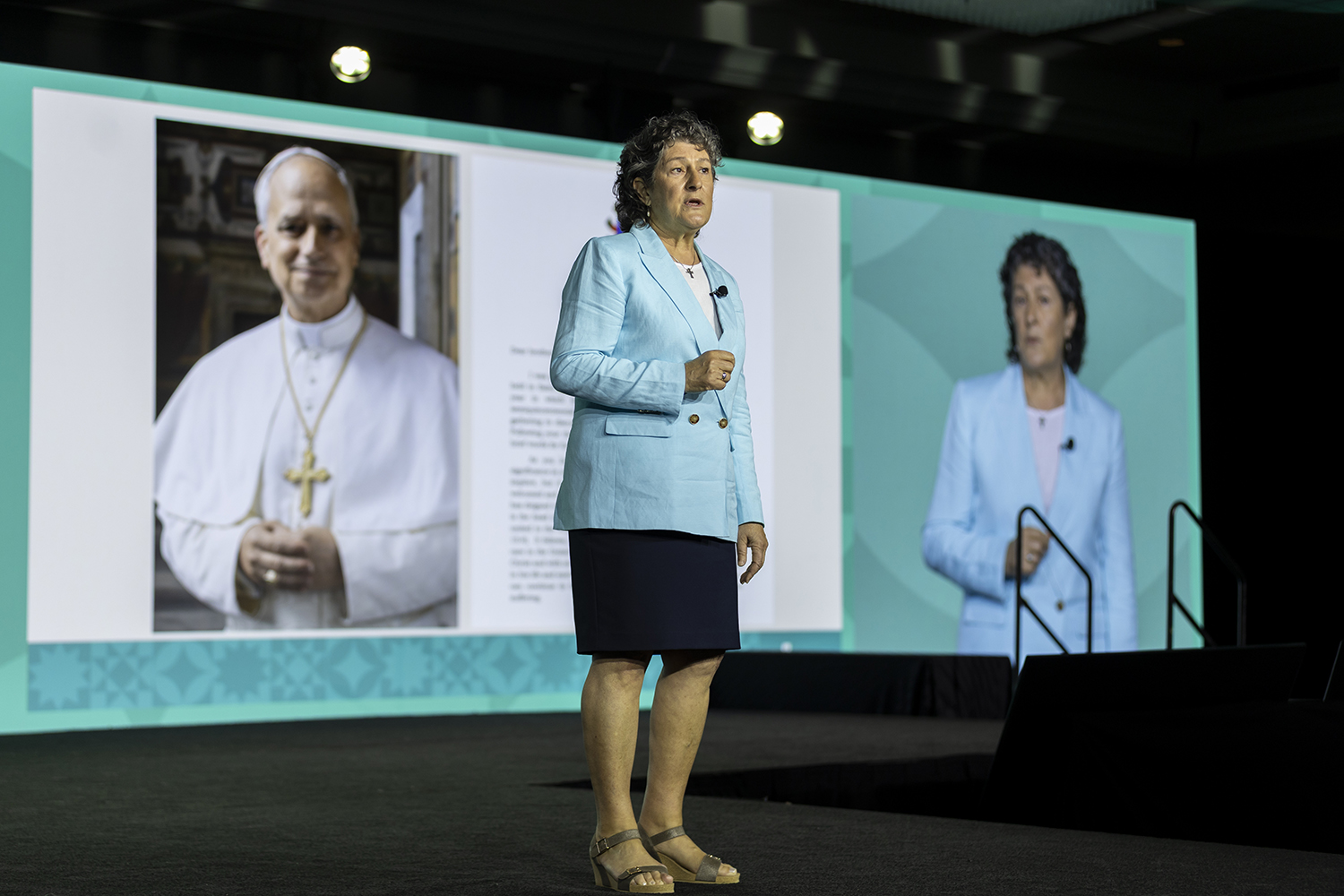
Sr. Mary welcomed attendees by focusing on the need for the Catholic healthcare ministry to pursue the vision of empowering bold change to elevate human flourishing, as is stated in CHA's vision statement.
She said the current healthcare system is broken, unaffordable and unsustainable. She said, "to empower change, we must stand united."
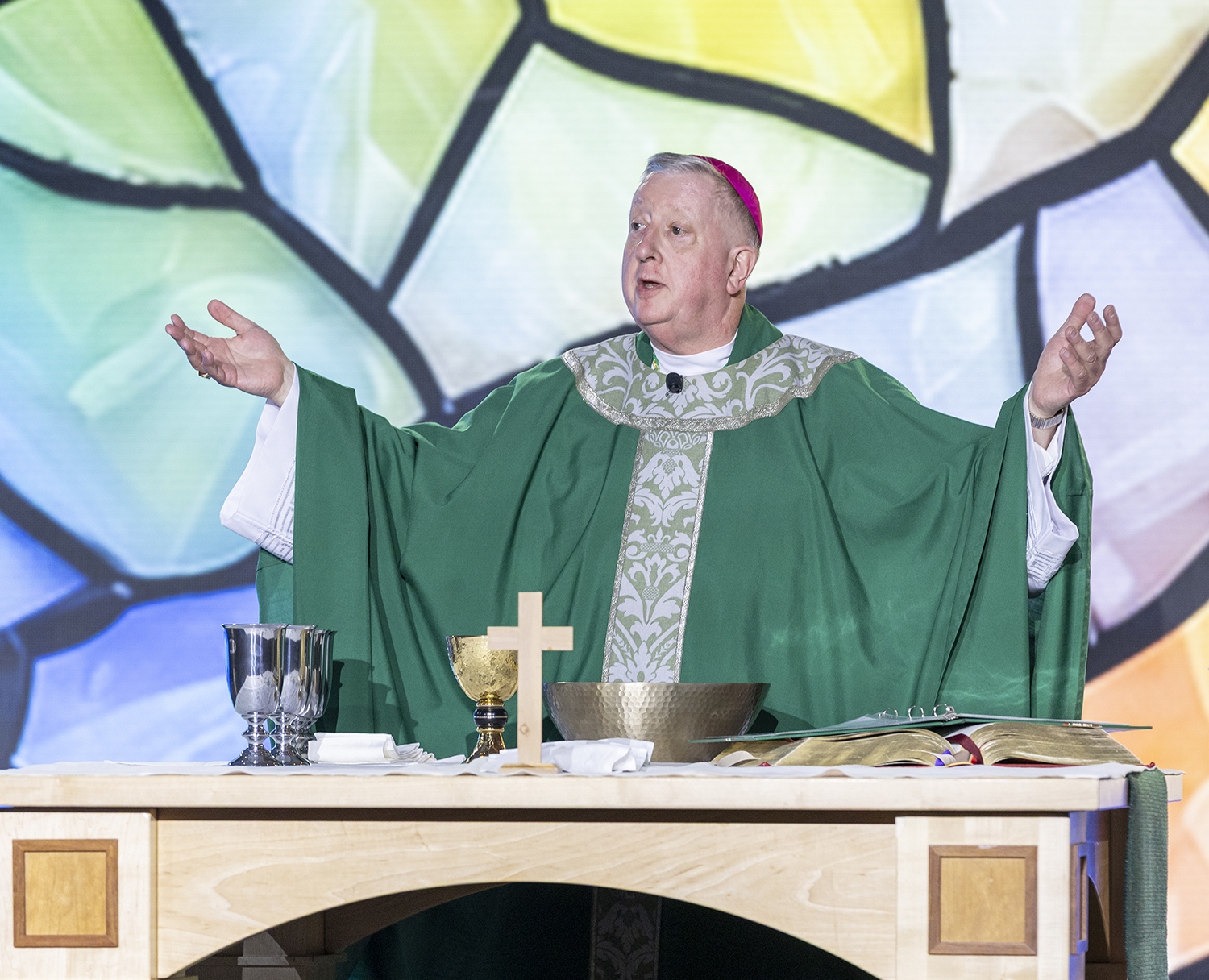
Adams built upon that concept as he discussed the healthcare system during a "fireside chat" with outgoing CHA Board Chairman Orest Holubec. Holubec is chief mission experience officer at Providence St. Joseph Health.
Rural, poor and Black
Adams began the chat describing his upbringing as a poor Black child in the rural South. Because of his severe asthma, he had to go to the hospital many times as a child. Once he had to be med-evaced to the emergency department and almost died. He said he intuitively understood inequities from his earliest experiences.
Gifted in science, technology, engineering, and math, Adams pursued engineering in college. While a student, he attended a talk by famed neurosurgeon Dr. Ben Carson and realized that Black men could be physicians.
He then pursued a medical degree. He became an anesthesiologist and then a university professor. When he was a state health commissioner, his handling of Ebola, Zika, HIV and hepatitis C outbreaks earned him praise, and he ascended to the role of surgeon general in 2017.
As the Trump administration's lead physician, Adams helped to guide the U.S. response to numerous national health crises, including an opioid epidemic, an e-cigarette and vaping epidemic and the COVID-19 pandemic.
He currently is a speaker on public health and a distinguished professor, presidential fellow and executive director of health equity initiatives at Purdue University.
Viciously attacked
During his address at the assembly, Adams shared experiences from his four years as surgeon general.
He recalled the early months of the pandemic when reliable data was lacking on where COVID was most severe, and so the administration was making policy choices based on bad data. He said this led to poor decisions, such as mass shutdowns, when shutdowns based on good, targeted data would have been best.
He spoke of the challenge of sitting in the "green room" ready to go on a news broadcast to speak about public health restrictions when he heard the broadcasters announce his segment. They said he'd be asked about President Donald Trump's decision to invite people to a large rally where protective masks would not be mandated, despite the COVID threat. Adams recalled that when he went live and was asked the question, he told viewers that they should make masking decisions based on their own personal circumstances, the environment and the risk factors. "I got ripped to shreds because I didn't condemn Trump," he recalled. He noted, though, that he based his commentary on the way he approaches medicine, equipping people with information to make their own choices.
He also shared a memory from what was one of the proudest moments of his life, being recognized in a White House ceremony. He remembered that his mother was scowling in the photos because of her disdain for the president.
While he brought out that memory with a smile and a laugh, he summarized the challenges of his tenure during the pandemic by saying, "I was in the public spotlight, trying to be the best I could, while the ones I tried to serve attacked me viciously."
'Watershed moment'
Adams drew upon his decades of service in healthcare to reflect on what he called today's "watershed moment in healthcare delivery."
He acknowledged that there are many concerns plaguing the healthcare delivery system, and delineated many of them. He spoke of how most healthcare dollars go toward the medical model of care, or the care that takes place after someone becomes ill, rather than to preventive measures that can help keep people well. He decried that the polarization of the nation has led to people making important decisions about U.S. healthcare through a political lens. He spoke of the aging of America even amid a decline in the healthcare workforce. And he talked about how financial pressures are putting a tremendous strain on providers, sometimes forcing the closure of vital medical facilities.
He said some of the biggest problems the healthcare system is facing have to do with public sentiment. People have become very angry that the nation is spending so much money on healthcare but getting very poor outcomes. People are going into severe debt and even bankruptcy because of the rising cost of care. And there is so much distrust of healthcare by some Americans that many people are forgoing essential care.
Adams said despite these headwinds, he remains optimistic. He said healthcare leaders can come together to focus on preventive care and community benefit. They can build important partnerships with others to advance the common good. They can cross the political aisle to work toward something better.
He said a good place to start is on rebuilding public trust.
And, he said of all those involved in the healthcare delivery system, "If we focus on what we have in common, we will actually be in a lot better place."