
Trinity Health is phasing its TogetherTeam Virtual Connected Care into adult acute-care units across its 26-state footprint. The trademarked care delivery model, in which registered nurses working virtually are part of a bedside care team, launched in late 2022.
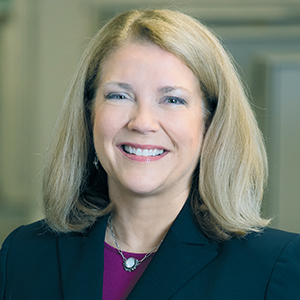
Senior Vice President and Chief Nursing Officer Gay Landstrom talked with Catholic Health World about the model and how it has been working. Her answers have been edited for length and clarity.
What prompted Trinity Health to create TogetherTeam Virtual Connected Care?
In late 2021 we began to realize that the pandemic, which was very traumatic, was causing a significant shift in the number of nurses willing or able to work in medical-surgical units. While there were needs elsewhere, in the emergency room and obstetrics and other places, the biggest need was in med-surg, telemetry, step down — those core inpatient nursing units.
We knew that we had to look at providing care in a different way, and we began to do some experimentation to tap into the creativity of our nurses, who understood care so well. We had many units trying different things. We had a robot helping deliver things in a couple of hospitals. We tried numerous ways to have a scribe for the RN to lessen their time documenting. We had other teams of people like physical therapy aides helping us with ambulating patients and turning patients and doing some elements of care.
At the end of all that experimentation, we really believed that we had found a couple of elements that if we combined them, we could create a new care delivery model.
How did you settle on the model?
We wanted to make sure that we came up with a way to optimize where and how RNs were spending their time. We don't want to have their time consumed doing things that somebody else could help with. We also knew that a lot of the nurses that we were hiring were newly graduated out of school. They needed growth and development and mentoring. And during the pandemic, we had a lot of nurses retire. We wanted to try and entice experienced nurses back into bedside care.
Can you describe the model?
What we created was a three-person team. We have a bedside RN. In many cases, they are likely earlier in their career and would benefit from mentoring. Their partner at the bedside is a non-RN. Depending on the market, availability and the kinds of patients that are cared for on that unit, that might be a nursing assistant partner, or a certified nursing assistant partner, or even a licensed practical nurse or licensed vocational nurse, depending on what state you are in. We had done time studies, and we realized that about 40% of what the RN was doing at the bedside could be accomplished by an LPN. And between 20-25% of what the RN would spend their time on could be supported by a nursing assistant. So those were pretty significant findings.
And in our TogetherTeam Virtual Connected Care model, we are incorporating a third partner — a virtual nurse, who is not at the bedside. They are on the other side of the TV screen. In that role, they are required to be RNs with at least eight years of experience, and have some proven mentoring capability, because that is a key part of their role.
Why was Trinity Health open to having RNs working virtually?
It gave a place for nurses who during the pandemic, decided, "I just can't do hands-on care anymore." Maybe they took a desk job, maybe they retired, maybe they left nursing. We've been able to entice a number of them back into care. They didn't really want to leave patient care, but they couldn't physically do what was required on the unit. We're able to tap into all that knowledge and experience and the ability to teach and guide the rest of the team.
We created a place for a senior nurse to be able to lengthen their career, and in a time of shortage, we absolutely want our nurses to have a place to be able to contribute to patient care for as long as they possibly can.
Where are the virtual nurses located?
They are on-site in our hospitals. In most cases, there is a hub somewhere in the hospital, on a unit that isn't being used, or somewhere like that. Sometimes they will come to the unit for a team huddle, and then they'll go back to their hub. In a couple of cases, we've got hospitals that are just a few miles apart and we may have one hub that is shared by both hospitals. But they're all close by. Should we have some kind of electronic failure, or computer systems glitch, or whatever, we would have those virtual nurses come into the hospital, to the unit, to support.
How has this model changed Trinity Health's nursing workforce?
When you create these teams with a mixture of experience levels and roles, it lowers the overall demands on direct care RNs. At the same time, patients are afforded increased access to their caretakers, because the work is divided amongst the team members.
What changes have you seen in the units?
When we implement this model, the units are much quieter. There are not as many patient call lights going off at any one time, because with the team approach we have the opportunity to anticipate the patient's needs before they need to make a call.
Can you point to a couple of those lessons that you've learned?
It makes a big difference to a patient that they can have quick connection with their team. We know how important that is for a patient who might be lying in a bed and either have questions or are experiencing pain. Waits are awful. And in our model, we reprogrammed the call system so that a patient can push a button and get their virtual nurse quickly on the television screen in their room.
Another thing that we've learned is when you have three people on a team, it does require regular and purposeful communication so that everything can stay coordinated, so that nobody's duplicating efforts, and we're not leaving any gaps. That requires that a number of times during the day, the team needs to compare notes and share information and decide who's going to do what and what the priorities are for the patient.
What technology was needed?
We use the same big television screen the patient uses to watch TV. There is a camera and sound system that is installed at the foot of the bed. Finally, a few years ago, technology got to the point where those cameras that were available were really good. You can zoom in 20 times, and the virtual nurse could really see the detail and work with the bedside nurse for teaching opportunities.
Does this model maintain the sacred encounters in patient care?
One of the things that we embedded into this model very intentionally to bridge the distance between the virtual nurse and the patient, and to foster teamwork, was the Caritas processes of the Watson Caring Science Institute. Those processes, focused on human loving kindness, are quite prevalent in nursing care across the country, particularly Catholic organizations. We brought them into the team, so that the patient feels that connection—that loving kindness.
I think one of the biggest signs that it is working is what we are hearing from patients. They are reaching out to virtual nurses in ways that they tell us they were hesitant to do with the bedside nurse. We don't understand everything that shifts that perception, but they are feeling the loving kindness from their virtual nurses who are on the other side of the screen. That is probably one of the biggest joys for me as I look at what we're seeing with this model.
Is the goal to have the model in adult acute care units across Trinity Health?
We have been steadily replicating this model. We do have a goal to have it on those types of units wherever it makes sense.
We're also developing a model and testing it in the emergency department. Emergency care was really tough during the pandemic, and a lot of seasoned nurses retired, and so there is a need to bring expertise and mentoring to emergency department nurses who may be early on in their career.