
Dr. Ali Ahmad has grown used to letting other surgeons watch him operate on the gallbladder, liver and pancreas at Ascension Via Christi Saint Francis Hospital in Wichita, Kansas.
In the past the observers often had to fly to Wichita and stay overnight in a hotel.
Now, the surgical oncologist regularly teaches people from around the country and the world virtually and in real time how to perform robotic-assisted surgery.
“They may take a few hours off from their schedule, clear that out,” Ahmad said. “All they really need is a laptop and a good internet connection, and we give them a secure link.”
Ahmad is aware of only two other surgeons in the country who provide training virtually on robotic-assisted operations on the da Vinci 5 system to remove cancer from the liver and pancreas.
Bridging gaps
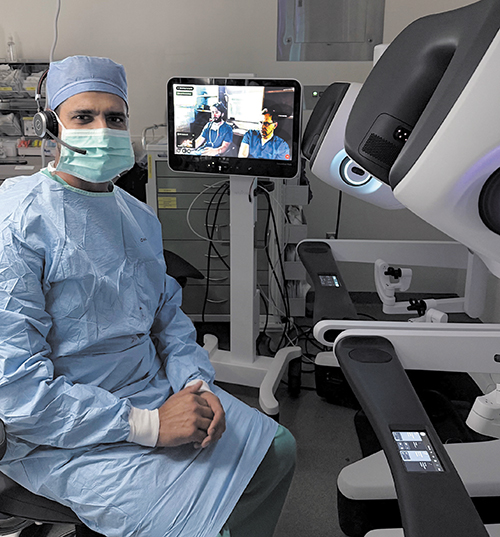
The training is specific to the hospital’s da Vinci 5 robotic surgery system, which is made by Intuitive. The company provides the secure network for the training and helps connect Ahmad with surgeons and medical students who want to observe his work.
“We can transmit that exact screen to them, and they can see exactly what I’m doing at the time of surgery, from their own laptop or their home screen,” he said. “So in that sense, it is very useful. It has really bridged a lot of gaps, especially on the international level.”
Ahmad said the latest model of the robotic system, which Ascension Via Christi Saint Francis has had for about two years, came with advanced virtual capabilities.
Ahmad is what Intuitive calls a key opinion leader, and the hospital is designated as a case observation site. Ahmad has maintained relationships for years with some of the surgeons and students he has taught and considers them peers.
Learning a complex surgery isn’t as simple as logging on and watching him work, he said. He and those he is training meet virtually to talk and watch other surgeries. Those in training might practice on cadavers or porcine models.
When surgeons are ready to work on their own, Ahmad can watch the screen to supervise, he said.
“And I can log in from my laptop, and instead of as a learning person, I can be the instructor on the other side. So it helps correspond both ways,” he said.
Just one way to train
An Intuitive spokesperson said that by the end of 2024, more than 89,500 surgeons had gotten training on the da Vinci platform. Telepresence is just one part of the company’s broader technology training program, which includes more than 60 robotic-assisted surgical technology training centers worldwide, simulation exercises, and hands-on opportunities. The company’s learning platform is available in 17 languages and used by more than 8,000 hospitals around the world, according to Intuitive. Recordings of surgeries and instruction, including some by Ahmad, are available in a digital library maintained by Intuitive.
More than 17 million da Vinci procedures have been performed worldwide, the spokesperson said.
Ahmad said he has personally trained more than 100 surgeons on the robotic platform. In the past couple of years, surgical training has picked up at the hospital, and sometimes a couple times a week a surgeon will log in remotely or come to Wichita to learn.
He said the virtual teaching has allowed surgeons to broaden their knowledge and access training that might not otherwise be available to them, especially on complex procedures.
“It’s really great to see a surgeon become successful, to be able to do whatever robotic surgery they were wanting to do, and see how they actually have a really good impact in the community that they are serving,” Ahmad said. “So your reach as a teacher, in certain ways, goes way, way beyond what you thought it would, what kind of impact it would have. So that’s where the gratification is. You’re helping patients out thousands of miles of way, which I would have never had the opportunity to do otherwise.”