
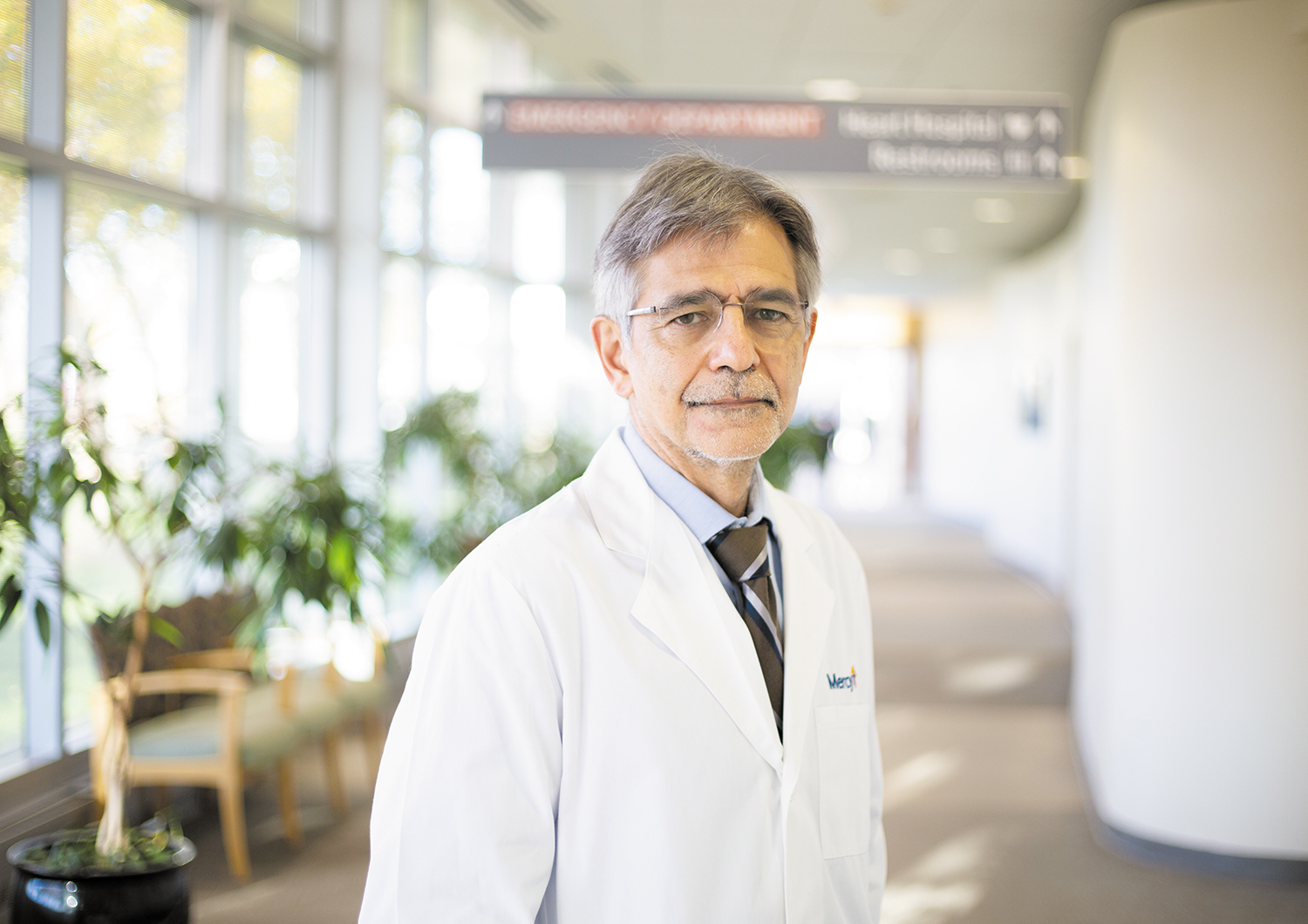
Dr. Farrin Manian practiced for 27 years at Mercy Hospital St. Louis, located in one of the city's wealthier suburbs. Unhoused people were the exception rather than the norm among the hospital's patient population.
Ensconced in what he calls his own bubble of a suburban infectious disease practice, he says he didn't appreciate the challenges people with no stable shelter faced in accessing health care and in daily living.
"It was like an out of sight, out of mind kind of thing," he recalls.
That changed in 2013, when he took a position at Massachusetts General Hospital, a teaching hospital affiliated with Harvard Medical School that serves the diverse urban population of Boston. In his seven years there, he helped care for many people who lacked permanent shelter. Daily, he saw how unstable their lives were as they camped on the streets and in the parks he walked through on his way to work.
"I was really exposed to the conditions of being unhoused in the cold and rain," Manian says. "And it just made me think about why can't we do better as a society to help this vulnerable population."
Even amid the ongoing need in Boston, Manian says he saw inspiring work being done, especially by the Boston Health Care for the Homeless Program. That program describes itself as an "integrated team of over 600 medical and behavioral health staff, social service providers, and support staff committed to providing comprehensive, high-quality health care for individuals and families experiencing homelessness in Boston and beyond."
Seeing the need back home
When Manian returned to Mercy Hospital St. Louis in 2020, he began to research homelessness in the region.
"I didn't know the statistics, but the more I looked into it, the more I found out that it's a big problem for us in the region," he says. "It is a problem in Missouri. It's not just the inner city. It's suburban as well as rural areas."
The 2024 homeless assessment from the Department of Housing and Urban Development found that 7,312 people were unsheltered in Missouri. In the St. Louis region, an estimated 1,700 people are unhoused.
Manian's findings on homelessness in St. Louis and his experience in Boston prompted him to act. In January, for the second year in a row, he organized a daylong symposium at Mercy St. Louis focused on how to address the needs of people experiencing homelessness. The topic was "Meeting Them Where They Are: Toward Better Health Care for Our Unhoused People."
The conference brought together national experts on the living conditions of people who are unsheltered and on best practices in providing them medical care; leaders of public health and social service agencies in the St. Louis region; and people who have experienced being unsheltered in the region.
"We were able to somehow, miraculously, bring everybody together and we hope to keep doing it every year," Manian says.
Awareness, networking
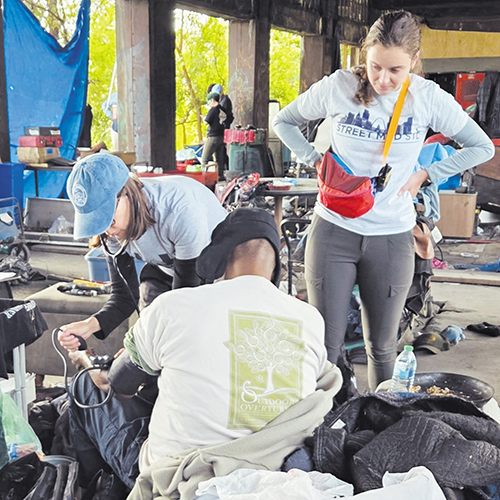
He says the idea for the symposium came to him about two years ago, after he and some of the residents he works with at Mercy began spending Saturday mornings with Street Med STL, a team of volunteers who visit encampments of people who are unhoused in St. Louis to provide medical care.
"We were rounding on the banks of the Mississippi among a bunch of tents and rain and then it just struck me that, within our group, we all know exactly what we need to do, but 99% of people out there are completely oblivious of what life in these encampments really is like," he recalls. "The lack of awareness at a societal level, to me, in our region, made me think that what we need to do is to have a symposium where we can have a lot of people from all different disciplines come together."
In addition to encouraging staff from across its footprint in Missouri, Arkansas, Oklahoma and Kansas to attend the conference in person or virtually, Mercy invites government officials, people affiliated with medical schools and other hospitals in St. Louis, and leaders of health care and social service organizations across the region. This year about 250 people attended in person or virtually.
One of the welcoming addresses at the conference came from St. Louis County Executive Dr. Sam Page, who in addition to being the county's top elected leader is an anesthesiologist.
Manian says the symposium's goals are to increase awareness of the unsheltered population and their needs and to provide a networking opportunity for people who have an interest in addressing those needs.
Understanding why
Based on his own experience, Manian says there are many reasons beyond not having a permanent address that people living on the streets don't or can't access health care. The reasons include lack of access to phones and transportation.
Another big reason, he says, is that many people who are unsheltered do not trust the health care system. "They don't really like to necessarily even seek medical care unless it's absolutely necessary," Manian says.
Even for those on the streets who are reluctant to seek care for themselves, Manian says society should not give up on improving their lives and health. He points out that compared to others, people who are unsheltered have higher rates of morbidity and mortality.
"That has to do with all the issues that go along with not having a roof over your head, even in the shelter, whether it has to do with trauma, crime, enduring or putting up with the elements, lack of food, frostbite, you name it," he explains.
As part of his volunteer work with Street Med STL, Manian visits a church in St. Louis once a month when it serves dinner to unsheltered people staying in the neighborhood. He brings supplies such as antibiotics and bandages and offers his medical services.
Just as important as tending to the health needs of the people at the dinner and at homeless encampments, Manian says, is acknowledging their presence and treating them with dignity. That approach builds trust, fosters hope and can help change the course of their lives, he says.
"This kind of a connection that we establish with our people, that is kind of a shared humanity that we're privileged to have when we encounter them," he says. "That, to me. is priceless. And that trust, I think, is going to be really, really important in terms of helping our people get out of the situation they're in."
A need for funding and advocacy
Manian says Street Med STL depends largely on the generosity of its volunteers to not only provide their time and talents but to also buy their own supplies. With more funding, the group could help many more, he adds.
"We want to expand our services, not just in downtown St Louis, but also in the county and rural areas," he says. "We need resources for that."
Manian recognizes that many people aren't able to gift their talents or donate money to help those who are unsheltered, yet they still want to help. He encourages them to speak out.
"I know that not everybody's going to be able to come around with us on Saturdays," he says. "But if we can really impress upon the community to become better advocates for the unhoused, I think that can gradually change our attitudes toward this population."