
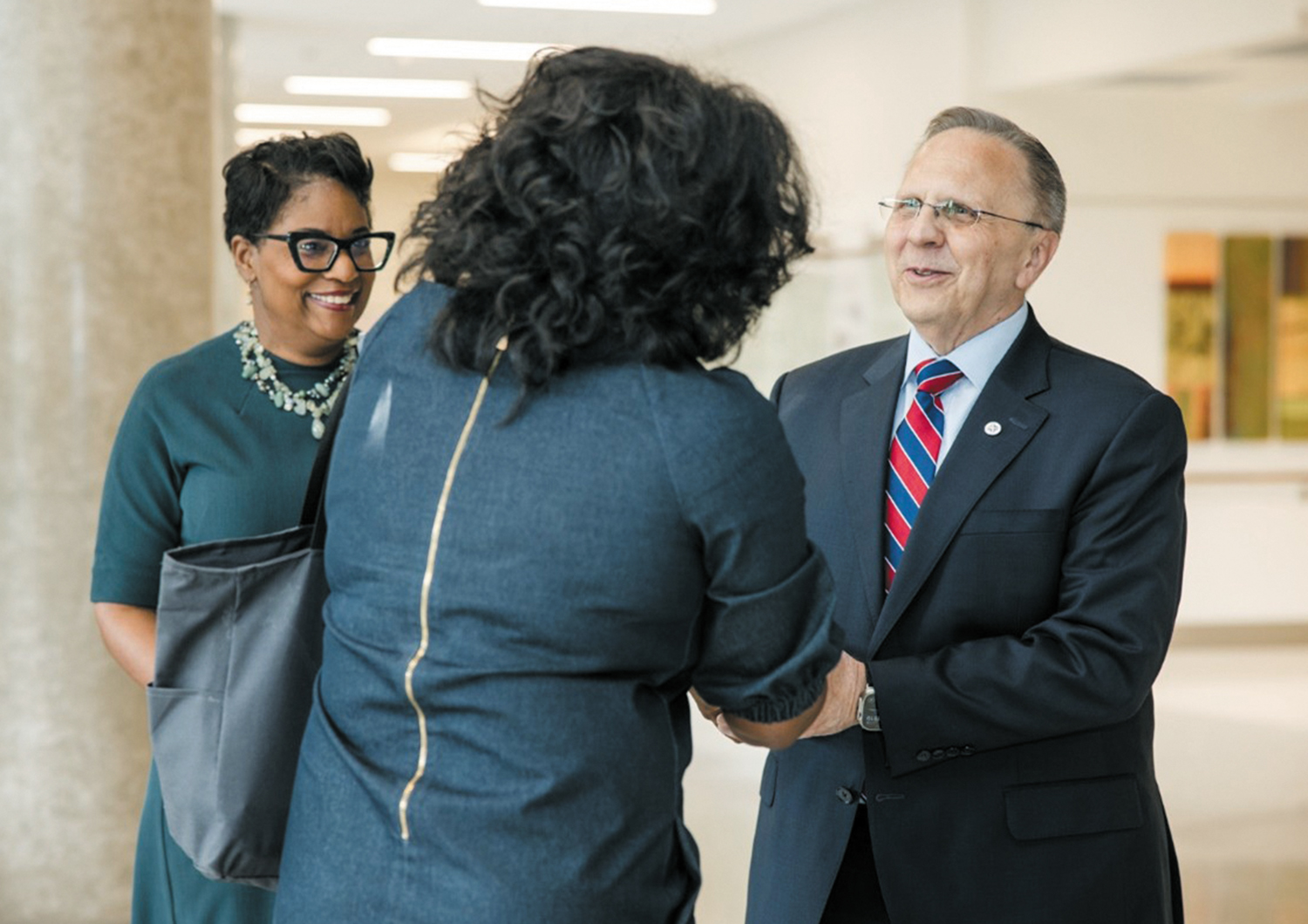
Mike Slubowski was present — albeit in a different role than today — at the very start of Trinity Health 25 years ago through the consolidation of Holy Cross Health System and Mercy Health Services.
Trinity Health expanded greatly over the past quarter century through merger and organic growth. It has more than tripled its revenue and become one of the nation's largest systems.
Slubowski, who had been on Mercy Health Services' executive team before that 2000 ceremony, remained a Trinity Health leader until 2010, when he departed to head SCL Health. He returned to Trinity Health in 2017 and two years later became president and CEO.
He spoke to Catholic Health World recently about the system's evolution and how it is positioning itself for what is ahead. His responses have been edited for length and clarity.
Thinking back over the last 25 years, what has meant the most to you?
A favorite memory is when I was privileged to sit in the session with our sponsors, the Sisters of the Holy Cross and the Sisters of Mercy Regional Community of Detroit, when they formed Trinity Health. We actually had a solemn ceremony, where we lit candles, and the formation of the ministerial juridic person was brought to light. And the sisters spoke about being filled with outrageous hope, and they had very high aspirations for the ministry.
Some of the things that excited me most over the 25 years were, first of all, forming a unified culture. Mission, vision and values were constructed and a common culture supporting that mission, vision and values has come to life.
And, then, we've seen growth. When Trinity Health originally formed our revenue was maybe $7 billion and now it's over $25 billion. We've brought other partners in — both religious sponsors that have become part of the public juridic person plus some freestanding organizations that share our values have joined the organization.
The thing that is really important about being a system is the value of leveraging your skill, learning, innovation and scale; and how you add those elements to what you do to lift all boats across the system.
What are some of the things you are most excited about for Trinity Health as you look ahead?
We do a balanced system scorecard, and we break it into four categories: purpose or mission effectiveness; people, which is both our caregivers and the patients we serve; portfolio, which is our mix of services; and then performance, which is financial and the clinical measures of success. So, I would say I am excited that every year we raise the bar on the measures on our scorecard and we continue to improve quality, safety, the care experience and our stewardship work.
Additionally, with our community benefits — which we call community impact reporting — we go beyond what the IRS accepts. For example, in fiscal year 2025, we did $2.9 billion of community benefit, which is about 11% of our revenue. We are very blessed to be able to give that kind of support back to our communities.
I'm also excited about the fact that we've continued to make a big investment in our common platforms. In March next year when Loyola comes up on a new version of our electronic health record platform, what we call TogetherCare Powered by Epic, we'll be the largest concurrent user organization of Epic in the country. I think enabling technology to support care delivery is a really important part of our focus, and it's making a difference for the people we serve.
Another thing I'm really excited about is our work to support our caregivers and our people. We're training 6,000 frontline leaders in being more effective leaders and supporting their people. Unless (our employees) are healthy, engaged, informed and empowered, it's pretty hard to take quality and safety and the care experience to the next level.
And, I'm excited that we have really been putting a lot of energy into growing what we call our community division: our physician medical groups, our home care and hospice operations, our PACE program — we're the largest not-for-profit PACE provider in the country — and our freestanding ambulatory surgery centers where we are expanding greatly in partnership with our physicians. This work is focused a lot on what we call asset light growth. Rather than building big brick and mortar (facilities), our focus is more about facilities that are closer to patients and members in the communities. These facilities are smaller, focused and use technology to support them there. Where care is growing is in the home, virtual and in medical offices. And then there is also the work we do with our community health workers out in the community, like helping people manage chronic conditions.
What are some things Trinity Health is doing to reposition itself for the challenges it is facing in today's environment?
We estimate the impact of government changes in policy and funding, and some of the Medicare cuts that are occurring will reduce our revenue by $1.5 billion. And that is on top of the gap we have to close every year — the difference between inflation and revenue increases we get that are also more than $1 billion.
So it's about not only focusing on the growth of our community-based work, but also about how we redesign what we are doing internally with that beginner's mindset, lowering our administrative and support costs and looking at alternative ways to deliver services. How do we optimize our service lines? How do we become more efficient? How do we further leverage our common platforms to lower the cost of care? How do we aggressively manage our suppliers of services?
I've written about the fact that when you look at big tech, big pharma, medical device suppliers, insurers — all the inputs into our system — their revenue is our cost. And, they're all public companies with higher earnings requirements than we have as a not-for-profit system, but they are extracting that margin out of us.
So how do we level the playing field where we are getting services that are fairly priced and allow us to provide our services at a lower price point to the people we serve? When I tour the sites and even see some of the care that members of my family recently received, it really gives me such an appreciation that this work is the most personal of services, body, mind and spirit.
So it's taking all the work that we are doing to the next level.
What are some big changes ahead for Trinity Health?
While I know there's a lot of controversy about artificial intelligence right now, I truly believe that it will transform care delivery in a good way. What we are learning already about the power of harnessing it in the right way is that it's going to help us support people in profound ways.
It's helping caregivers with getting back to the basics on care delivery instead of having to sit at the computer.
One of the things as I look back on 25 years is how slow things change in health care delivery — people are resistant to change. And I think we really need to use enablers and support our workforce — really open our minds and hearts and capabilities to embrace change and the possibilities that come from what we're experiencing in modern medicine in society.