
After the suicide of a beloved, longtime Mercy caregiver, the system responded the best it knew how. The system's leaders provided on-site counselors, engaged spiritual caregivers and referred those affected to the employee assistance program.

But in that process, they realized there were some issues, said Patrick Dotson, director of the employee assistance program at Chesterfield, Missouri-based Mercy. Not everyone who was providing support knew how the others were responding. And some responses, though well intentioned, were not necessarily best practices.
Leaders challenged Dotson: How can we take this type of response to the next level and ensure that Mercy has true wraparound support for caregivers facing a crisis?
That was the push behind the Caregiver Incident Response Team, or CIRT, which launched in October. The team responds to disruptive events impacting healthcare across the Mercy ministry, such as workplace violence and threats, a caregiver death or suicide, an unexpected patient death, patient trauma and suicide, storm and weather impacts, grief and loss, caregiver doxxing and online harassment, protests, and restructuring or reductions in force.
Mercy leaders had already put a suicide response plan into place and already had a plan for mass casualty incidents, Dotson said.
"But the challenge was, well, what about all of these other disruptive events that fall in between?" he said. "How can we better serve our caregivers who are emotionally rocked by disruptive events that happen at the workplace?"
Mercy has 55 hospitals and 1,400 clinic practices, outpatient facilities and outreach ministries in eight states. The ministry employs about 52,000 caregivers.
Building the structure
Dotson, who presented on the CIRT team at the CHA Assembly in June, said the hospitals already have Behavior Incident Response Teams, or BIRTs, that respond when a patient is acting aggressively. Leaders figured the CIRT acronym would be familiar to caregivers. "The C stands for caregiver, so that helps the caregivers know this is for us," he said. "This is a support for us."
One priority in creating the CIRT is that it gives leaders across the ministry one phone number to call following a disruptive event in their workplace that deeply impacts a team.
The CIRT phone number reaches a member of the employee assistance program, who then helps organize a meeting across local and ministry-wide teams: employee assistance, spiritual care, behavioral health, peer support, human resources, mission, and whoever else might be pertinent, such as security. The call will prompt a CIRT response plan meeting, usually a 30-minute Teams call.
"The idea is: Let's get everyone on a call and talk about what happened, talk about where is the team emotionally right now, how they are affected, who's most impacted, and then talk about how can we best support this team?" 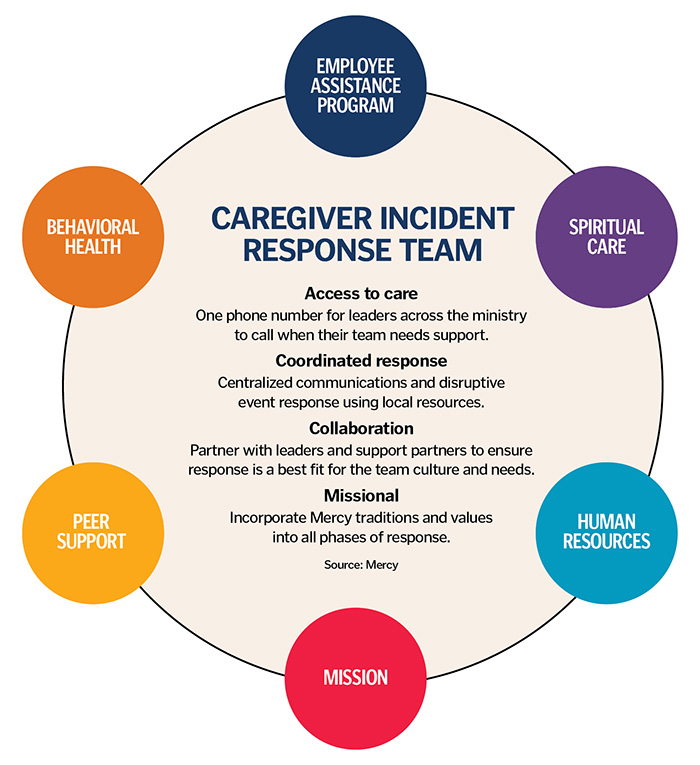
Customizing response
What works well for one team may not work well for another, Dotson pointed out: Some might want to share emotions with a counselor as a group, others may want to do so individually, some might want to talk to a chaplain.
"It really varies, so we are matching the level of support as a ministry with the exact needs of that team," he said. "I think that's the recipe for ensuring our caregivers truly receive and feel that support and care."
At one Mercy clinic, several caregivers had lost loved ones over the holidays and were dealing with sadness and grief. There was a pall over the clinic. A leader called the CIRT line for support. At the response plan meeting of involved leaders, they talked about having a memorial service, and the leader of the caregivers mentioned that her co-worker had gifted her a vial of holy water from the Vatican. She had been looking for an occasion to use the water, and it was later incorporated into a blessing ceremony for the team and clinic.
"The creativity of all those gathered together leads the care and support into unique directions," said Dotson.
As of the end of July, the CIRT team had responded to nearly 40 requests in 15 Mercy communities. Workplace violence has been the main reason leaders call, followed by caregiver death, and then unexpected patient deaths, Dotson said.
'We are never alone'
Mercy caregivers have noticed the extra response. Leaders appreciate the chance to talk to one another to see how they can provide support, Dotson said.
"I tell people all the time, as an EAP leader, the Mercy mission is to extend compassionate care and exceptional service, just as the Sisters of Mercy before us," he said. "This ministry of Christ has been entrusted to us, and when someone reaches out to us, I say you are allowing us to fulfill our mission."
After a caregiver at one clinic unexpectedly died, the news hit her co-workers hard. CIRT leaders and senior leaders reached out within 30 minutes of the initial call to learn how they could help. A spiritual care team member arrived at the clinic that day, and more members and a counselor arrived the next day and followed up with a care plan for anyone in need of more support.
"The experience reminded me that even in the hardest moments, we are never alone," the leader who made the call wrote. "We have each other, and we have resources that bring comfort and hope when we need it most. These sacred moments are not just about loss, they are about love, community and the strength we find together."