

Providence St. Joseph Health is working toward being carbon negative — or emitting less carbon than it produces — by 2030. The system and its 51 hospitals and 1,000-plus additional sites across seven states are finding that it can be very difficult to pursue this goal.
By tapping into their creativity and resourcefulness, environmental stewardship leaders and associates across Providence have built momentum in achieving large-scale stewardship gains.
The health system's Alaska region has had to be especially inventive in this work, in large part because the state's remoteness makes waste reduction efforts extra challenging.
Darcy Moxon, sustainability manager of Providence Alaska, says creativity, communication and a "community mindset" have been key to her approach to doing all she can to discover ways to reuse all types of materials. She continually communicates with employees throughout Providence Alaska, asking them what reusable items they are struggling to find a home for. She then reaches out to people and organizations locally to see who can use these materials.
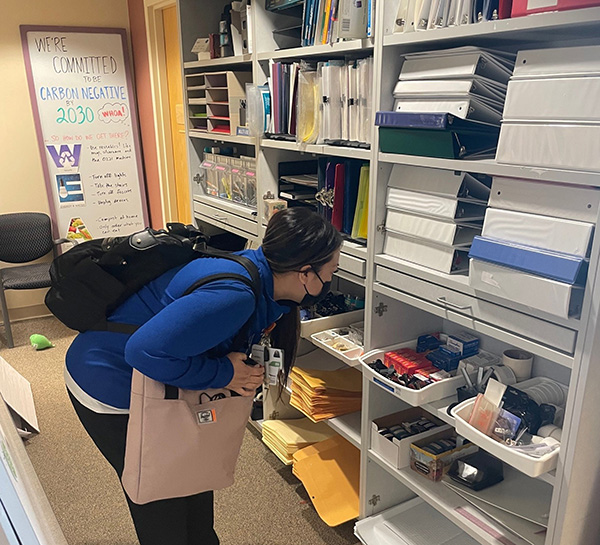
The Earth's resources "are not infinite, and we need to be smart in how we are using what exists," Moxon says.
Reuse room
In her four years in her role — she is the inaugural sustainability manager for Providence in Alaska — she has helped to find many solutions. She spearheaded the creation of the region's "reuse room" at a Providence Anchorage facility and has evolved it into a self-serve resource where employees can find everything from office supplies, to chairs, to file cabinets, to scrubs.
When Moxon learned local teachers could benefit from the supplies, she hosted a supply day that drew several dozen teachers each of the last two years. Last year, teachers received about 3,000 pounds' worth of items.
She learned that local organizations could benefit from Providence food waste, and now partner organizations pick up that waste and use it for animal feed and garden fertilizer.
She's helped arrange for usable but unneeded medical supplies to go to a Providence education and training institute as well as to an Anchorage university. And she's sent clean hospital laundry that cannot be returned to circulation to local animal shelters to use as bedding.
'Trashion' show'
Moxon helped develop a particularly creative way to reuse no-longer-needed material through Anchorage's first-ever "Trashion Show" last month.
A couple years ago, Moxon came up with the idea of engaging community members in repurposing unneeded supplies into clothing. She got the idea from another Providence region that had invited colleagues to create clothes from the blue wrap used to protect sterile medical equipment.

Moxon asked the Anchorage Museum whether it would want to partner, given its similar environmental stewardship focus and goals. Museum staff signed on.
The two organizations hosted designer workshops, inviting community members once a month for about a year to take what they wanted from a collection of Providence discards. Moxon facilitated the sessions.
Providence and the museum then invited the designers to display their pieces in a runway show at the museum June 11. The designers showcased nearly 80 outfits at the event that drew hundreds of attendees.
The designers "blew everyone away," Moxon says. Some of the outfits were for shock value, she laughs, but some were beautifully designed art pieces. "We received nothing but great feedback," Moxon says, "and it was so impressive to see such talent and creativity on display."
With that event over, the museum now is displaying selected outfits in an on-site gallery. Providence may host the collection in August.
Alaska peculiarities
Moxon notes that in general her role and efforts around waste reduction are similar to what her sustainability colleagues throughout Providence do. However, she noted that Alaska has special challenges.
For one, the Alaska region is too far from the other markets to share its reusable items with other Providence facilities. In some cases, even the communities where Providence has sites in Alaska — Anchorage, Kodiak Island, Seward and Valdez — are too far from one another to share such items.
Additionally, recycling is expensive in Alaska because of a lack of recycling facilities, and very limited types of items can be recycled in the facilities that do exist. Much of Alaska's waste is sent on barges to Seattle, so that increases the cost of disposal as well.
Moxon notes that the landfill is by far the cheapest method of disposal, but because of Providence's commitment to protecting the Earth, the system avoids that option to the extent possible.
Moxon says prior to joining Providence, she didn't realize a large organization could be authentic in its sustainability efforts. But, in her role she has seen the health system's commitment up close. "Our CEO at the time I started (now-retired leader Dr. Rod Hochman) said things needed to change ... and I said to myself, I must be a part of this."