
Catholic Health World Articles

August 20, 2026

Chief experience officers take on formidable challenge of making sure patients' experiences align with what is promised

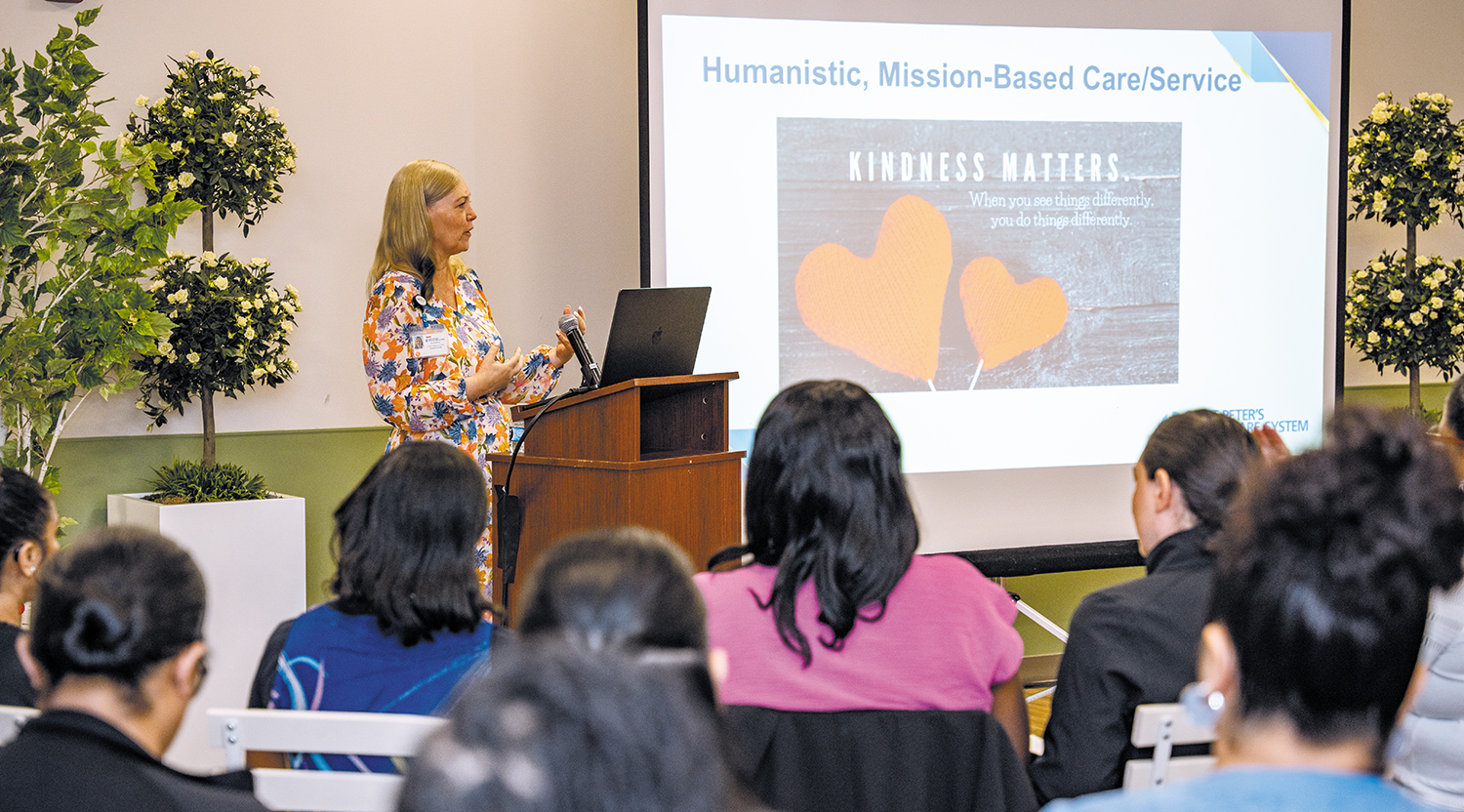
Lisa Drumbore speaks to employees of Saint Peter's Healthcare System of New Brunswick, New Jersey, during a Service Excellence Thought-Leaders Team educational program. The program was on Saint Peter's commitment to its "Treating You Better for Life" brand promise and the importance of delivering an exceptional patient experience at every point of care. Drumbore is the health system's chief patient experience officer and vice president of marketing and communications.

Decades ago, when Lisa Drumbore was sitting, anxious and alone, in the employee cafeteria on her first day as an intern at the WQED Public Broadcasting Service station in Pittsburgh, a man asked if he could join her for lunch. To her astonishment, it was Fred Rogers, who filmed the beloved "Mister Rogers' Neighborhood" at WQED.

Drumbore

During what Drumbore recalls as a wonderful chat, Rogers offered to divulge the three key elements of his success. He told an attentive Drumbore that the first element was to be kind. The second was to be kind. And the third? Be kind.

Drumbore says this advice resonates now more than ever in her role as chief patient experience officer at Saint Peter's Healthcare System in New Brunswick, New Jersey. She feels that "kindness and empathy and meeting people where they are" are essential to delivering mission-based care to patients.

Drumbore, who also is vice president of marketing and communications, is one of the patient experience experts at ministry facilities who take on the formidable challenge of ensuring that the employees are providing care that fully reflects the organizations' mission, vision and values. These experts say for patient experience to live up to what the organizations are promising, associates must be well-equipped to deliver on those promises.

"What we are doing at Saint Peter's is highly complex, and very strategic, but at the core is the element of humble service to our fellow humans, and a focus on human dignity at all stages of life," Drumbore says. "How we ensure that happens — that's the magic that is so simple but yet so complex in healthcare."

Haycock

Striking a balance
At CommonSpirit Health, which has over 160,000 employees working at more than 2,300 care sites in 24 states, the mission is to "make the healing presence of God known in our world by improving the health of the people we serve, especially those who are vulnerable, while we advance social justice for all," says Camille Haycock, CommonSpirit Health senior vice president, patient experience. CommonSpirit is striking a continual balance between a focus on the hard science of measuring and improving patient experience and the soft science of ensuring employees are conveying to patients and their loved ones that they and their experiences matter.

For the hard science aspect of the work, CommonSpirit has been perfecting how it measures patient experience through surveys and related composite scores. The system has been standardizing how its team leaders train, mentor and coach all employees to implement the soft science of showing kindness and respect.

Haycock says this patient experience work is embedded into all of CommonSpirit's operations and into the balanced scorecards that every facility uses to guide decision-making. She says it all maps back to the system's mission, vision and values. "It's a colossal fail if we do not deliver on kindness," she says.

A clinical team at Marian Regional Medical Center in Santa Maria, California, — from left, Tanya Torres Portillo, cardiovascular sonographer, and nurses Nathan Betts and Joesef Batista — prepares to care for a patient in the cardiac cath lab. The hospital is part of CommonSpirit Health, whose patient experience experts have been focused on standardizing how leadership systemwide trains, mentors and coaches associates to provide not just top-quality care but also optimal patient experience.

Sacred encounter
Jen Bayersdorfer, Providence St. Joseph Health chief quality officer, says at her system, which has about 119,000 employees working in more than 1,000 facilities across seven states, patient experience work is directly connected with the goal of creating space for sacred encounters, particularly between employees and patients.

Bayersdorfer

That system has concentrated on fostering a culture in which associates are equipped with the tools required to immediately address patient wants and needs.

Providence has worked with its vendor partners that secure patient feedback to ensure the health system and its facilities get that feedback in a quick, actionable way. Multidisciplinary teams at both the system and facility levels use the findings as well as anecdotal feedback to continually improve how everyone engages with patients. It is all about how the patients perceive that employees make them feel, says Bayersdorfer.

Accountability to mission
Saint Peter's is a standalone, diocese-sponsored system in New Jersey that includes the 478-bed Saint Peter's University Hospital, a children's hospital, a joint venture surgery center and a network of outpatient sites.

Drumbore says people generally have felt there has been a "dehumanization" in society, especially since the pandemic. A goal of Saint Peter's has been to make sure every associate is accountable for Saint Peter's mission, vision and values that focus on humanizing healthcare.

She says senior leaders and the system's diocesan sponsor are closely involved in making this happen.

Drumbore notes that some of the survey scores that the system watches closely have to do with being the provider and employer of choice. Saint Peter's healthcare facilities are among the top three in the state on the Hospital Consumer Assessment of Healthcare Providers and Systems, or HCAHPS, survey from the Centers for Medicare and Medicaid Services.

"Our approach is based on human dignity and service," Drumbore says.
Washington

Delighting patients
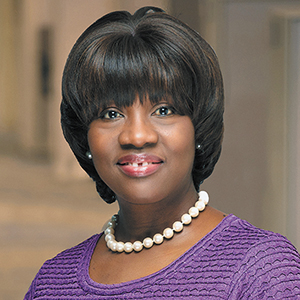
Julie Spencer Washington is executive vice president, chief marketing, communications and customer experience officer at Trinity Health. She joined the system from the consumer retail sector where "the consumer is boss," and she says that credo speaks to the importance of listening to and understanding patients and their loved ones and being sure to meet them where they are.

At Trinity Health, which has 133,000 colleagues and 38,900-plus physicians and clinicians across 23 states, patient experience leaders work closely with interdisciplinary teams across the system to better understand and act on patient feedback and experience data.

Washington says relational care is at the heart of Trinity Health's approach and "reflects its mission as a healing ministry, helping build trust through deeper connections based on each person's needs." Washington says by listening, meeting people where they are and taking a whole-person perspective, "the system works to create an experience where every patient feels heard, valued and supported throughout their care journey."

Stromberg

Nate Stromberg, regional director of patient experience, Trinity Health Mid-Atlantic, says that relationship-building among colleagues and between colleagues and patients is a key part of this process.

"Health equity is a huge part of this — we're treating people as individuals," he says. "It's about how we're listening to the voices" of patients.

Stromberg adds that, in a way, he's trying to engage all associates in his region in becoming patient experience experts. "This is part of the mission," he says. "We're all serving together in the spirit of the gospel."


Ministry systems and facilities use varied approaches to build connection and trust between associates and patients

Chief patient experience officers and their colleagues across the ministry are putting in place many types of programming to improve how they address patients' needs. The programming is enabling the systems and their facilities to better understand patient perceptions and needs, convey that information to employees, teach employees how to best meet the needs, measure the results of these efforts, and make improvements as needed.

Here are some of the tactics several ministry organizations are using:

CommonSpirit Health
  • Is looking at how best to measure kindness, since everyone has their own understanding and definition of it. CommonSpirit uses data to measure elements that are related to kindness, such as patients' perception of the trustworthiness of care providers. Now that all CommonSpirit facilities are on the same electronic health record, the health system uses that record to gather the data and then analyze it and act on it.
  • Provides "kindness training" to help employees understand how best to convey respect when interacting and engaging with patients and their families. This includes training on hospitality standards, eye contact, listening and conversing in a way that honors the patient and family and conveys kindness.
  • Carries out much of its patient experience work through patient and family councils.
  • Uses intentional rounding to quickly identify and resolve issues that can detract from patients' experience.
Providence St. Joseph Health
  • Has been developing a "listening system" to perfect how each facility gathers and understands patient feedback. Working with vendor partners, Providence is seeking to get that feedback quickly and in a tailored way. The system and its vendors are rolling out a survey platform that can stratify patients for a better understanding of particular population groups' perspectives. Providence sites can use that platform to invite specific patient populations to be in focus groups or studies.
  • Relies on patient and family councils and advisory groups to give feedback.
  • Uses patient rounding intentionally to connect with patients and to take a just-in-time approach to resolving their concerns. Providence is continually honing associates' rounding routines, including by providing a framework that addresses key quality and experience points. Those doing the rounding are empowered to quickly resolve any patient experience issues that surface. Leadership in Providence facilities also round in patient rooms, with an eye toward quick resolution of issues.
  • Teaches employees to use common bedside tools to quickly identify and resolve concerns that can mar a patient's experience. Visual boards documenting daily patient care plan goals are an example.
Saint Peter's Healthcare System
  • Engages its leaders on a regular cadence in studying patient experience data and in reading all patient and family comments. The leaders create a 90-day action plan each cycle to address concerns.
  • Empowers its 3,000 employees to serve as informal patient advocates who are responsible for making sure patients and their families have the best possible experience. Saint Peter's makes it clear to employees that they are accountable for upholding service standards.
  • Provides service excellence training to employees. Executives act out scenarios using cues such as eye contact and body language that show respect to others.
  • Rewards employees who excel at practicing the service standards. This includes featuring videos of employees who carry out the standards well.
Trinity Health
  • Grounds its patient experience work in listening to patients with the support of data from patient and family member surveys. The system is working with its vendors to become ever better at gathering feedback, especially from patient populations that have been difficult to reach. For instance, knowing that younger generations may not respond as well to the traditional mailed surveys, Trinity Health is looking to text, email and phone surveying to remain attuned to a broader swath of patients and family members.
  • Is exploring how best to "close the loop" with people who provide feedback and input. Trinity Health facilities are acknowledging issues that patients report, addressing and resolving them quickly, then reporting back to the patients how the problem was fixed.
  • Trains on the ICARE protocol, in which employees Introduce themselves to patients, Connect with them, Ask for permission before starting a care procedure, Reduce their anxiety and Exit their presence with reverence. The protocol creates a consistent experience for all patients and colleagues. ICARE is a common healthcare framework that Trinity Health has adapted to align with the central focus of its culture, emphasizing the importance of having continual, meaningful touchpoints with patients so that they feel seen and understood.
  • Ensures leadership is discussing service protocols that improve patient experience at employee orientation. Then leadership builds upon this introduction during workshops and through other educational programming. Trinity Health also reinforces it by recognizing employees who are doing it well.
  • Makes sure patient experience leaders keep a continual in-person presence at the system's facilities so they know how well protocols are taking shape. These patient experience leaders make frequent visits to the facilities within their purview.
— JULIE MINDA
CHA Publications

Reprint Requests

Would you like permission to reprint an article from one of CHA's publications? To do so, please use our online request form. Please allow our team 1-2 business days to respond to your request.