
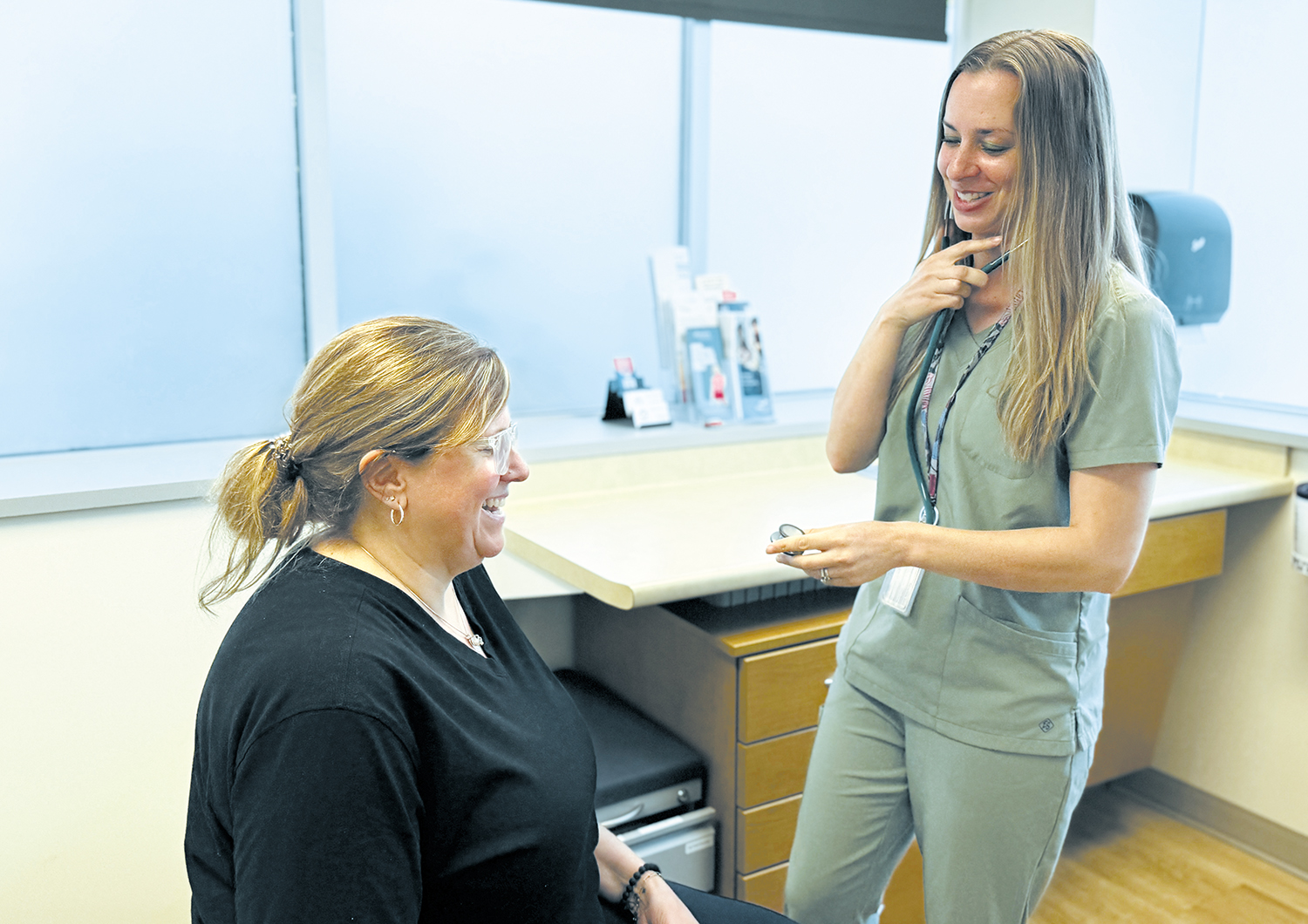
In her late 20s and early 30s, nurse practitioner Lauren Palmer felt everything was going her way. She enjoyed her job at SSM Health Monroe Clinic Medical Group in Monroe, Wisconsin. She was married to a man she loved. Life was good.

Palmer yearned to give back. After mulling it over for a few years, she decided that giving a part of herself through live organ donation would fulfill her need to help someone.
"It seemed like a pretty easy thing to do, something that would make a direct impact," Palmer says. "I mean, I had two kidneys — and I could live with just one."
In November 2023, Palmer, 33, underwent laparoscopic donor nephrectomy — removal of a kidney for donation through small incisions in her abdomen. While preparing for surgery, she never had to think about one potentially significant obstacle: loss of income. Under a then-new SSM Health policy, live organ donors receive six weeks of paid leave.
"So that was a really nice benefit," Palmer says. "I didn't have to worry about my job being safe."
SSM Health is one of at least two Catholic health systems that offer the benefit. The other is Bon Secours Mercy Health.
Reducing barriers
Palmer began thinking about organ donation after reading an article about an infant who needed a liver donor. The idea percolated in her mind, then settled in. Palmer knew she would become a donor; it was a matter of figuring out the details. The paid leave greatly eased the process.
"If I didn't have that policy, I probably would have waited a while just to accrue more PTO," Palmer says, "so that if I got sick, unrelated to the surgery, I'd have that covered."
Being evaluated as a potential donor, matching to a recipient and figuring out a schedule took several months. Palmer says she never felt pressured to go through the surgery or undergo it by a particular date. Her biggest worry was whether she'd be nauseous from the anesthesia.
Everything went well and the nausea was manageable. She needed only Tylenol for her postoperative pain. As for her recipient, all Palmer knows is that he or she lives in Pennsylvania, and the transplant was also successful.
"It was a really great decision," Palmer says. "It makes me really happy knowing that someone feels like themself again."

SSM Health launched its live donor paid leave policy in April 2023. The request came from a staff member considering organ donation. Amanda Ellis, vice president for Total Rewards (the system's compensation and benefits program), says it made sense for hospital administrators to say yes because the policy fits perfectly with SSM Health's mission, and its vision statement: "Peace, hope and health for every person, family and community, especially those most in need."
"It really was kind of a no-brainer for us as an organization," Ellis says.
SSM Health chose a six-week period for the paid leave because that mirrors the standard time for short-term disability. Since the system enacted the policy, two employees, including Palmer, have used it.
"The goal is to reduce the barriers for our team members, which creates the opportunity to provide the selfless gift of organ donation," Ellis says.
'Feels really good'
Bon Secours Mercy Health enacted its three-week paid leave policy for live organ donors in January. It was inspired by a Lima, Ohio, family physician who felt compelled to help a teenager she'd never met. Dr. Christine Gaynier of Mercy Health — Lima West Family Medicine knew about Will Stoll from his aunt, one of her childhood best friends. Stoll's medical issues stem from Eagle-Barrett Syndrome, a congenital condition that often affects the kidneys and urinary tract.
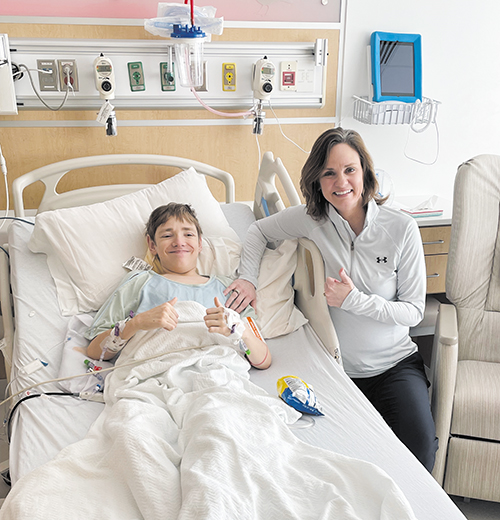
"He was a 17-year-old kid unable to go to high school because he was spending three days a week in dialysis and then a fourth day every week seeing his specialist," Gaynier says.
In 2023, Gaynier decided to investigate the donation process. It turned out she was a match for Stoll. The two met the night before their surgeries. As a doctor, Gaynier was intimately familiar with medical settings but had almost no experience as a patient. Stoll was glad to help out.
"He was so used to being hospitalized," Gaynier says. "He showed me how to order dinner from the TV."
Because there was no policy in place at the time, Gaynier used paid time off for her recovery. Three weeks later, she was back at work. Afterward, she contacted her supervisors and hospital administration, asking that a paid leave policy be put in place, and they immediately began looking into it.
Stoll, now about to turn 20, no longer needs dialysis, and is enjoying college. "That feels really good," Gaynier says.
Recently, a labor and delivery nurse Gaynier works with used the new policy to donate a kidney to a friend.
"I hope that each living donor serves to spread the word that you can donate and still live a normal and healthy life afterward," Gaynier says, "and that that will make more people consider making a living donation themselves."
Policies benefit even non-donors
Kidneys are by far the most frequently donated organs, according to the federal Health Resources and Services Administration. Liver segments, which mostly regrow in the donor, are second.
Right now, more than 103,000 Americans, many of them children, are on the national transplant waiting list, according to the American Society of Transplantation. Every day, 13 of them die waiting.
Hospital systems including SSM Health and Bon Secours Mercy Health are part of the society's Living Donor Circle of Excellence for their donation policies. Some states have laws mandating paid leave for live organ donation. Certain laws apply to state employees, others to workplaces with more than a certain number of employees.
Even beyond those mandates, there is a growing national trend of paid leave for live organ donation, according to Shauna O'Brien, the society's director of communications and marketing.
"Awareness around living donation has increased substantially over the past decade, and with that, so has public and employee demand for meaningful support," O'Brien says in an email.
Nicole Martel, chief rewards and well-being officer for Bon Secours Mercy Health, says adopting the time-off policy was an easy decision for executive leadership. Like Ellis of SSM, Martel says it aligns with the system's Catholic mission.
The policy's benefits extend beyond the realm of potential live donors, according to Martel. She compares it to parental leave, which not everyone can take advantage of.
"Oftentimes, just the idea of offering a benefit — even if it doesn't apply to everyone — makes all employees feel more cared for," Martel says.