
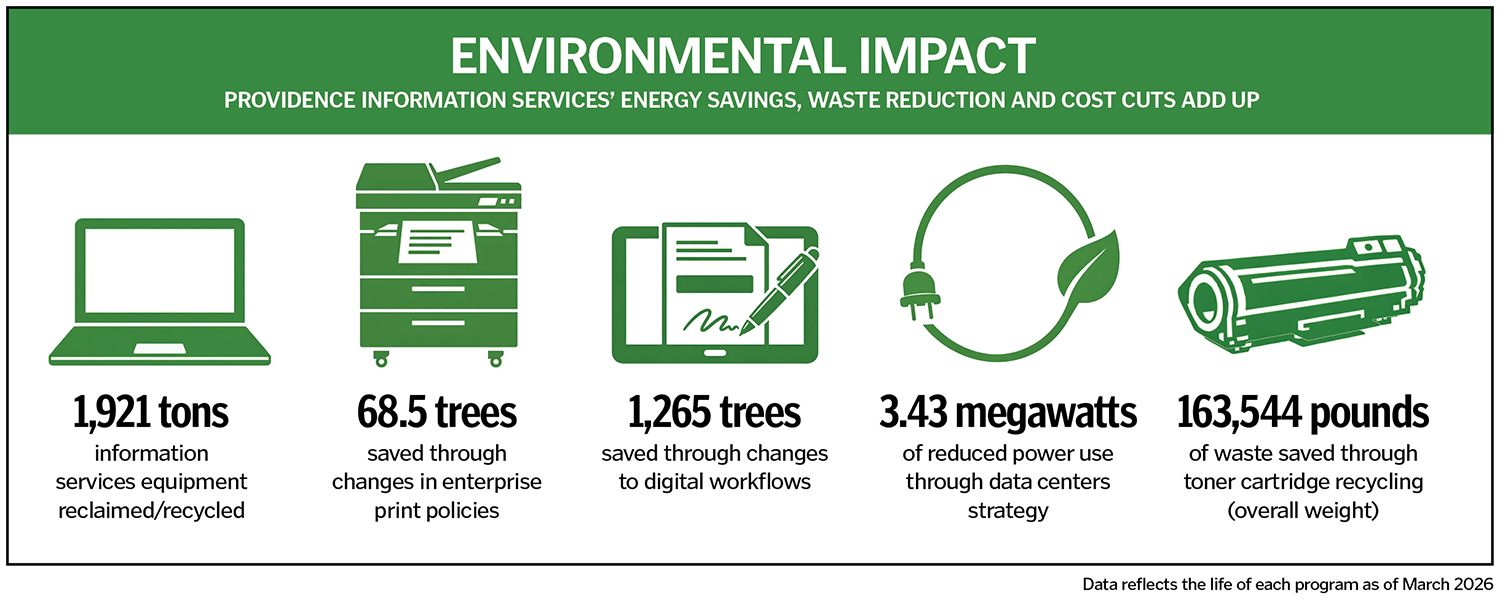
Providence St. Joseph Health's information services division uses analogies when quantifying some of the wins it has achieved in environmental stewardship.
The more than 1,900 tons of e-waste the system has reclaimed since 2022 is about equivalent to the weight of eight Statues of Liberty. E-waste is hardware related to information technology that is at the end of its life and that would otherwise be disposed of.
The nearly 12.3 million sheets of paper saved through recent software and printing policy changes is equivalent to saving a forest of nearly 1,300 trees.
The division called a past energy-saving project "Carnation" because the amount of electricity the system was saving could power the town of Carnation, Washington, population of about 2,300, for an entire year.
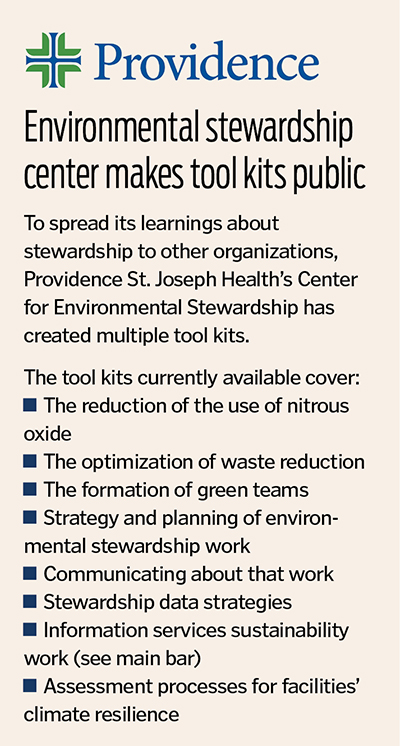
When implementing environmental stewardship programs in 51 hospitals and more than 1,000 outpatient sites across seven states, such large-scale accomplishments are possible. Providence St. Joseph Health has had such success with its energy-saving, waste-reducing, cost-saving and other environmental strategies that it wanted to help other organizations achieve similar results. It has created the Information Services Environmental Stewardship Toolkit to share practical ways to use technology to achieve important goals.
"I do believe grassroots efforts become movements," says Wasif Jamal, Providence senior vice president and chief technology officer of information services, "and we have the opportunity to bring like-minded organizations together" to advance environmental stewardship.
"It takes more than one organization," he adds. "Everyone has to play a role."

A hardwired priority
According to the tool kit, Providence prioritizes environmental stewardship systemwide because its mission is to express God's healing love to all, and the health of the environment is interconnected with the health of people. Providence's work in this area is grounded in part in the so-called "Hopes and Aspirations" document that the Sisters of Providence developed when they transitioned their health care ministry to lay sponsorship in 2009. The document calls upon Providence to be a good steward and to enable others to learn stewardship.
Beth Schenk, chief environmental stewardship officer, says stewardship is not a standalone program or one-off project — it is integrated into all of Providence. "It is hardwired throughout the health system," she says.
She says it's been fun and exciting to see how the smart, creative associates in information services have embraced environmental stewardship and discovered seemingly countless ways to steward Providence's resources well.
Digital transformation
Jamal explains that the efforts span multiple practice areas within information services, including engineering, supply chain, information technology assets and service engineering. During annual planning and monthly update meetings, Jamal and the leadership of these areas formulate information services strategies, then track progress with data and adjust their work to meet evolving needs.
He says environmental stewardship is part of Providence's digital transformation strategy. Under this strategy, the system is putting in place the most effective technology to promote optimal health care delivery. The sustainability of the technology is a key factor in decision-making, he says.
Jocelyn Jazwiec is Providence manager of service engineering and the technology and environmental stewardship liaison. She came up with the idea for the tool kit. She says Providence is continually modernizing its technology, and from that foundation, associates have the freedom to be curious and problem-solve. She says many great environmental stewardship ideas come from frontline associates throughout the system.
Providence has a structure that promotes the sharing of these ideas and best practices within and among facilities and divisions, Jamal notes.
Step by step
The tool kit provides a step-by-step explanation of how Providence's information services department plans and executes its stewardship work, including strategy setting and planning, implementation, analysis and reporting. The kit also provides examples of top projects Providence has undertaken and the results. An appendix includes an overview of the umbrella environmental strategies that guide the work. The appendix also covers some ways artificial intelligence plays into the stewardship work.
The six case study examples from information services in the guide are:
- Reclaiming 209,000 devices and equipment to extend their use and disposing of outmoded devices in an environmentally friendly manner.
- Developing strategies and partnerships with vendors to ensure print devices are modern and efficient and printing policies that conserve paper. The team has cut the printing equipment used by half, saved nearly a half million sheets of paper and recycled tens of thousands of outmoded printer parts.
- Analyzing equipment used throughout the system to maximize efficiency in terms of power use. This includes right-sizing hardware and adjusting settings so equipment can power down when not in use. The new processes are resulting in reductions in energy consumption.
- Employing strategic decision-making around what data is moved to cloud-based platforms and the implications when it comes to the data centers that store the information. Those data centers can require a lot of space, energy and other resources and can cause pollution. Providence is moving to data centers that are entirely or nearly carbon neutral.
- Guiding the system through software standardization, including by partnering with vendors. Some of the efforts involve medical and legal paperwork requiring digital signatures. Providence estimates the efforts have saved 10 million sheets of paper and 60,000 pounds of other resources.
- Opening a global data center in Hyderabad, India, to monitor the progress of environmental stewardship efforts systemwide. Using a scorecard approach, the Hyderabad and U.S. ministries together achieve a 20% reduction in carbon emissions. An additional result is that more than 100 facilities now use renewable electricity. Information services was heavily involved in this scorecard effort.
A common home
Jamal says a challenge is that there are so many competing priorities in health care and limited resources to devote to each priority, so it can be difficult to keep stewardship work front and center.
However, he notes that it is very often the case that stewardship work ties in with and advances other top priorities of the health system. For instance, switching to online patient documentation rather than paper can be more efficient and effective while also cutting costs and saving resources.
"We are seeing that environmental sustainability not only is critical to do — it is a no-brainer," he says.
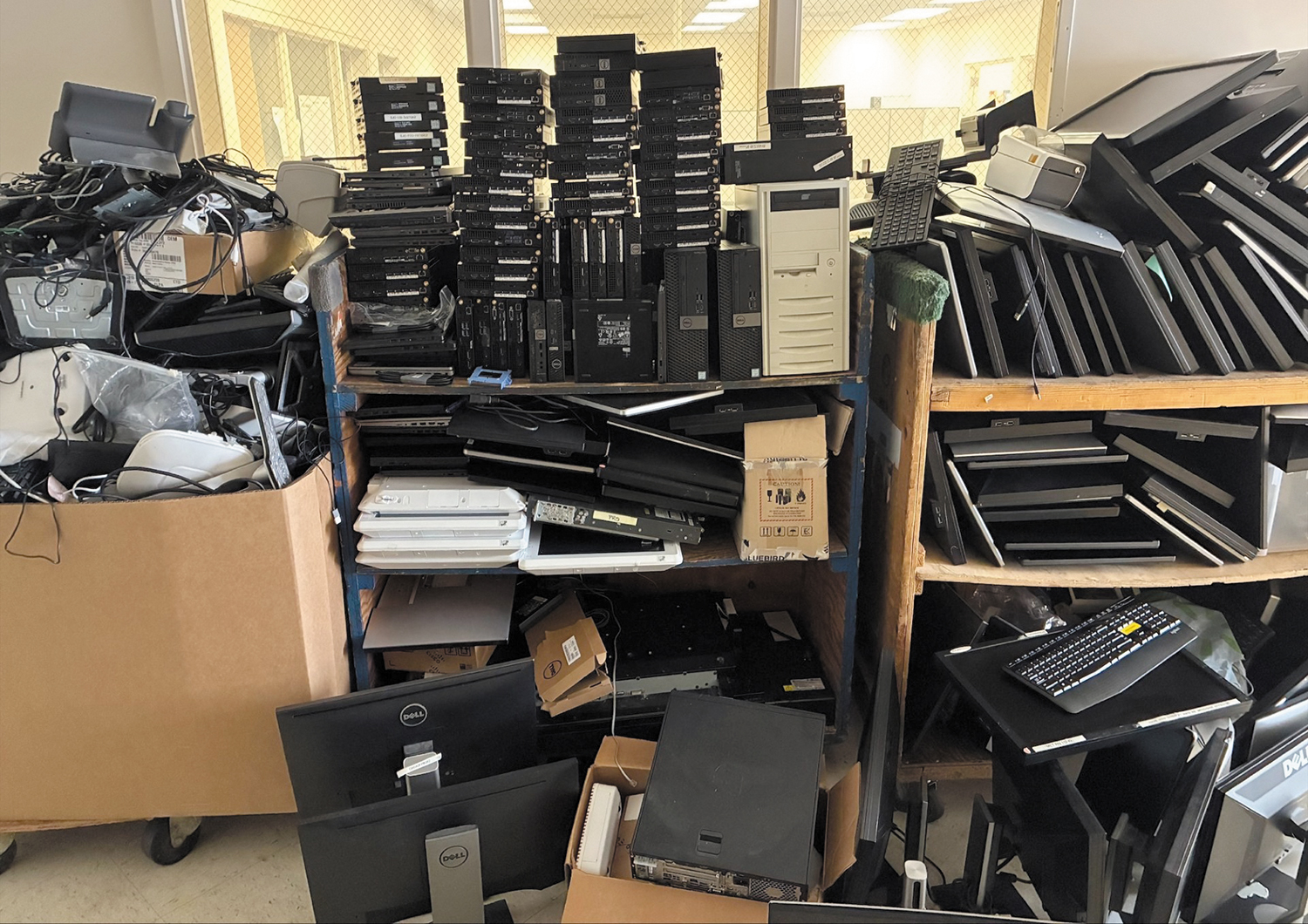
Providence St. Joseph Hospital Orange in California has a designated area where staff can drop off e-waste, or outmoded electronic equipment. Through a Providence St. Joseph Health environmental stewardship strategy, the system seeks to keep equipment in use as long as feasible and then disposes of it in an environmentally friendly manner.
Schenk says, "We start to see a pattern where we conserve resources, then save money. There are so many people in information services with great ideas that are showing a track record of success and financial stability as well as care of our common home and care of the patient. I'm excited to see what comes next, and in information services, it's a fast-changing world."
Jamal says the metrics the division keeps help the team make the case to leadership about the benefits of the stewardship projects.
He says the tool kit is a way to inspire other organizations to join the efforts. "There are actions we can take every single day to benefit the enterprise and community and the tool kit lays out some of these approaches and activities."
Jamal says the work information services is undertaking has personal meaning for him since it is having a direct impact on the community. "We live in the same communities where we work. If we help make the community healthier (from an environmental standpoint), we're making it better for ourselves too."