
When Anna was admitted to Denver's Mount Saint Vincent about a year ago, she was suffering severe bipolar disorder that interfered with her life. Anna had been unable to attend school after second grade.
After three months at the behavioral health treatment facility, Anna was able to return home, and now, her adoptive mother Kelly says, "She's doing well, she's in school regularly, she caught up, she's in the seventh grade, and she's one of the most magnificent kids you'll ever know." The family asked that their last name not be used to protect Anna's privacy.
"Her time at Mount Saint Vincent … literally changed the course of all our lives," Kelly said of herself, her husband and four adopted children.
The behavioral health treatment center provides mental health care to children with severe emotional and behavioral conditions rooted in mental illness, trauma, abuse or neglect. About 95 percent of Mount Saint Vincent's clients are on psychotropic medicines when they arrive; and two consulting psychiatrists monitor the medication while the children are at the facility, which can mean reducing, changing or maintaining the dosing.
The facility cares for hard-to-treat clients — children who've been unresponsive to other mental health interventions. Many act out and can be violent at home or at school. The vast majority of clients have come in contact with social service and/or law enforcement systems, according to Kirk Ward, clinical director of Mount Saint Vincent.
Lifesaver
Mount Saint Vincent employs an uncommon approach called the Neurosequential Model of Therapeutics to determine the extent of a child's developmental impairment, identify the child's strengths and vulnerabilities and determine steps to spur healthy emotional and psychological progress. Ward said, "The information gathered from the Neurosequential Model of Therapeutics process helps formulate an individualized approach to treatment." The goal is to stabilize the children so they can successfully reintegrate into home, school and society.
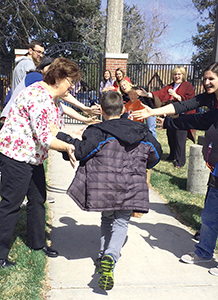
About 85 percent of Mount Saint Vincent's clients attain an increased level of functioning with residential or day therapy at the facility and successfully transition to home or a foster environment and treatment in their home community. That follow-up care may include day treatment, intensive in-home therapy or outpatient therapy, or specialized therapy in school. About 83 percent of clients realize a decrease in their psychiatric symptoms, according to information on Mount Saint Vincent's website.
Kelly said Anna's is a success story. "Mount Saint Vincent saved my daughter's life, and we're forever grateful to Mount Saint Vincent for the work they do."
Addressing the trauma
Part of Denver-based SCL Health, Mount Saint Vincent provides residential care for up to 36 children, aged 5 to 12; a day treatment program; a school with six classrooms for both its residential and day treatment clients; and other services.
Mount Saint Vincent began using the Neurosequential Model of Therapeutics several years ago having determined that talk therapy and other common "one-size-fits-all" therapeutic approaches "didn't work for a fair number of children," said Ward.
The team's search for a model that would address the underlying trauma that causes many pediatric psychiatric disorders led them to the Neurosequential Model of Therapeutics pioneered by Dr. Bruce Perry, a pediatric trauma specialist who founded and is senior fellow of the Houston-based not-for-profit ChildTrauma Academy. Key members of the Mount Saint Vincent team trained under Perry, and in 2012 the facility was certified as a "flagship site" of the Neurosequential Model of Therapeutics.
Repairing damage
Ward explained that Perry's model focuses on the functioning of four major structures of the brain — the brain stem, diencephalon, limbic system and neocortical system — and related neural and cognitive abilities that develop sequentially from the time a baby is in utero, on.
Brain development and function is significantly impacted by genetics, the prenatal and postnatal environment, early life experiences and relationships, among many other influences. In an interview published in the September 2012 issue of the Australian and New Zealand Journal of Family Therapy, Perry said that childhood trauma can result in poorly organized neural networks, disruption in brain function and abnormal development. Perry's model helps clinicians reconstruct a child's developmental route and identify where impairment may have occurred, and which brain functions may have been disrupted, then set out to repair those functions sequentially, from lower order to higher order functions.
So, for instance, a child who has been abused may lack the cognitive skills and self-control associated with more advanced brain functions needed to participate in productive talk therapy. A therapist might first work with exercises that engage and repair a child's somatosensory system, eventually moving toward relational skills, perhaps using dogs or horses as a therapeutic bridge to building healthy relationships with people. (See sidebar.)
According to Perry, as told to the Australian and New Zealand Journal, patterned, repetitive activity such as grooming an animal, dancing, swinging or massage repatterns poorly organized neural networks involved in the body's stress response.
Brain map
To determine what type of therapies to employ in a child's treatment, Mount Saint Vincent staff complete an extensive review of 32 categories of functioning, including social, emotional, cognitive and physical functioning. The evaluation includes interviews with the child and significant people in his or her life; observations of the child's functioning; reviews of the child's family; school and social history; and math, reading and other academic proficiency tests. Assessment results are analyzed, resulting in a brain "map" for the child.
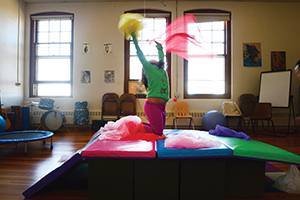
The map, a grid of boxes representing different areas of development, is color coded with green boxes for areas in which the child is fully functioning, yellow for areas of moderate impairment and red for major impairment. The staff use this map to understand which functions of the brain may be impaired, and to determine which therapies — potentially including art, dance/movement, music, play and animal-assisted treatment — may work best for that particular child.
Feeling and being safe
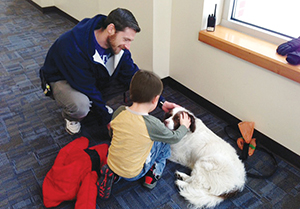
Egan said, especially early in a child's therapy at Mount Saint Vincent, dance, art and animal-assisted therapy help the child learn to self-regulate, to relate to others, to feel safe, to have fun. Much of this, she reinforced, is repetitive work aimed at rebuilding brain function.
"Most of the children are able to be helped — to be safe and to be calm" in a way they were not before "so they can return to their environment," she said.
Dr. Bruce Perry's approach repairs brain functionality sequentially Created by pediatric trauma specialist Dr. Bruce Perry of the Houston-based ChildTrauma Academy, the Neurosequential Model of Therapeutics focuses on the functioning of four major brain structures:
Ward explained that these brain structures develop in utero, and development continues after birth. In a safe environment, when there is patterned, rhythmic nurturing, these brain structures' cells arrange themselves in an organized way. Ward said when trauma disrupts or damages cell development, repetitive sensory stimulation may be therapeutic. Therapists at Mount Saint Vincent use rhythmic, patterned activities repeated over and over to reorganize the brain and establish healthy neural networks. Ward said for a child with damage to brain areas controlling less advanced brain functions, rhythmic, repetitive petting of an animal may be beneficial. Rhythm matters in these therapeutic interventions to repair the brain of a traumatized child, Perry said in a September 2012 interview published in the Australian and New Zealand Journal of Family Therapy. "One of the most powerful sets of associations created in utero is the association between patterned repetitive rhythmic activity from maternal heart rate and all the neural patterns of activity associated with not being hungry, not being thirsty, and feeling 'safe'. In other words, patterned, repetitive and rhythmic somatosensory activity becomes an evocative cue that elicits a sensation of safety." |
Mount Saint Vincent offers additional services for youth, community |