
God is our refuge and our strength,
an ever-present help in distress.
Thus we do not fear, though earth be shaken
and mountains quake to the depths of the sea, though its waters rage and foam
and mountains totter at its surging.
(Psalm 46:2-4)
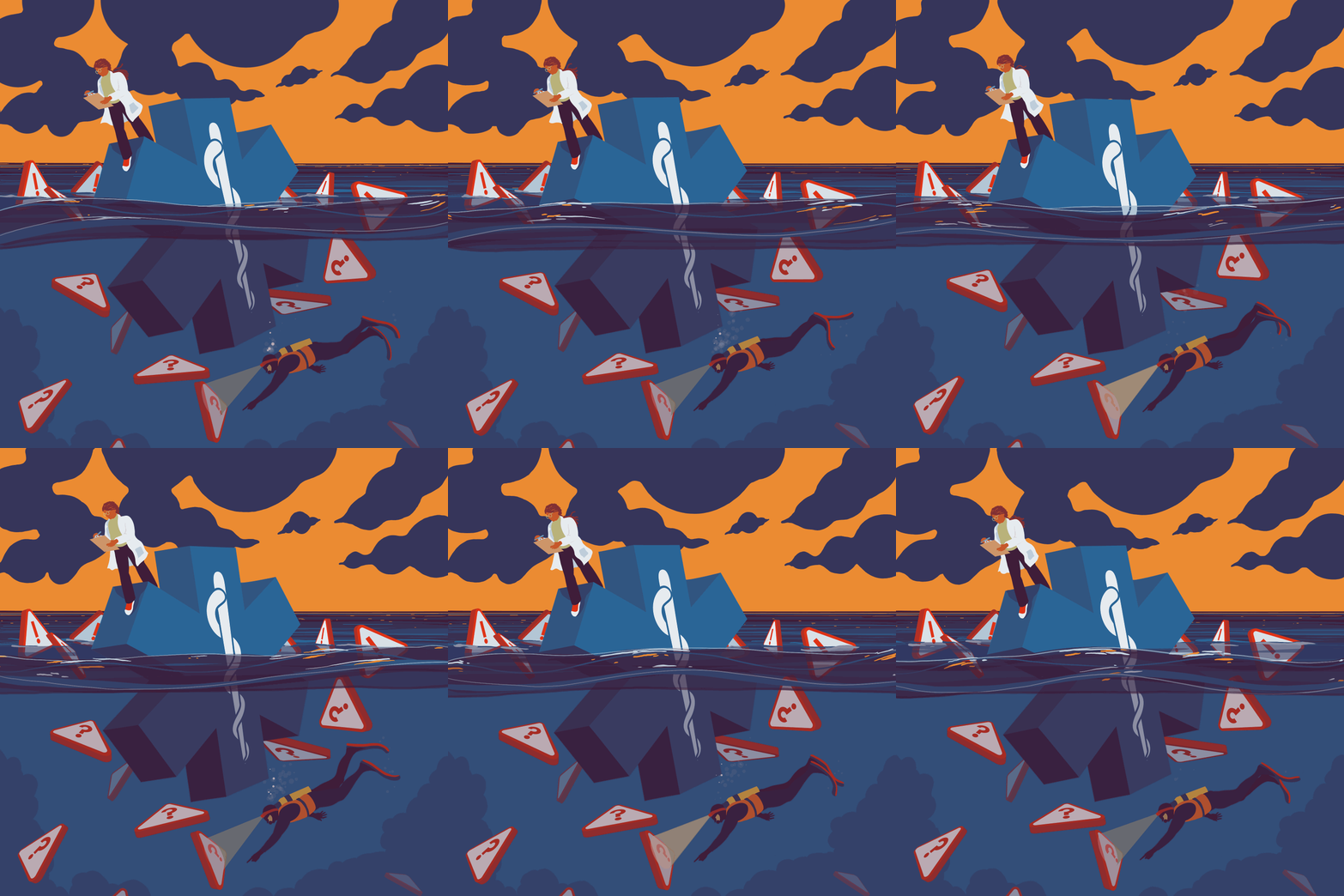
Emergencies, disasters and catastrophes have been present on Earth since its creation and will continue for however long our planet survives. Throughout its history, Mother Nature has proven a formidable and competent purveyor of events which, by and large, have remained the same in terms of types of disasters (wind, flood, earthquake, etc.) only varying in intensity. With the rise of civilizations, another form of disaster, unique from natural ones, was created and widely known as "man-made" disasters. These types of disasters have morphed and evolved over time, changing along with technological and other advances in society.
Along with these, there is a third type of disaster called "complex disasters," which has components of both man-made and natural disasters, that have greater reach and more complicated responses than the others alone. Disasters, unfortunately, have been increasing for multiple reasons, including climate change and widespread events that affect larger numbers of the population.
Droughts, wildfires and flooding are becoming more severe in the U.S., where the average number of billion-dollar disasters has risen from approximately three per year in the 1980s to around 19 per year from 2015 to 2024, with 2023 and 2024 setting records for the most billion-dollar disasters.1
Disaster is a term regularly used in health care, describing anything from an individual patient who is very sick, to a community situation. The technical term for a disaster is exhaustive and filled with qualifiers. The United Nations Office for Disaster Risk Reduction describes it as a "serious disruption of the functioning of a community or a society at any scale due to hazardous events interacting with conditions of exposure, vulnerability and capacity, leading to one or more of the following: human, material, economic and environmental losses and impacts."2
Health care, by the nature of our work, is an essential and integral piece to most disaster scenarios, and it prepares for and responds to multiple hazards. However, in addition to health care's critical role in disaster response, it also provides an indispensable and crucial function in society outside of the response. Because of this, it is vital that health care maintains continuous operations, regardless of the circumstances, including in times of extremis.
As a condition of its obligation to serve people and the community — often in very difficult situations — health care finds itself threatened by many hazards that most other sectors of society are spared. In addition to the more commonly understood naturally occurring catastrophic events, such as tornadoes and floods, health care is also exposed to a wide range of other hazards from criminal behavior, such as assaults on the workforce3 and active shooters,4 to technical, man-made hazards such as cyberattacks.5-7
After 9/11 and Hurricane Katrina, most hospitals and health care systems are, at a minimum, familiar with the principles of emergency management. These are well laid out in various forums, specifically with the Federal Emergency Management Agency. Most health care systems also employ professional emergency managers for this purpose. However, when it comes to thinking about disasters in terms of risk, it is also important to think about what to consider during the extenuating circumstances of disasters and the peril of planning against the last disaster.
MITIGATING RISK ACROSS HEALTH CARE, COMMUNITIES
Risk is something that is commonly understood in epidemiology and medicine, such as relative risk and attributable risk of disease due to exposure, all based on mathematical probabilities. From my time working at the U.S. Department of Homeland Security, however, "risk" takes on a different meaning, more applicable to the topic of disasters where "risk" equals hazard multiplied by exposure multiplied by vulnerability divided by capacity, or simply R = (H x E x V) / C.
All risks have potential to become disasters, if capacity is outstripped.
"Hazards" are dangerous phenomena, substances, human activities or conditions that may cause a loss of life, injury or other health impacts, property damage, loss of livelihoods or services, social or economic disruption, or environmental damage.
"Exposure" is people, property, systems or other elements present in hazard zones that are subject to potential losses.
"Vulnerability" is conditions determined by physical, social, economic and environmental factors or processes that increase the susceptibility of an individual, a community, an asset or system to the impact of the hazard.
"Capacity" is the combination of all strengths, attributes and resources available within an organization, community or society to manage or reduce the disaster risks and strengthen resilience.
Using this formula, risk can be applied to a situation from the patient level up to the community level.
The concept of exposure and vulnerability plays an important role in any risk. For example, the exposure to a flood is similar for any two homes within a flood zone. However, depending on construction materials and engineering, they can have dramatically different outcomes. One leads to disaster while the other does not.
In health care, this can be extrapolated to multiple scenarios, not just natural disasters, but also risks such as cybersecurity or personal violence. Considering risk in these terms, you can appreciate how to minimize risk by decreasing exposure to the hazard, decreasing vulnerability and increasing capacity through policy, procedure and engineering.
In addition to applying these concepts to a hospital, clinic or health care system, they can also be applied at a community level, which eventually has an impact on health care operations. For example, during the COVID-19 pandemic, people living in poverty frequently had higher exposure to the virus due to higher population density households and inability to work from home. Populations in poverty experience higher rates of chronic illness and poorer overall health, and their limited resources, including access to care, increase both individual and community vulnerability during disasters, demanding extensive mitigation efforts.
NAVIGATING CHAOS THROUGH DECISION-MAKING STRATEGIES
Beyond the acute effects of disasters on health care systems, other challenges and issues can emerge because of the disaster. In the military, we call these the second- and third-order effects of an event. First-order effects are those directly attributable to the event, such as the destruction of homes from a tornado and the resulting injuries from the debris. The second-order effects have a cause-and-effect relationship that would not exist were it not for the disaster. Using our tornado event, people with homes damaged in the tornado's path lose access to their medications or medical equipment, such as insulin or an oxygen concentrator, creating a health crisis not as a direct result of the tornado, such as trauma from flying debris, but from the aftereffects.
Third-order effects are even further removed but attributable to the event as well, such as the loss of economic activity in the tornado zone from families moving out due to the destruction, creating even worsening conditions and impacting the overall health of the community. These effects need to be considered by health systems when thinking through responses and the resulting effects to the community in disasters both large and small.
We must always remain skeptical that we have complete knowledge of any disaster and practice humility and remain open to the fact that some irreducible knowledge will always exist between what is known and unknown in any disaster or scenario.
Lastly is the concept of understanding what past disasters have to teach us while avoiding the belief that the next disaster will follow previous patterns or that we have identified all the hazards to health care. Medicine and health care examine historical data on disease and treatment to predict outcomes, such as a retrospective study that looks at cigarette smokers to understand the increased risk of developing lung cancer. This type of thinking is also important for insight into disaster response.
From past experiences, health care systems recognize how to respond to mass casualties, the steps that must be taken, and the infrastructure required to support those efforts — until we don't. The knowledge about previous disasters unfortunately comes from experience which, if we are smart, create after-action reviews that drive policies, procedures and technologies to mitigate risk and prepare for the next event. By and large, these are appropriate to help with the next disaster, employing the "lessons learned" model. However, we must always remain skeptical that we have complete knowledge of any disaster and practice humility and remain open to the fact that some irreducible knowledge will always exist between what is known and unknown in any disaster or scenario.
Think of how little we understood about COVID-19 during the early phases in 2020. Flexibility in thinking, managing operations and planning are key components to any disaster response, and there are multiple models, usually originated from the military, that can help health care leaders facing highly confusing challenges. One such model is called the OODA loop, developed by Air Force Col. John Boyd. OODA is an acronym for Observe, Orient, Decide and Act. His theory was that by cycling through this loop, he could arrive at a decision at a rapid pace. It involves gathering data (Observe), making sense of the data (Orient), choosing a response (Decide) and executing the response (Act).
During the COVID-19 pandemic, the St. Louis Metropolitan Pandemic Task Force used the military decision-making process to develop our strategy, employing techniques commonly used for complex operations for our collective response.8 The key idea is that those who are most successful in disaster response, similar to battlefield commanders, rely on tools that help organize their thoughts. Trying to understand muddled information during a disaster can lead to fog, friction and noise, and place health care leaders in perilous positions. Using a tool grounds the thinking process and forces discipline in what are often confusing situations.
Health care also needs to appreciate that there are unknown disaster scenarios that are over the horizon. Hazards to the health care sector include not only obvious threats but also insidious ones, such as global warming — which can introduce new diseases to vulnerable populations — and health care policies that increase risk by reducing vaccination rates, limiting access to care, and weakening federal response capabilities. Each of these makes the community more exposed and vulnerable, decreases capacity, and increases the probability of a disaster occurring.
PLANNING BEYOND THE STORM
Disasters have been a normal part of the world since its birth billions of years ago and will continue throughout time unabated. This is a fact that cannot be altered. Whether naturally occurring or man-made, disasters have also become more complex due to the sheer intricacies of society. This requires communities and health care systems to become more adept at understanding risks to the population and developing plans to mitigate, prepare for, respond to and recover from a wide range of hazards to minimize the impact.
Health care must recognize that disasters don't just stop after the storm passes; they have long-lasting second- and third-order effects that require planning to make communities whole and stable.
DR. ALEXANDER GARZA is chief community health officer for St. Louis-based SSM Health. A colonel in the U.S. Army Reserve with multiple deployments, he is currently the command surgeon for the 108th Training Command. He previously served as the Department of Homeland Security's assistant secretary for health affairs and chief medical officer. Garza is the winner of CHA's 2022 Sister Carol Keehan Award.
NOTES
- "Billion-Dollar Weather and Climate Disasters," NOAA National Centers for Environmental Information, https://www.ncei.noaa.gov/access/billions/.
- "Definition: Disaster," United Nations Office for Disaster Risk Reduction, https://www.undrr.org/terminology/disaster.
- "Workplace Violence," Occupational Safety and Health Administration, https://www.osha.gov/healthcare/workplace-violence.
- "Active Shooter Planning and Response in a Healthcare Setting," FBI, https://www.fbi.gov/file-repository/reports-and-publications/active_shooter_planning_and_response_in_a_healthcare_setting.pdf/view.
- "Report: Health Care Had Most Reported Cyberthreats in 2024," American Hospital Association, May 12, 2025, https://www.aha.org/news/headline/2025-05-12-report-health-care-had-most-reported-cyberthreats-2024.
- "Healthcare and Public Health Cybersecurity," Administration for Strategic Preparedness and Response, https://aspr.hhs.gov/cyber/Pages/default.aspx.
- "Healthcare and Public Health Sector," Cybersecurity and Infrastructure Security Agency, https://www.cisa.gov/stopransomware/healthcare-and-public-health-sector.
- Dr. Alexander Garza, Dr. William Claiborne Dunagan, and Dr. Keith Starke, "The COVID-19 War: Military Lessons Applied to a Public Health Campaign," NEJM Catalyst Innovations in Care Delivery 2, no. 1 (2021): https://catalyst.nejm.org/doi/abs/10.1056/CAT.20.0549.