
ST. LOUIS — Dozens of speakers, including some from Catholic health systems, presented at the national CleanMed conference here May 12-14. The gathering is for leaders in healthcare sustainability and presented by the nonprofits Health Care Without Harm and Practice Greenhealth. Here are some takeaways.
Inhaler emissions can be reduced. Dr. Brian Chesebro, medical director of environmental stewardship with Providence St. Joseph Health, said 160 million inhalers with more than 2.3 million metric tons of carbon dioxide were dispensed in the United States in 2024. Climate-friendlier alternatives can be prescribed, and the same drug or therapeutic class can be dispensed in different ways, such as in an inhaler with less propellant or in a smaller canister. A tool for measuring the estimated greenhouse emissions per inhaler is available on the Providence Center for Environmental Stewardship website.
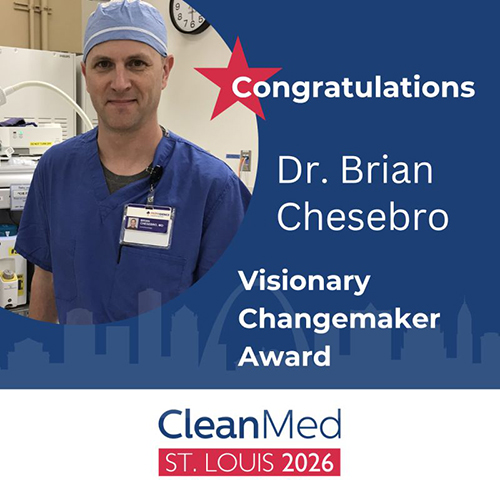
During the closing plenary of the conference, Chesebro received the visionary changemaker award. Health Care Without Harm CEO Emily Bancroft noted that Chesebro was one of the first medical directors of sustainability in the country. "He's demonstrated that health professionals are not only champions, but essential leaders in achieving climate goals," she said.
Buyback programs can help save money and the environment. Oriana Turley, program manager of environmental stewardship with Providence, described the system's reprocessing program, in which employees and clinicians collect used medical devices and the items are sold or donated for refurbishment or recycling. Air transfer mattresses and compression sleeves are the largest category of items by weight that are bought back and recycled by companies and are considered the system's biggest polluters because of the materials they are made of. In 2025, the system had a 29% buyback rate, recovering more than 555,000 devices and saving more than $10 million.
Collecting items across a system that spans seven states is challenging, Turley said.
"Education, putting the right systems in place to make sure that the bins and the signage and everything is in the right place, to help people do the right thing, is a very difficult task," she said. "So this is a mountain we will continue to climb. But really important to the cycle and the circularity of the reprocessing program is that we can't buy back what we don't collect."
The system has focus groups and educates leaders about the importance of collecting items. It even had a successful systemwide medical device collection contest among hospitals. "Turns out, when you turn on the competitive nature of clinical folks, things really do happen in a fun way," Turley said.
Reducing choices can help make better decisions. Thomas Kalla is the senior manager of sustainability with The Resource Group, a supply chain and purchasing subsidiary of Ascension. He discussed its supply chain strategies for purchasing items for Ascension's more than 3,600 sites of care in 17 states and Washington. He told a story about a shoe salesman who deliberately brought two pairs of shoes out for customers to choose from: If customers had three pairs to choose from, they'd leave without buying anything. The Resource Group takes a similar approach, offering just enough but not too many options.
"Trying to remove those variables, trying to remove those choices, trying to make sure that we bring the right information, is something that's important," Kalla said.
The Resource Group has 19 affinity groups and 18 decision teams to determine what to buy and where to buy it. It incorporates environmental sustainability in its decisions and tracks greenhouse gas emissions from suppliers. "One of the examples that we like to use at The Resource Group is a ballpoint pen. When we look at the attributes, we're making sure: Does it write normally? Does it have the grip that you need?" And, he said, does the supplier help reduce greenhouse gas emissions?
Healthcare facilities may not be prepared to handle a climate-related disaster. Beth Schenk, executive director of environmental stewardship with Providence, worked with healthcare sustainability consultant Geoffrey Glass of Octet Works to see how more than 50 Providence hospitals were prepared to handle climate events such as wildfires, flooding, and extreme heat or cold. According to the World Economic Forum, she said, the risk of damage to hospitals from extreme weather events has increased by 41% since 1990.
Within Providence itself, buildings have been damaged by heat and frozen temperatures. A clinic burned down and dozens of caregivers lost their homes during the Palisades wildfire in 2025. The door jambs of a hospital in Portland, Oregon, melted during a heat dome event. "That sort of stuff, honestly, for people who've been paying attention to climate for a number of years, was still shocking," Schenk said.
Working with Glass, more than 60 caregiver teams were interviewed in seven states about building infrastructure such as heating and cooling capacity, emergency power capacity, and water supply. The interviews showed what the teams did well and what they needed to improve. The findings are being incorporated into plans and budgets.
"It was a great partnership with some of these teams who don't speak the same language to have a common process, to go through assessments," said Glass. That helped them understand one another, he added.
Providence created a Climate Resilience Facility Assessment Toolkit to help health systems evaluate their own climate resilience, which is available on the Providence Center for Environmental Stewardship website.
Further reading: SSM Health and nonprofit Forest ReLeaf partner to plant trees and hope in St. Louis communities