
As leaders in well-being, the Catholic health ministry is called to foster an environment of healing where patients, co-workers and local communities may flourish. Together, we represent a community of nearly 700,000 associates, united by the healing ministry of Jesus and the enduring vision of our foundresses, dedicated to advancing human flourishing.
Today, the well-being of healthcare teams remains a pressing challenge amid what Erik Wexler, president and CEO of Providence St. Joseph Health, calls the ongoing "polycrisis" environment.1 Burnout rates among nurses and physicians are estimated at about 48% for physicians and 35% for nurses, while rates among healthcare executives may reach as high as 75%.2 The consequences extend beyond the workforce itself, affecting organizational effectiveness, quality outcomes, patient safety and mission fulfillment.
Although many healthcare organizations have implemented programs and services to support workforce well-being, comprehensive frameworks remain limited. Most notably, many initiatives overlook a critical dimension of well-being: spirituality. Research from Columbia University has demonstrated that spirituality serves as a protective factor against depression, anxiety and substance use,3 yet it is frequently absent from organizational well-being strategies. Fortunately, this is an area where we in Catholic healthcare are well-equipped and experienced. Spirituality has always been at the heart of our ministry and central to what it means to receive whole-person care.
A ROAD MAP FOR CAREGIVER WELL-BEING
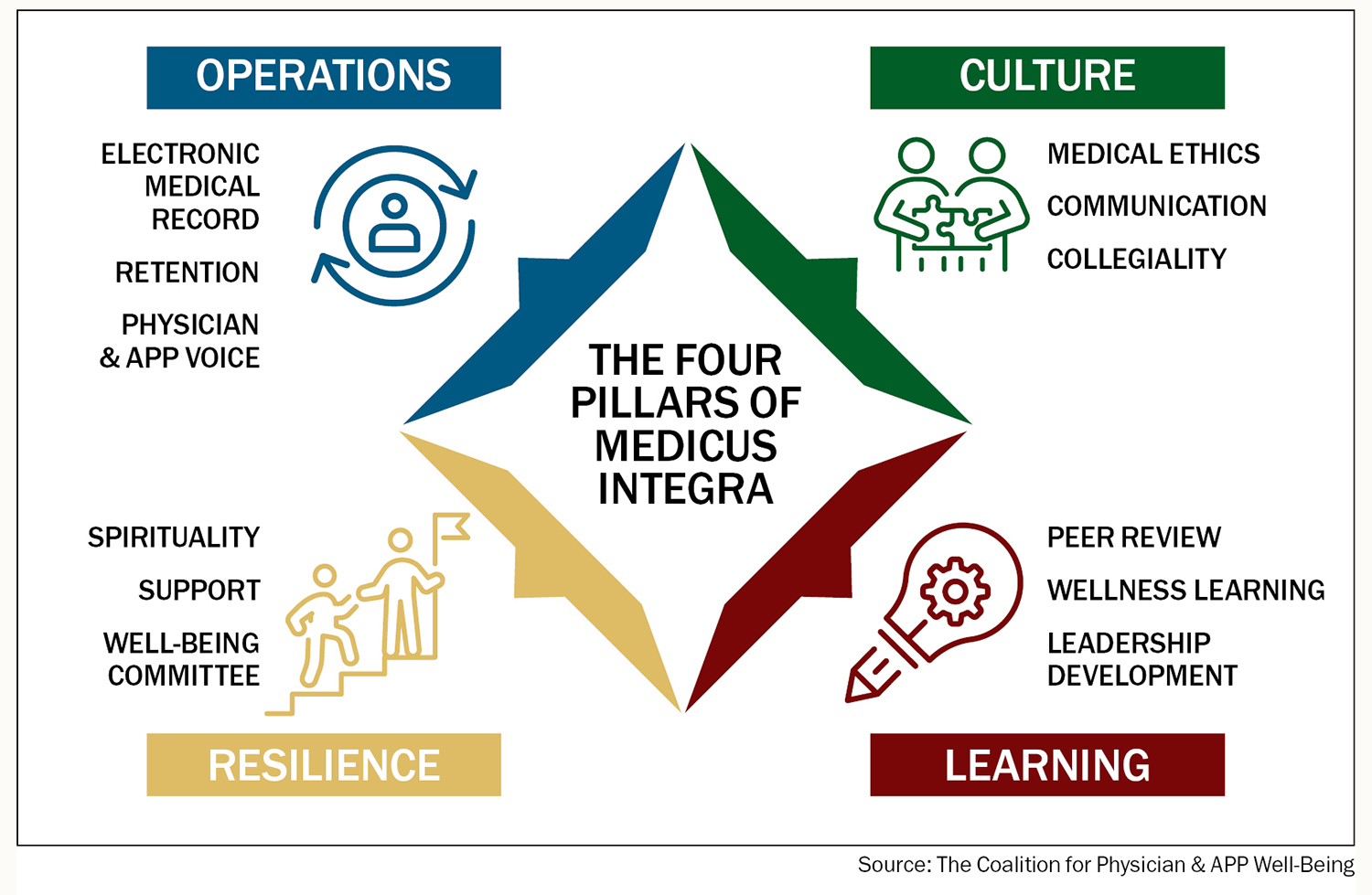
To address this gap in spiritual care, the Coalition for Physician & APP Well-Being developed Medicus Integra about a decade ago, a recognition program that assesses organizations against established criteria. It is designed to help healthcare organizations evaluate, strengthen and measure their well-being initiatives. The coalition's origins are deeply connected to faith-based healthcare and its long-standing commitment to whole-person care. (Both authors of this column serve on the coalition's board.)
Medicus Integra is built upon four foundational pillars: operations, ethics, learning and resilience. Spirituality is recognized as an essential component of the resilience pillar. The program's criteria offer healthcare organizations a practical, no-cost road map for assessing current efforts and advancing a more integrated approach to well-being.
Medicus Integra aligns existing organizational resources — including employee assistance programs, ethics and mission services, and benefits offerings — within a broader strategic framework that also encompasses electronic medical records, quality and safety initiatives, peer review, teamwork and professional learning. The framework is applicable across health systems, hospitals and medical groups. In recent years, Mercy Health Physicians, the physician group of Cincinnati-based Mercy Health (prior to merging with Bon Secours) received Medicus Integra recognition in 2019, and then Bon Secours Mercy Health engaged in the program and received its Medicus Integra recognition in 2022.
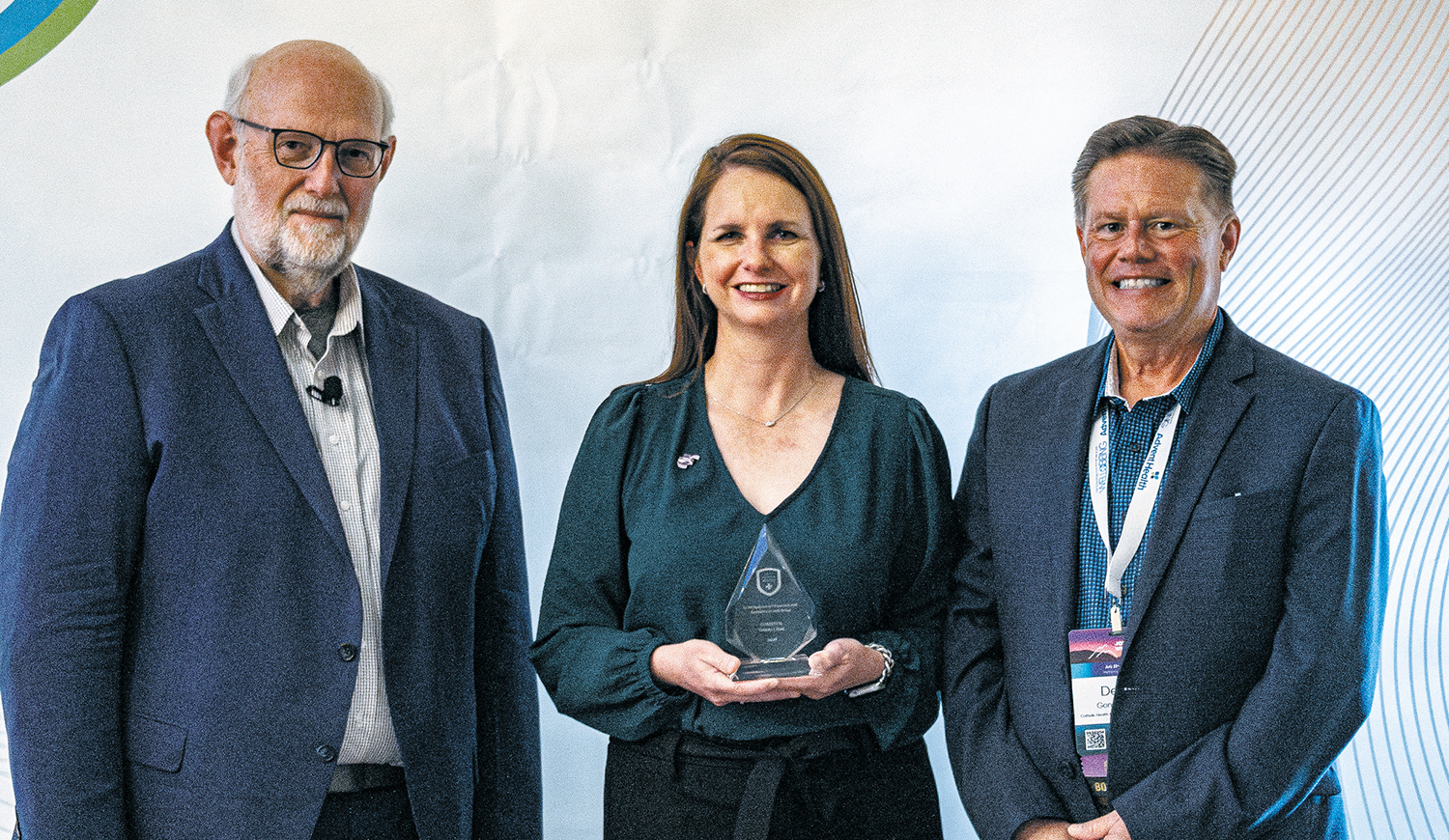
This past July, at the coalition's Joy & Wholeness Summit in Memphis, Tennessee, CHRISTUS Trinity Clinic received the Medicus Integra Award. The multispecialty medical group that is part of CHRISTUS Health includes over 1,500 clinicians across more than 400 locations in Texas, Louisiana, Arkansas and New Mexico.
Dr. Marisa Emmons serves as CHRISTUS Trinity Clinic's chief clinician wellness officer. "We have been doing well-being initiatives for 10 years and were ready to take our program to the next level. Medicus Integra gave us that opportunity," said Emmons.
The medical group's well-being program, called the HoneyComb Project, began with the idea that the organization could improve processes and teamwork such that both clinicians and staff could better enjoy where they work. That joy would be visible to patients, who would then want to receive care in the medical group's facilities.
Since the program's inception, Emmons and the team have partnered with legal, human resources and mission leaders to improve communications, share resources and work in alignment on bigger projects. "Having legal support was critical when starting our peer support program to ensure confidentiality, and the team has been an ongoing partner in identifying clinicians facing board complaints and other similar stressors so we can proactively reach out," Emmons said.
Human resources members have been another area of partnership, including support for engagement and burnout surveys, recognition of service anniversaries, awarding of "CHRISTUS Kudos!" points for various well-being activities that can be redeemed for gift cards or prizes, and in-person explanation of benefits for new clinicians at orientation.
SHARED OWNERSHIP, LASTING IMPACT
When the HoneyComb Project was started by Emmons and Dr. Linda Ray, an internal medicine physician with CHRISTUS Trinity Clinic, they knew they needed to include others for the program to be sustainable. Physicians and advanced practice clinician leaders are involved in various activities, including planning and executing the annual Clinician Excellence Awards, held in each geographic area. When clinicians bring ideas to Emmons, she encourages them to participate and provides support as needed, whether in ways big or small.
For example, a group of clinicians wanted to participate in a local 5K that was sponsored by CHRISTUS, so Emmons provided the team with T-shirts to wear. "I'm happy to consider any activity or solution to an issue that my colleagues may have," said Emmons. "If it's not feasible, I'll work with them to find a compromise that is."
To build future wellness leaders, Emmons partnered with the talent development team to build their own Scholars of Wellness program, focusing on the drivers of burnout, tools for mitigation, and how to share that knowledge with colleagues. Nominations for the scholars come from physician leaders, operational leaders and winners of the internal Rising Star Excellence Award.
"I'm happy to consider any activity or solution to an issue that my colleagues may have. If it's not feasible, I'll work with them to find a compromise that is."
— Dr. Marisa Emmons
The key difference between Medicus Integra and other well-being recognition programs lies in its focus on spirituality. Mission leaders have been part of the CHRISTUS program from early on and have been key partners in supporting the clinician as a whole person. The first presentation at new clinician orientation covers mission and history, which flows into subsequent discussions of collegiality, culture and well-being. "We also realized there was a gap between mission, pastoral care and our ambulatory facilities. We are currently running a pilot in which the chaplain is rounding in our clinics. The focus is on building relationships with our clinicians, though we expect there to be spillover to the rest of our employees in those locations," Emmons explained.
The inclusion of advanced practice providers in the Medicus Integra criteria also aligned with the vision of CHRISTUS Trinity Clinic's work. Emmons explained: "Physicians and advanced practice providers work together to lead the healthcare team, though we also recognize that they bring different skills to the team. Several years ago, we learned that our APPs did not feel heard. Since then, CHRISTUS Trinity Clinic has identified an APP leader who has developed a council with regional representatives. I meet with her regularly to collaborate and partner. We recently revised our annual clinician evaluations, creating separate ones for physicians and APPs. They are very similar yet still address the items unique to each professional."
Subsequent surveys show APP engagement has improved, and turnover has decreased. Where differences exist between physicians and APPs, such as with delegation of prescriptive authority in nonindependent practice states, Emmons works with recruiting, operations, APPs and physicians to streamline processes and provide education on the requirements.
"While we focus our activities on our clinicians, we are cautious about negative downstream effects to other members of the team," Emmons said. One example is the collaboration with the quality team to create standing orders that allow team members to work efficiently at the top of their licenses. These standing orders reduce work for clinicians, allow staff to care for patients more easily, and improve patient satisfaction.
MORE THAN A 'NICE-TO-HAVE' OPTION
Emmons shared that the overall goal of their well-being work is to reduce the "noise" of healthcare so clinicians can do what they are trained to do: take excellent care of patients. She and her team strive to reduce work-related frustrations and give clinicians time to refuel away from work. "We recognize that caring for patients is sacred work. We do our best work when we can be fully present in body, mind and spirit. Supporting our clinicians as whole people allows them to be more present."
The Medicus Integra recognition also highlighted areas for further growth and connected the medical group's team with other leaders doing similar work. Emmons noted that applying for Medicus Integra would not have been possible without the support of her leadership, who have always valued well-being work at CHRISTUS.
This work is not simply a "nice-to-have" option at the mercy of the ministry's financial performance. The well-being of staff is and always has been central to the mission of Catholic healthcare.
DENNIS GONZALES is senior director of mission at the Catholic Health Association, St. Louis. DR. HERBERT SCHUMM is the founder of Schumm Associates, a coaching and consulting firm focused on health and ministry professional wellness and leadership. He is also a member of CHA's Well-Being Advisory Council.
NOTES
- Erik Wexler, "Healthcare's Polycrisis: It's Time for a New Path Forward," Modern Healthcare, June 17, 2025, https://www.modernhealthcare.com/opinion/mh-healthcare-crisis-providence-erik-wexler/.
- Kriti Prasad et al., "Prevalence and Correlates of Stress and Burnout Among U.S. Healthcare Workers During the COVID-19 Pandemic: A National Cross-Sectional Survey Study," eClinicalMedicine 35 (2021): https://doi.org/10.1016/j.eclinm.2021.100879; Richard A. Smiley et al., "The 2024 National Nursing Workforce Survey," Journal of Nursing Regulation 16, no. 1 (2025): https://doi.org/10.1016/S2155-8256(25)00047-X; "WittKieffer Issues Report and Call to Action on Healthcare Executive Burnout," WittKieffer, December 5, 2022, https://wittkieffer.com/news/wittkieffer-issues-report-and-call-to-action-on-healthcare-executive-burnout.
- Lisa Miller, The Awakened Brain: The New Science of Spirituality and Our Quest for an Inspired Life (Random House, 2021).