
I recently visited Nano Nagle Place in Cork, Ireland, a heritage and community center that tells the story of Irish Catholic educator and social reformer Nano Nagle and the origins of the Presentation Sisters, the congregation she founded in 1775. During her lifetime, Nagle, called the "Lady of the Lantern," made nightly visits with her lantern to poor families in Cork and championed education as a path out of poverty. Although she spent most of her life serving as a layperson, she later founded a religious order with an active ministry in education and social reform.
This visit prompted me to reflect on the evolution of women's religious congregations since the 17th century. From their initial foundations in Ireland and across Europe, Catholic sisters carried their ministries around the world and gave birth to many new communities and institutions. Inspired by the Gospel, which was reflected in the charism of their congregations, they saw the need for healthcare, education and social services in far-flung places. They were pioneers and adventurers for Christ.
I remember reading the daily diary of a group of sisters from my own congregation, the Congregation of Jesus, who traveled by boat from Ireland to Australia in the 1880s, knowing that they would never see their homeland again.1 In South Sudan, I have visited the graves of Comboni Missionary Sisters from Italy, who died of malaria within months of arriving in Africa. In Indonesia, the Sisters of Jesus, Mary and Joseph, who arrived from the Netherlands, are remembered with gratitude for their healthcare ministry, which changed the lives of so many, especially women and children. When visiting Cooktown in Australia, I saw photos of Mercy Sisters, newly arrived from Waterford, Ireland, wearing black serge habits in the searing heat of Queensland.
These examples are repeated throughout the world. Across the U.S., the history of these courageous pioneering women can be traced in convent graveyards, congregational archives and exhibitions, local museums, heritage centers, biographies and chronicles. These women left their homelands during times of war and conflict, famine and misfortune, religious persecution and social deprivation. They inspired other women to join them.
Their legacy and heritage are to be found today in health and educational systems, social services networks, community development initiatives, social justice movements and advocacy on behalf of those who are marginalized and forgotten. The members of these congregations saw the needs in remote places and reached out over the centuries to provide schools, hospitals, clinics and many social services not provided by the government.
As the number of sisters diminishes, how then do we carry on the founding vision and charism of these different congregations? We know that the charism of a religious congregation is the special spiritual gift given by the Holy Spirit to its founder. It defines the congregation's unique identity, its core mission and its specific way of living out the Gospel. What, then, should happen when institutions founded by different congregations come together, bringing their distinct charisms to continue the provision of healthcare?
When laypeople take up leadership and management positions, are they being called to preserve the charismatic identity of the hospital, or of the hospital system that they lead and manage, which is often a collective of congregations? These are not easy questions to answer, but I offer a few of my reflections on these topics.
RECLAIMING OUR ROOTS
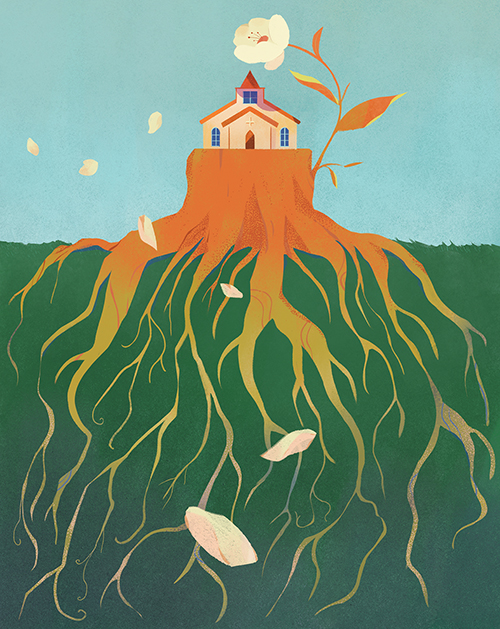
Firstly, I believe that it is important to remember and to reclaim the lay roots of religious congregations. Many founders, like Nagle, were laywomen or laymen who never set out to establish religious congregations. However, to receive official recognition and approval from the Catholic Church to carry out their different apostolates, establishing a congregation as a religious order or under a bishop was the only canonical option available at the time. In addition, this recognition ensured the Catholic identity and the continuity of the established ministries.
However, as religious congregations initially grew and spread worldwide, a wider local Church network of laypeople, made up of family, friends and parish members, supported the sisters' mission and ministry. As the number of sisters increased over time and congregations and their institutions expanded, the local links and bonds between the religious and their local lay supporters tended to remain geographically confined. As congregations grew nationally and internationally, they relied more on their institutional structures and less on these local networks, which gradually weakened over time.
Members of religious congregations occupy a unique consecrated state that sets them apart from laypeople. Since Vatican II, processes of renewal and adaptation have led many religious congregations to revisit their origins and rediscover the important role of the laity in their early history, development and expansion. Now it is almost as if the Holy Spirit has brought the life cycle of congregations full circle in parts of the world. As more laypeople, who are not vowed religious, take responsibility for congregational institutions, the mission, ministry, founding vision and charism of these congregations are being nurtured, interpreted and integrated into the life of the Church by laypeople.
As more laypeople, who are not vowed religious, take responsibility for congregational institutions, the mission, ministry, founding vision and charism of these congregations are being nurtured, interpreted and integrated into the life of the Church by laypeople.
Members of the congregations, religious sisters and brothers who are present in smaller numbers, are now being called to play a new role. They are offering a new type of presence and are scattered like mustard seeds within the whole enterprise; they help to nurture future growth, which is being led by the laity. Their roles are now more varied — accompanying and mentoring lay leaders, participating on boards, being a pastoral presence, or providing spiritual and theological formation.
Religious and laity are being called by the Church to intertwine their vocations, charisms and ministries and to "live the communion that saves by walking in a synodal way … by going forth to meet everyone in order to bring the joy of the Gospel."2 As religious introduce laypeople to the charism, history and spirituality of their congregations, they pass on a living tradition that will continue to have influence in ways discerned by lay leaders.
RESPONDING COURAGEOUSLY, PROPHETICALLY
Secondly, moving into the future, fidelity to the founding charism is not about responding as the sisters, past or present, would have responded. The charism, as already noted, is a living heritage that has to be continually explored, reinterpreted and contextualized. It is about continuing to nurture and develop the Catholic identity of the ministry in fidelity to the Gospel, Catholic social teaching and the Church's synodal way of proceeding. This is what the founders did.
Like them, today's lay leaders must respond to contemporary contexts in courageous and prophetic ways. It is about venturing forth into new and uncharted territories, knowing that the founding charisms offer Gospel values and spiritual traditions to sustain the ministry. However, at the heart of each charism is the Catholic identity, which was central to the founder's graced beginnings.
It can be a particularly helpful exercise to explore the writings or sayings of the founders and see how they echo important passages of Scripture and different contemporary challenges found in Catholic social teaching. The charisms have to be contextualized in the current reality of the Church and society.
Some years ago, reflecting on my congregation's educational work in his diocese, the bishop of Darjeeling, India, remarked, "You came to Darjeeling in the 1850s and you laid a golden egg, and then you sat on it. Now is the time to get off the egg and go to new places and meet new needs in new ways." This is the challenge facing lay leadership. It is not about preserving what has been entrusted to them but about doing what the founders did: bringing the richness of their vocation and personal gifts to the needs and challenges that lie ahead.
The Church's synodal journey is offering the same kind of challenge. It is a reminder that every baptized person is called to participate in and be part of God's mission in the world. The recently published document, "Recollecting: Accompanying the Preparation of the Local Church's Evaluation Assembly," has some helpful pointers about how to bring together the past, present and future.3 It says that recollecting means remembering, which in Scripture actually means "recognizing what the Lord has brought to maturity in the journey of our communities and allowing ourselves to be guided towards the next steps." It means "recognizing God's action in history in order to discern the present and open ourselves to the future."4
This is the challenge facing lay leadership. It is not about preserving what has been entrusted to them but about doing what the founders did: bringing the richness of their vocation and personal gifts to the needs and challenges that lie ahead.
At this point in history, it is good to look back and see God's action in and through the founders and the members of the various congregations, recognizing that a new phase of that story has already begun. Visiting sites associated with the founders or reading their biographies or congregation's history offers precious time to give thanks for the journey undertaken so far. Then it calls for evaluation and discernment to identify the processes of change and transformation that lie ahead.
CARRYING THE MISSION FORWARD
A Catholic healthcare system, like a local church, is being invited by the synodal process to examine its relationships, ecclesial processes and bonds in order "to bring to life an exchange of gifts at the service of the common mission."5 The exchange of gifts across different institutions, involving different individuals and teams, enriches the health ministry in many ways.
Each institution and healthcare system is a microcosm of the wider world with a highly complex community, striving to meet the needs of people in a fast-changing environment. The Church today seeks to foster communion, participation and mission by engaging in listening, dialogue and discernment. There will be many different levels of engagement, ranging from full participation to skepticism, lack of interest and involvement, and even opposition.
However, like the early founders of congregations and the generations of members who followed them, the challenge is to continue creating welcoming spaces where people committed to meeting the needs of the day can come together. Some will engage because of their faith commitment, others because of their bonds with the institution or congregation, and others for personal reasons. But in the words of the late Pope Francis, "There is space in the Church for everyone."6 We believe all are welcome, and indeed, all are needed.
In conclusion, I want to return to Nagle's legacy in Cork. She represents all those extraordinary women and men who, initially as laypeople in their times and contexts, responded to health, education and social needs. The Holy Spirit led each of them and their followers along a particular charismatic path and vocation to ensure the continuity of the mission and to meet the needs of the times.
That mission is now increasingly being entrusted to the laity to carry it into the future. Let us remember that:
"In the face of fear, they chose to be daring,
In the face of anxiety, they chose to trust,
In the face of impossibility, they chose to begin."7
What will you (we) choose to do?
SR. PATRICIA MURRAY, CJ, is chair of The Anna Trust: Catholic Sisters' Elder Care Fund, based in Rome. She is a consultor at the Dicastery for Institutes of Consecrated Life and Societies of Apostolic Life. She served as the executive secretary for the International Union of Superiors General from 2014 to 2025.
NOTES
- The Congregation of Jesus (CJ) has historically been known by different names, including the English Ladies (Englische Fräulein) in German-speaking Europe, the Loreto Sisters in Ireland and worldwide, and Las Irlandesas in Spain.
- XVI Ordinary General Assembly of the Synod of Bishops, "For a Synodal Church: Communion, Participation, Mission," The Synod, October 26, 2024, section 154, https://www.synod.va/content/dam/synod/news/2024-10-26_final-document/ENG---Documento-finale.pdf.
- "Recollecting: Accompanying the Preparation of the Local Church's Evaluation Assembly: Notes for Bishops and Synodal Teams," The Synod, July 27, 2026, https://www.synod.va/content/dam/synod/process/implementation/recollecting/260065_1_ENG_RECOLLECTING.pdf.
- "Towards the 2027 Assemblies of the Local Churches: 'Recollecting' Resource Published," The Synod, July 27, 2026, https://www.synod.va/en/news/towards-the-2027-assemblies-of-the-local-churches-recollecting-r.html.
- "For a Synodal Church: Communion, Participation, Mission," section 65.
- Andrea Tornielli, "For Everyone," Vatican News, August 4, 2023, https://www.vaticannews.va/en/vatican-city/news/2023-08/pope-francis-tornielli-editorial-wyd-lisbon-welcoming-ceremony.html.
- This quote is an adaptation. The original 1977 poem uses the language "she" rather than "they" and is by Sr. Raphael Consedine, PBVM, "Profile: Nano Nagle" in Songs of the Journey (Presentation Sisters Victoria, 2001).