
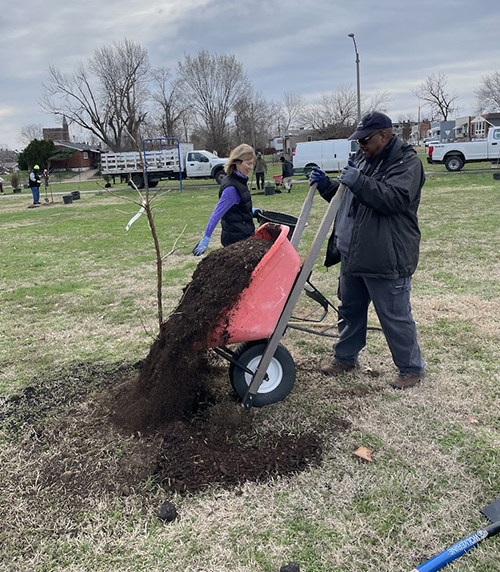
That's why SSM Health has partnered with the St. Louis-based nonprofit Forest ReLeaf to plant hundreds of trees and thousands of seedlings with the goal of replenishing the tree canopy in disinvested St. Louis parks and neighborhoods, some of which were devastated by a tornado last May.
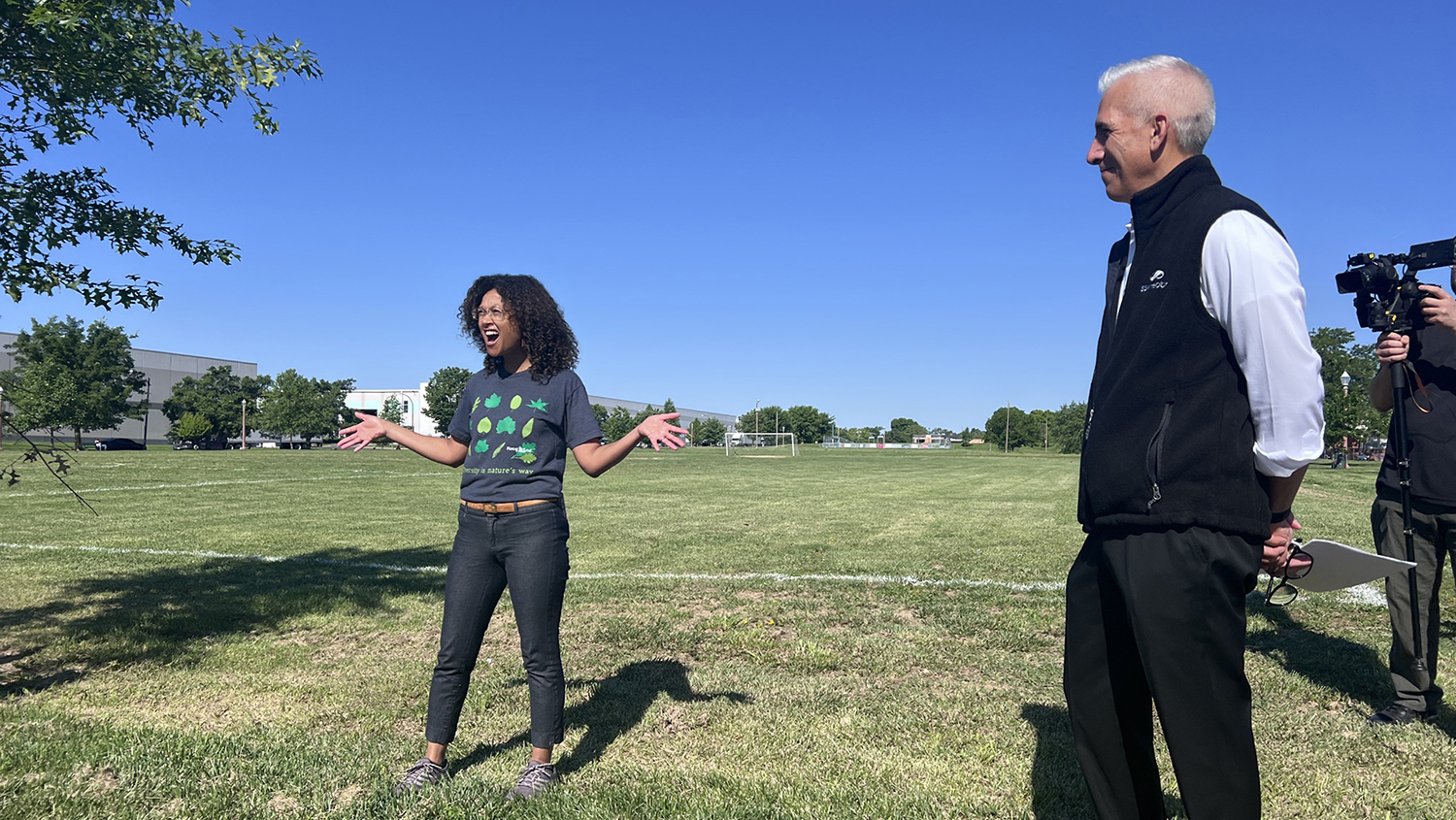
Dr. Alex Garza, chief community health officer with SSM Health, based in St. Louis, and Rebecca Hankins, partnership manager with Forest ReLeaf, led a bus tour through north St. Louis neighborhoods to talk about their organizations' teamwork. The tour was part of the national CleanMed conference May 12-14 in St. Louis. The annual conference for leaders in healthcare sustainability is presented by the nonprofits Health Care Without Harm and Practice Greenhealth.
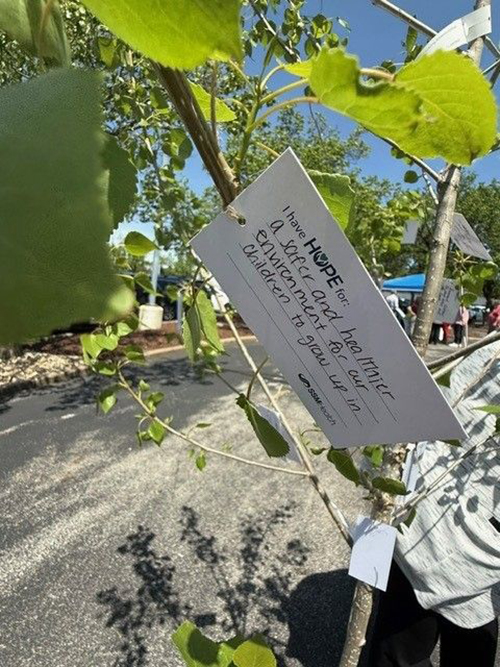
"The act of planting a tree brings so much hope to a community and it is so valuable and vital," Hankins said. "We cannot underestimate the power that trees play in people's lives."
Environmental justice
Garza explained that the partnership with Forest ReLeaf aligns with the tenets of Catholic social teaching and the teachings of St. Francis, who felt there was no way to separate environmental justice from social justice.
SSM Health, which has locations in Missouri, Wisconsin, Oklahoma, and Illinois, has committed to reducing its carbon footprint by 50% by 2030 and to reaching net zero carbon emissions by 2050. The health system has planted about 20,000 trees over the years throughout its service areas.
"Even though planting trees sounds somewhat simple, it's actually an investment in our communities, and it's investing in the dignity of the communities — respect, health equity, all those different things — particularly in the neighborhoods that we're going to be visiting today," Garza said to tour participants.
A focused partnership
Forest ReLeaf grows about 25,000 Missouri native trees each year to give away for planting on public and nonprofit lands statewide. The group has partnered with SSM Health for about five years, explained Hankins, with events that include tree planting and seedling potting. The two have focused on certain ZIP codes and parks in disinvested neighborhoods in north St. Louis, working together to rebuild more than 370,000 square feet of tree canopy.
"The act of planting a tree brings so much hope to a community and it is so valuable and vital. We cannot underestimate the power that trees play in people's lives." — Rebecca Hankins
"Anything that we can do to reduce that heat effect from all the asphalt and lack of tree canopy is what results in lessening people with cardiac issues, with asthma, with heat exhaustion, all of these things," Garza said. "I'll just keep reemphasizing how this is a unique partnership between health and forestry."
Forest ReLeaf is committed to making sure the trees grow and flourish. The group works with the city forestry department on planting trees in parks and regularly waters the trees for the first two summers. It monitors and prunes them for three more years. Currently, the organization is watering 2,000 trees in St. Louis city parks.
The CleanMed group tour stopped at several locations in north St. Louis, where crime rates are higher and life expectancies lower than in neighborhoods just a few miles away. The path of the tornado that swept through on May 16, 2025, taking down houses and trees, remains visible. In north St. Louis' O'Fallon Park alone, 350 trees were lost to the tornado.
"It really impacted parts of the community that had the least capability to bounce back from the disaster," Garza explained as the bus crawled by upturned stumps, trees with broken branches, and homes with blue tarps covering damaged roofs and collapsed walls.
Listening to a community
Hankins spoke about the importance of communicating with residents and partners about their needs. For example, she mentioned how several years ago Forest ReLeaf planted trees in the middle of a field in a park, not realizing that people played soccer there. The group then focused on planting trees along the park perimeter, providing shady areas for players to rest.
Forest ReLeaf also planted saplings in parks that were later vandalized or stolen or were inadvertently mowed down by city workers. Now, the group tries to plant larger trees, and in one park, used protective deer caging designed as an art installation. Forest ReLeaf added signage that explained its efforts. All those trees survived, Hankins said.
"We think that engaging the community, engaging parks, having a purpose for the trees, made people realize, 'Oh, these are intentional, and they should be here,'" she said.
Hankins encouraged tour participants to use a tree equity score tool published by the nonprofit American Forests. Users can find out how cities and neighborhoods compare to one another based on factors like tree canopy cover and other socioeconomic indicators.
"There's a huge misconception when you're in a low-canopy community that the community does not care about trees," she said. "And that's not true. They actually care a lot about trees. They just don't have the means or resources to do something about it."
Mental and spiritual benefits
One of the bus tour's stops was Beckett Park, where other conference attendees had mulched the ground around trees planted earlier. SSM Health volunteers had dug the holes, and residents had planted the trees in honor of loved ones lost to gun violence. The project is a partnership between the health system, the tree group and community nonprofit Better Family Life. So far, families have planted about 75 memorial trees in five city parks.
"This was a perfect partnership for all of us," Garza said. "How many healthcare initiatives can you think of that have a health benefit, an environmental benefit, a mental benefit, and a spiritual benefit?"
Anitress Muhammad, membership coordinator with Better Family Life, told the tour group she was grateful for the partnership and that the community reaction has been positive. Hundreds have gathered at the parks for these tree-planting events, and they can remember their loved ones as they revisit and watch the trees grow.
"It gives us the beauty, the calm, the peace, the life back," she said.
Further reading: Catholic healthcare leaders share sustainable efforts during national CleanMed conference